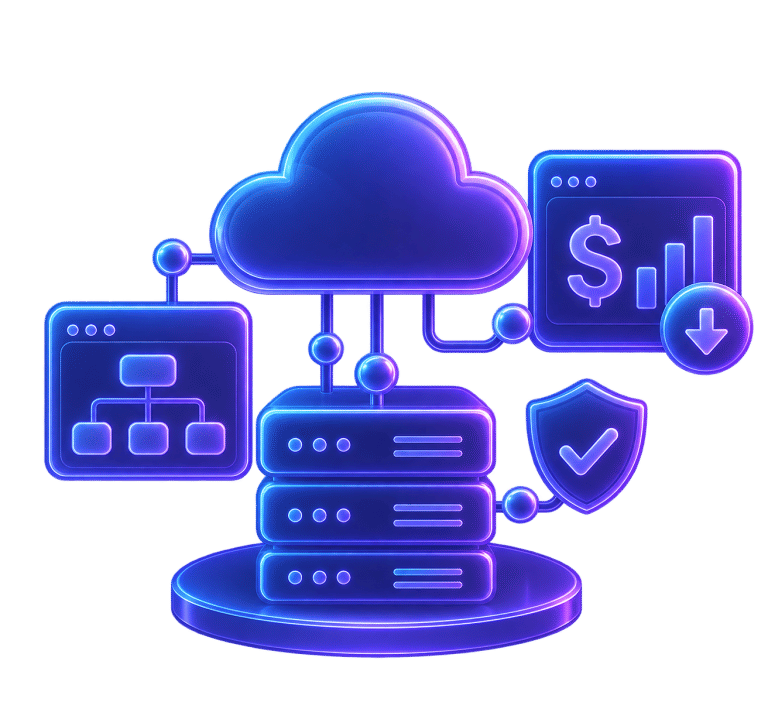


Multiple accounts, teams, or clouds without common standards
Separate cloud environments complicate security and operations.
A unified landing zone brings shared standards for identity, networking, access, and governance without restricting how individual teams work.






From new product infrastructure to existing cloud environments needing redesign, Geniusee provides cloud architecture solutions for different business and technical requirements.


IT experts are ready to help you migrate your cloud systems









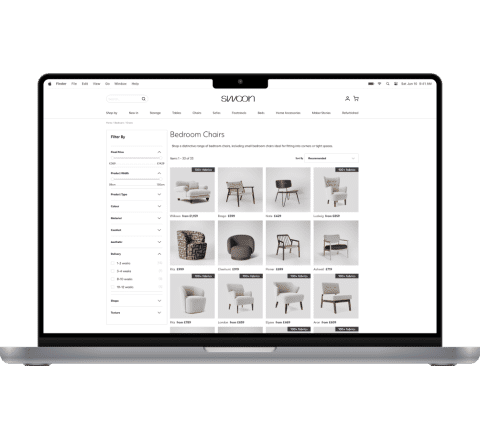
Swoon: Cloud-native backend for a furniture brand
Swoon partnered with Geniusee to modernize its backend and support a fast-growing e-commerce operation. The new serverless architecture cuts infrastructure costs, automates key workflows, and integrates payments, freight, and shipping systems into a single, reliable backbone for the brand.
Case details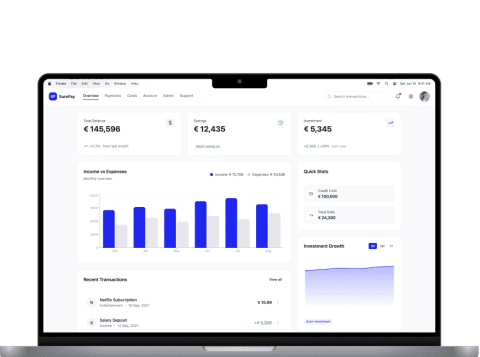
How we secured a business-critical Atlassian platform with near-zero downtime by migrating VMware to AWS
We migrated a multi‑node Atlassian platform from a single VMware host to a resilient AWS architecture in a way that was almost invisible to end users. The client eliminated a single point of failure, strengthened their security posture, and gained a clear roadmap for further cloud modernization. Instead of relying on one aging server, they now run in AWS in the eu‑central‑1 region, with an environment ready for future load and security stability.
Case details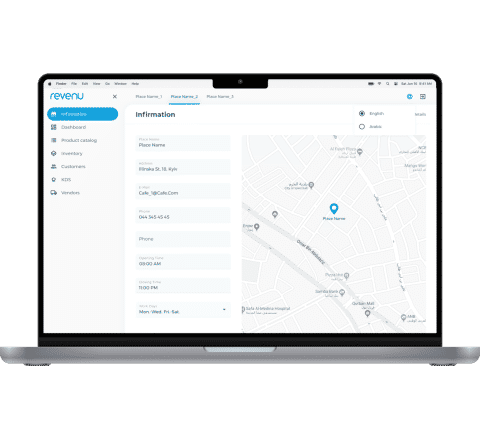
Revenu: All-in-one POS and restaurant management system
When Revenu approached Geniusee, they had a clear vision: to transform the restaurant experience through a unified POS and management system. Together, we set out to create a solution that simplifies restaurant operations, boosts staff efficiency, and enhances customer satisfaction.
Case details
Predictive marketing intelligence platform Wyzoo [Now Xperra]
Discover how Geniusee helped Wyzoo build an AI-powered platform for customer segmentation, predictive insights, and smarter marketing decisions.
Case details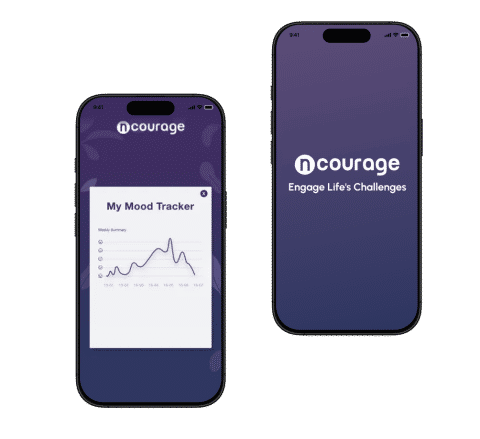
nCourage: Audio app for anxiety and productivity
nCourage is a mobile-first wellness platform dedicated to helping users manage anxiety, stress and sleep challenges through on-demand audio content, journaling and mood tracking.
Case detailsGeniusee’s cloud computing architecture services cover assessment, design, and the implementation roadmap, with the same engineers available to build what they designed. Unlike consulting services that end at the blueprint stage, these cloud design services extend to the operational phase. The scope ranges from a single workload review to a complete platform architecture across accounts, regions, and cloud providers.
Certified AWS Partner delivering secure, scalable cloud-native solutions.

ISO-compliant processes ensuring quality, security, and reliability.

Trusted integration partner for financial data connectivity and open banking.

Team of ISTQB-certified QA engineers for world-class software testing.

Consistently rated ★5.0 by clients for reliability and delivery excellence.

Accredited partnership supporting advanced testing and continuous QA automation.

Discovery
Workshops with engineering, product, and finance stakeholders establish the business goals, current systems, expected workloads, compliance obligations, and budget boundaries. The output is a shared understanding of what the architecture must achieve, what it must avoid, and how it fits the wider cloud strategy.
Assessment and requirements
Where an environment already exists, the team audits it: architecture, accounts, cost model, security controls, CI/CD, and operational processes. Non-functional requirements get documented explicitly, covering SLAs, RTO, and RPO, data residency, tenancy, and growth assumptions.
Design options
Two or three candidate architectures are sketched and compared, for example, serverless against containers, or single-region against multi-region. Each option comes with its cost range, operational burden, and risk profile, so the decision is made on evidence rather than preference.
Detailed design and cost model
The selected option is developed into target-state diagrams, decision records, a landing zone blueprint, IAM and network design, a CI/CD plan, and infrastructure-as-code skeletons. A cost model projects spending at launch and at planned growth stages.
Implementation roadmap and build
The design is broken into phases with milestones and dependencies. Geniusee can hand the roadmap to your team or execute it directly; either way, the architects who made the decisions stay involved through the first production release.
Review and optimization
After launch, real usage replaces assumptions. Performance, cost, and reliability data are reviewed against the design targets, and the architecture is adjusted where production behavior differs from the model.


Cloud technologies and platforms we design with
| Domain | Technologies and platforms |
|---|---|
| Cloud governance and landing zones | AWS Control Tower, AWS Organizations |
| Containers and orchestration | Amazon EKS, Amazon ECS, Kubernetes |
| Serverless architecture | AWS Lambda |
| Databases and data storage | Amazon Aurora, Amazon DynamoDB |
| Messaging and event streaming | Amazon EventBridge, Amazon SQS, Amazon Kinesis |
| Cloud networking | AWS Transit Gateway |
| Monitoring and observability | Amazon CloudWatch |
| Infrastructure as code (IaC) | Terraform, AWS CloudFormation |
| Cloud platforms | AWS, Microsoft Azure, Google Cloud Platform (GCP) |

Different industries bring different constraints to a migration. We account for them in the architecture and cutover plan.
- Trading and banking platform architecture with multi-AZ resilience and low-latency data paths
- Multi-account structures with PCI DSS and DORA controls designed in
- Event-driven transaction processing with immutable audit trails
- Cost models for compute-intensive analytics and risk workloads
- Learning platform architecture that scales for enrollment peaks and concurrent sessions
- Content delivery and video storage design for global learner audiences
- Student data protection aligned with FERPA and GDPR residency rules
- Cost-per-learner tracking for usage-based products
- eCommerce architecture built for seasonal spikes with autoscaling and caching
- Order, inventory, and payment integration patterns with queue-based decoupling
- Analytics and recommendation pipelines on managed data services
- Multi-region content delivery for international storefronts
- Multi-tenant platform architecture for property management and CRM products
- IoT data ingestion for building and workplace management systems
- Document storage design with encryption, retention, and access controls
- Data residency architecture for platforms operating across regions
- Hybrid architecture keeping plant floor systems on site with cloud analytics
- Sensor data pipelines and time-series storage for predictive maintenance
- ERP and MES integration patterns with secure connectivity
- OT and IT network segmentation carried into the cloud landing zone






What does a cloud architecture design engagement deliver?
A documented target-state architecture with diagrams, architecture decision records explaining each major choice, the landing zone and account blueprint, the identity and network model, a reliability plan with RTO and RPO targets, a cost projection at launch and at growth stages, infrastructure as code skeletons, and a phased implementation roadmap. Every item is written for the team that will build and operate the system, not as a presentation for executives only.
Which cloud platform is best for our workload?
It depends on the workload, the existing contracts, and the team’s skills. AWS offers the broadest service catalog and is where Geniusee holds its deepest expertise. Azure is well-suited to organizations with heavy Microsoft dependencies. Google Cloud has strong data and AI tooling. The assessment compares the options against your requirements, including data residency and exit costs, and documents the recommendation with its reasoning rather than defaulting to a single vendor.
What cloud deployment models do you design for?
Public cloud on AWS, Azure, or Google Cloud; private cloud on dedicated infrastructure; hybrid setups that keep specific workloads on premises; and multicloud architectures that spread workloads across providers for resilience or specialization. The choice of cloud model depends on regulations, latency, existing systems, and cost, and hybrid designs offer the same connectivity, identity, and data-flow rigor as single-cloud ones.
How long does cloud architecture design take?
An assessment of an existing environment typically runs two to four weeks. A full target-state design for a new product or a bounded modernization usually takes four to eight weeks, depending on the integration count, compliance scope, and the number of stakeholders who need to sign off on decisions. Larger enterprise landing zone programs run longer. The timeline is set at the end of discovery once the scope is known.
Should we use microservices, serverless, or Kubernetes?
None of these is a default. Serverless suits event-driven and variable workloads where paying per execution beats running idle capacity. Containers on ECS or Kubernetes are well-suited to long-running services and teams that need runtime control. A modular monolith is often the right starting point for a small team with a simple domain. The design records the choice per workload with the trade-offs, and revisits it as the product grows.
How do you design for high availability and disaster recovery?
High availability comes from distributing services across availability zones with load balancing, health checks, and automated failover, which covers component failures within a region. Disaster recovery covers regional failures and requires replicating data and services to a second region, either in a warm standby or active-active configuration. The two are designed separately, with RTO and RPO set from business impact, because full multi-region redundancy costs far more than most workloads justify.
Can you redesign our existing cloud environment rather than start over?
Yes. Most redesign work is incremental: the assessment identifies the components that block scaling, inflate cost, or fail compliance, and the roadmap moves those to managed services, containers, or a new account structure in phases while the rest keep running. A full rebuild is recommended only when the current design cannot support incremental change, and that recommendation is supported by evidence from the assessment.
What are the benefits of cloud computing when the architecture is designed properly?
Capacity that scales with demand instead of forecasts, operational costs tied to usage, managed services that remove undifferentiated maintenance work, resilience patterns that are expensive to replicate on premises, and release automation that turns deployment into a routine action. None of these arrive automatically with a cloud account. They are the result of deliberate compute, data, and governance decisions, which is what the architecture engagement exists to do.