
About the client
Linguist is an official and exclusive representative of leading international publishing houses and also operates its own publishing division. The company adapts textbooks for the Ukrainian education system, with materials approved by the Ministry of Education and Science of Ukraine and selected by teachers for the New Ukrainian School program for 6 consecutive years.
Business context
Teachers in Ukrainian schools need digital learning materials that work with existing textbooks and support the competency-based and student-centered principles of the New Ukrainian School (NUS) reform.
Available tools did not fully address this workflow. Teachers often had to create interactive materials manually, using products not designed around Ukrainian textbooks and curricula. Some also required more technical knowledge than educators could reasonably invest in content preparation.
School infrastructure added another constraint. Digital learning tools needed to remain practical in environments where internet connectivity could be unstable, while offering enough functionality for everyday teaching.
For teachers, these limitations meant additional time spent preparing materials and fewer options for applying digital teaching methods. Students had less access to interactive learning content and fewer opportunities to develop digital literacy within their regular studies.
Linguist initiated LINFOR as a comprehensive learning management system for digital textbook supplements. The goal was to connect existing educational content with interactive learning activities and provide teachers, students, parents, and administrators with a single environment for managing the learning process online and offline, in both synchronous and asynchronous formats.
Communication is established exceptionally well. The approved deadlines are being met, with almost no deviations from the roadmap. It is a well-assembled team, featuring an excellent, professional PM and great specialists.
Yuliia Mochalova,
Founder at LINFOR
Integration with existing textbooks and curricula
Interactive digital supplements had to work directly with Ukrainian textbooks and align with the national educational curriculum.
Support for New Ukrainian School methodologies
The platform needed to accommodate competency-based and student-centered teaching approaches required by the New Ukrainian School (NUS) reform.
Reliable use with unstable internet connections
Schools needed access to digital learning tools that could remain practical in environments with inconsistent connectivity.
Free educational access with room for commercial projects
The platform needed to provide teachers and students with free functionality aligned with state requirements, while giving Linguist the flexibility to create separate commercial projects.
Low technical barrier for teachers
Educators needed to create engaging, interactive materials without advanced technical skills or excessive preparation time.
These limitations also had a direct impact on the people using educational materials:
- Additional workload for teachers. Existing tools left educators spending time on manual content creation and limited their ability to apply NUS teaching methodologies consistently.
- Growing pressure on teachers’ digital skills. As digital pedagogy becomes a standard part of education, limited access to appropriate tools could restrict professional development.
- Limited interactive learning for students. Students had fewer opportunities to work with engaging digital materials, potentially affecting learning outcomes and access to learning experiences aligned with international standards.
- Fewer opportunities to develop digital literacy. Limited interaction with digital learning content could slow the development of skills increasingly important for students’ future education and careers.













Solutions we implemented
We worked with Linguist through structured 2-week Scrum sprints, bringing together project management, business analysis, UI/UX design, frontend and backend engineering, DevOps, and QA.
Planning and refinement sessions defined requirements and sprint goals, while regular reviews gave stakeholders visibility into development progress. We also introduced a formal change-control process to assess how scope adjustments would affect the timeline and budget before implementation.
Modular learning platform architecture
We designed and implemented LINFOR around a modular architecture that separates educational content, learning logic, and user-facing functionality. This structure makes individual parts of the platform easier to manage and gives Linguist a clearer technical foundation for extending LINFOR with additional educational content and learning scenarios.
Centralized content management
In collaboration with the Linguist team, we implemented the Payload Content Management System (CMS) as the central repository for educational materials, news, instructions, and textbook metadata. The CMS supports Ukrainian and English content, as well as content versioning, providing administrators and methodologists with a single environment for maintaining learning resources.
H5P-powered interactive learning
We integrated H5P.com as LINFOR’s interactive content layer, rather than developing separate mechanics for each exercise format. The integration provides teachers and administrators with access to more than 50 interactive content types, including tests, dialogues, presentations, and other learning activities that complement traditional textbook materials.
Role-specific learning environments
We built dedicated platform experiences around the workflows of teachers, students, parents, and administrators. Teachers receive their own dashboard for working with educational content and exercises, while students and parents have a separate personal environment for accessing learning materials. Administrative functionality covers users, content, tests, and exercises across LINFOR.

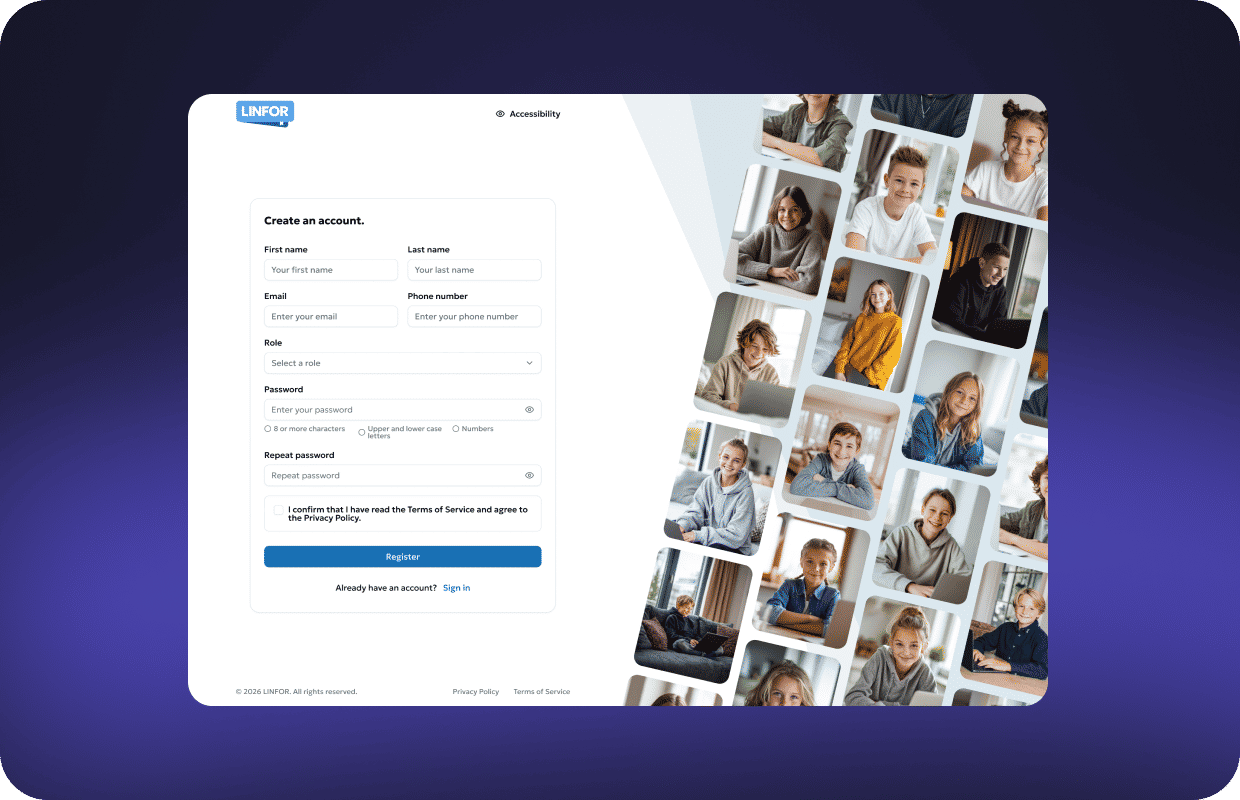
Registration onboarding
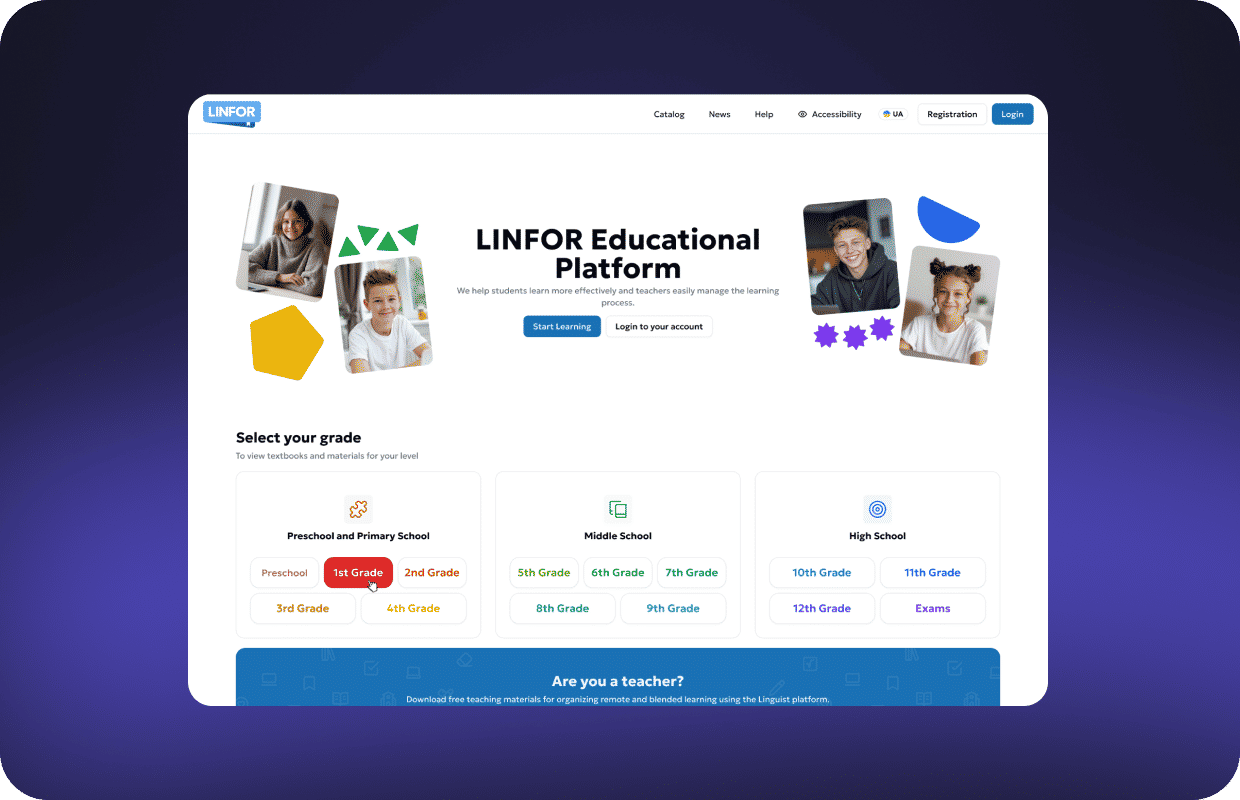
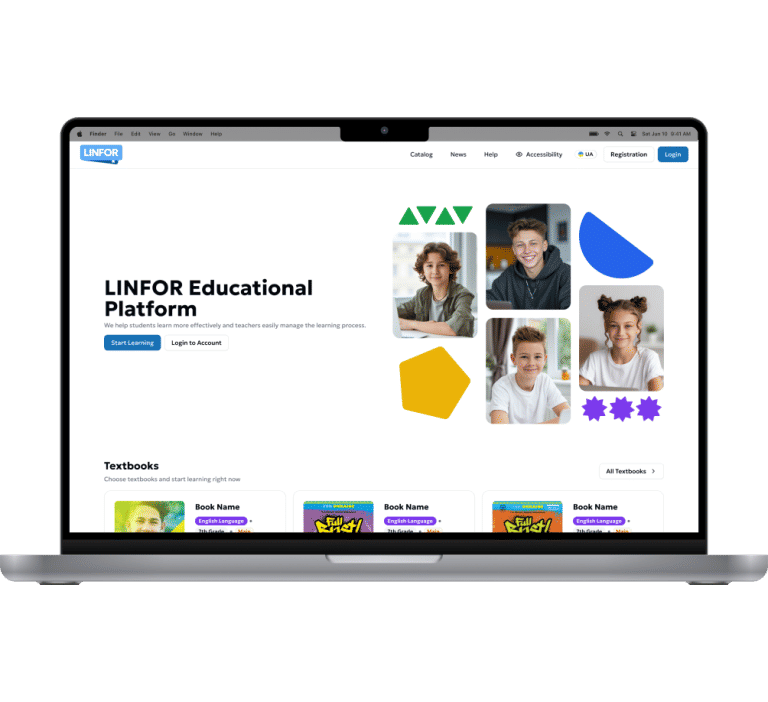
Landing page
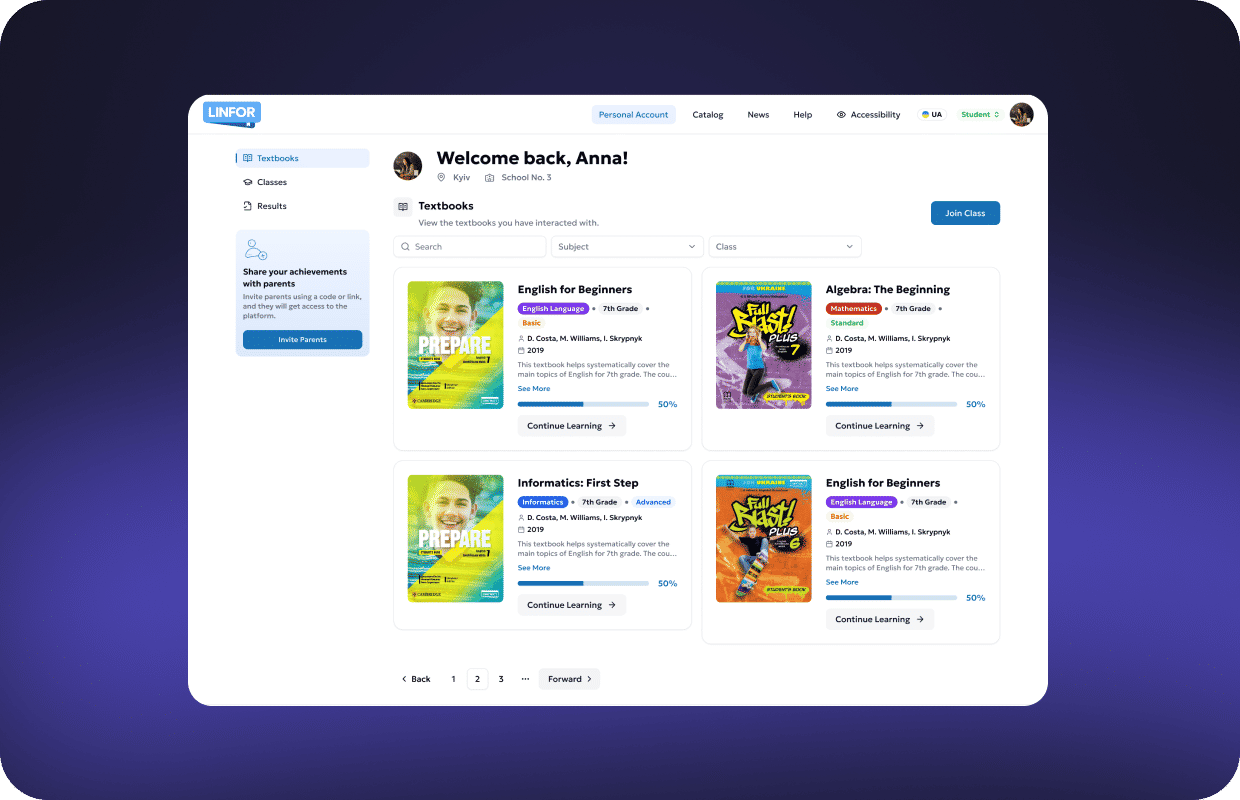
Personal dashboard (for students and parents)
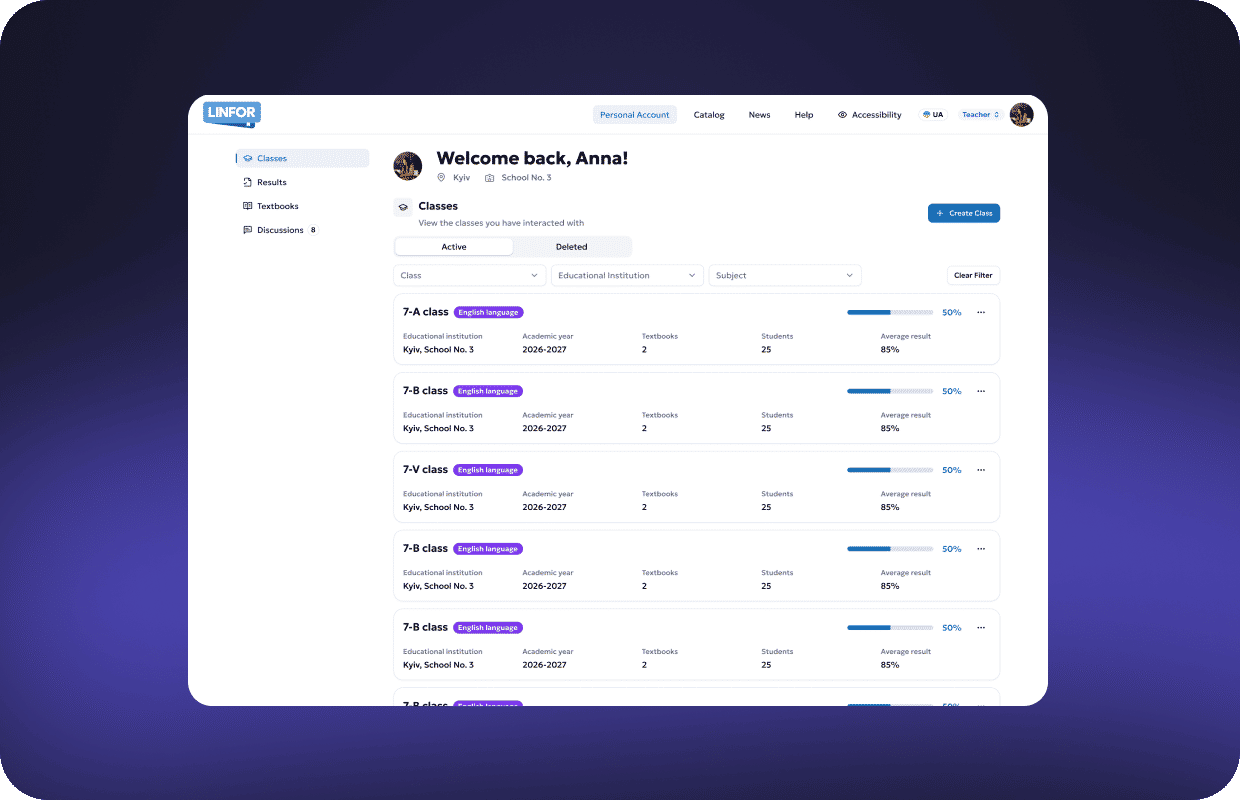
Personal dashboard for teachers
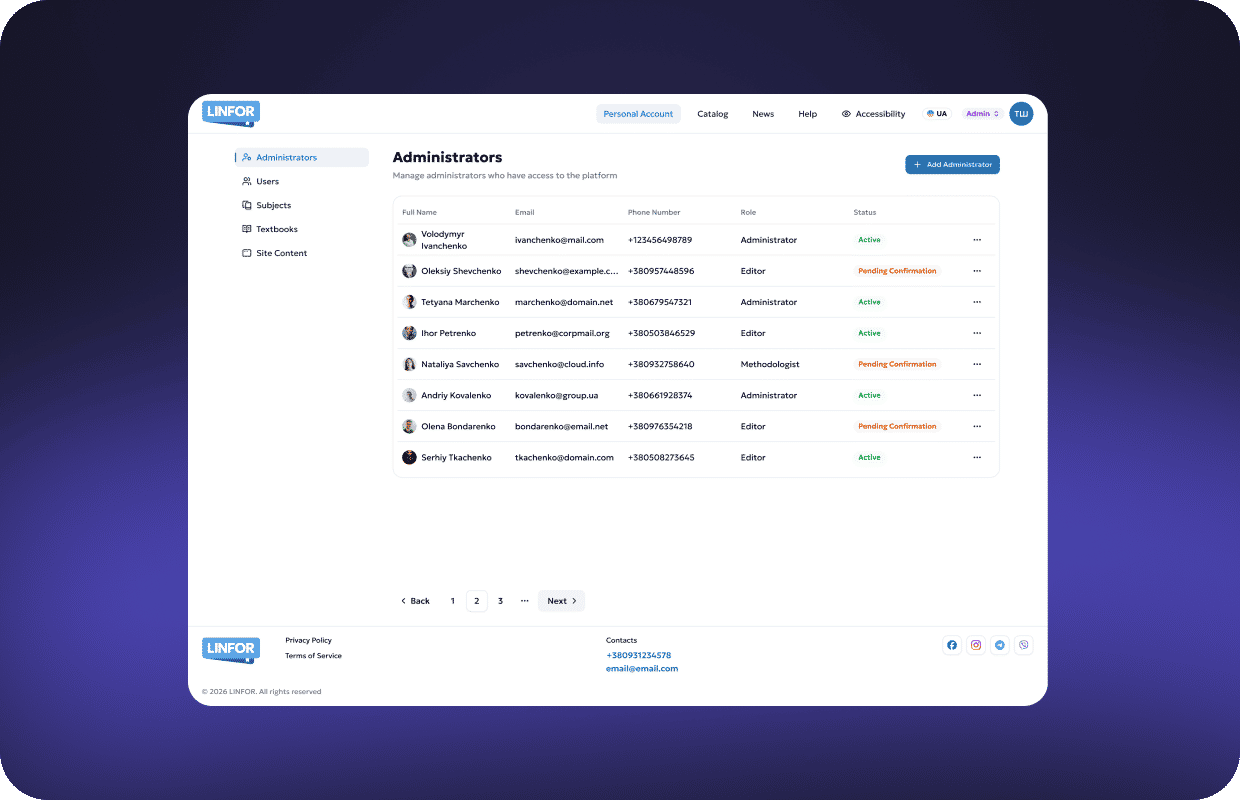
Admin management
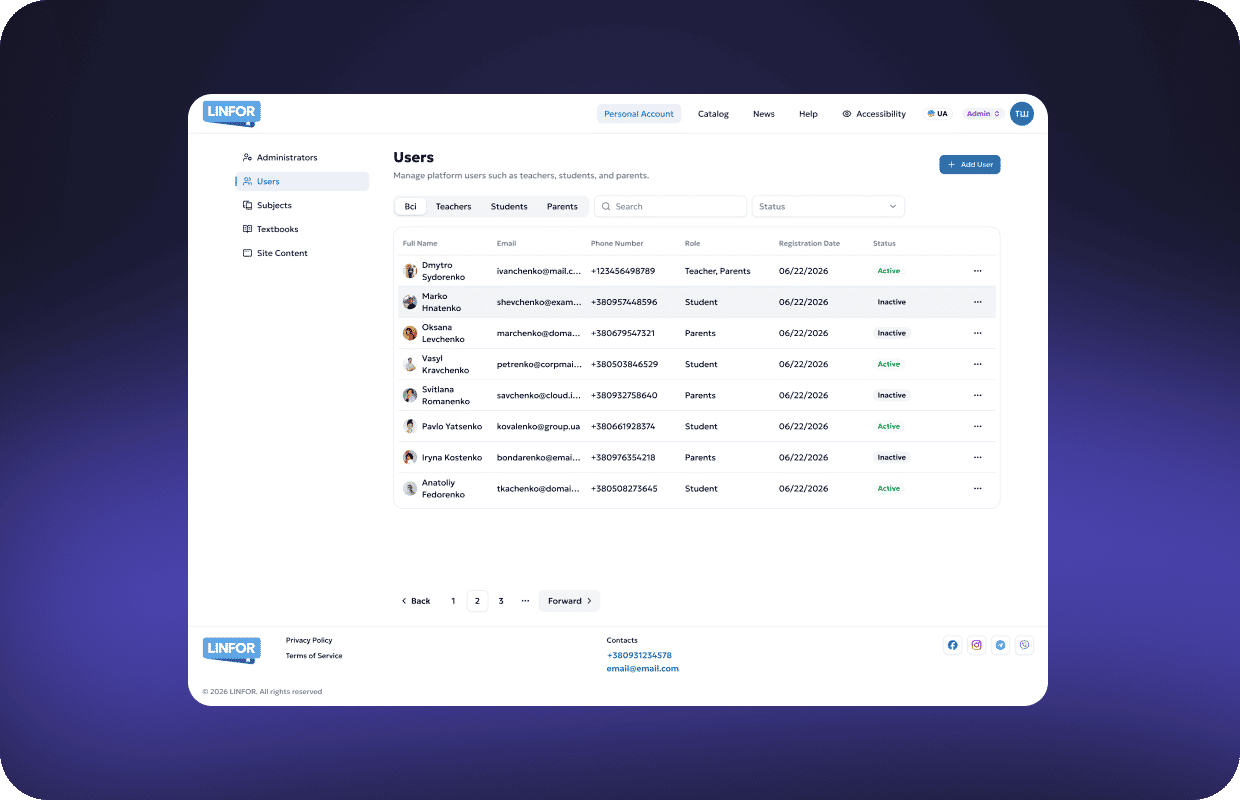
User management
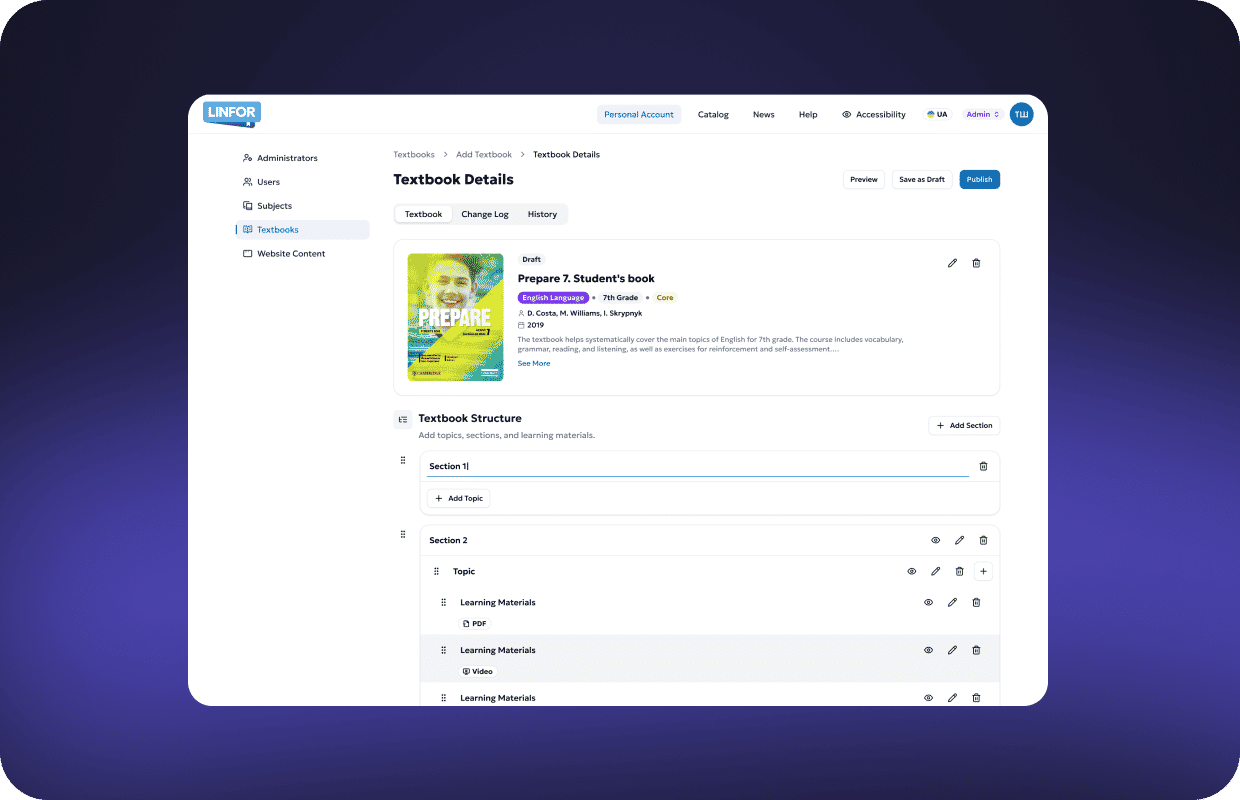
Content management
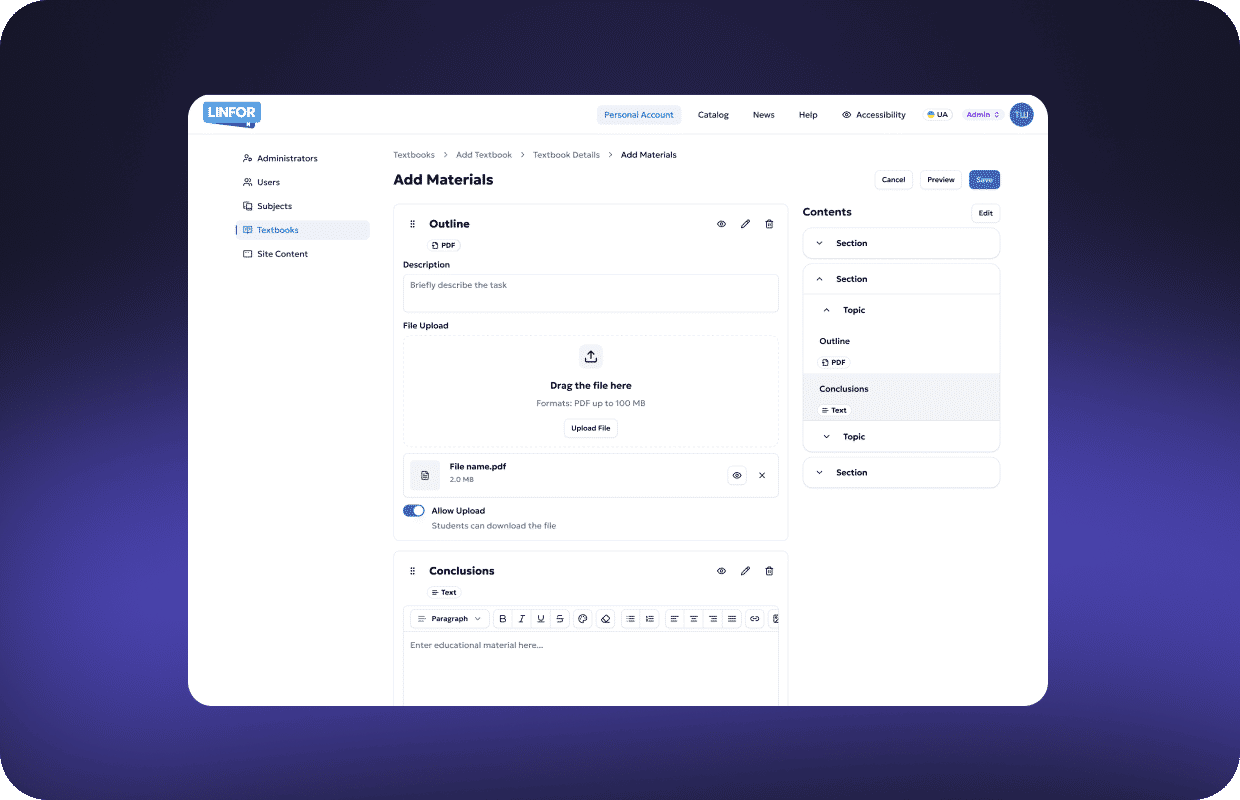
Test/exercise management
LINFOR has reached the MVP validation stage. The current version is being tested by authorized representatives, while broader product success will be measured against defined criteria for usability, content adoption, educational validation, and active users.
✅ MVP entered the educational validation process
Authorized representatives are currently testing the LINFOR MVP as part of the process toward formal validation by the Ministry of Education of Ukraine. This brings the product into the next stage of assessment before broader adoption within its target educational environment.
✅ Delivery stayed closely aligned with the roadmap
The client confirmed that the project met expectations and highlighted strong communication throughout the delivery process. According to the latest NPS feedback, approved deadlines have been met with almost no deviations from the roadmap.
✅ 3–5 classes per teacher set as a usability benchmark
One of LINFOR’s defined success criteria is for teachers to manage an average of 3–5 classes simultaneously without reported usability issues. This benchmark will help evaluate whether the platform supports everyday teaching workloads as adoption increases.
✅ 80% task adoption and 60% multimedia usage are defined as content benchmarks
The project targets the use of 80% of available interactive task types by methodologists and administrators. Another criterion requires that 60% of created digital supplements include multimedia elements, providing a measurable indicator of how extensively LINFOR’s interactive capabilities are used alongside textbook content.
✅ Formal validation and active-user adoption targeted through 2026
LINFOR’s success criteria include formal validation by the Ministry of Education of Ukraine and other authorized bodies. The project also defines a target number of active teachers and students to be reached by December 31, 2026. An active user is defined as someone who has logged in and interacted with content within the previous 30 days.
Third-party integration exceeded AWS Lambda capabilities
During a third-party integration, the team found that AWS Lambda lacked the capabilities required to run the external service correctly.
Our resolution
We investigated the technical requirements and adjusted the infrastructure approach, moving the affected workload to AWS Elastic Container Service (ECS). This provided the environment required by the external service, allowing the integration work to continue.