
The service fits four situations.






Every result below comes from the published case study.
Genuisee’s versatile experience, gained over more than 8 years, has enabled us to form a team with a proven track record.

Pick the starting point that matches where your product is today: an idea, a prototype or a live application.
How we work together: a fixed scope for a defined PoC or MVP, a dedicated team for ongoing product work, or AI engineers added to your team.


From fragmented travel requests to an AI-powered concierge platform
Geniusee partnered with a small travel company to develop an AI-powered concierge platform that integrates travel assistance and service management into a single digital environment. The MVP combines an AI-powered chatbot for travelers with an administrative platform for managing its content, users, data, and operations.
Case details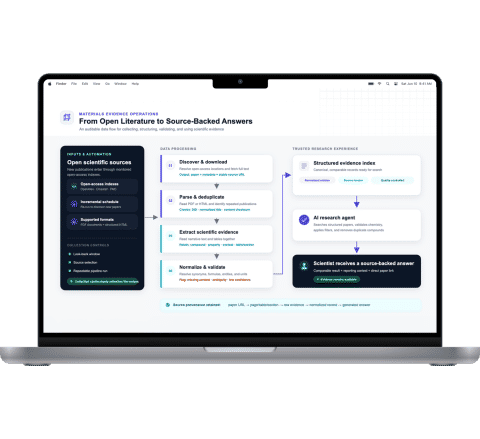
 Materials science
How Geniusee helped Planck Technologies process 10,000 scientific papers with an AI data pipeline
Planck Technologies develops AI-powered technology for materials discovery, helping researchers evaluate porous materials for industrial applications. They addressed Geniusee to build a scientific data pipeline that collects research publications, extracts and normalizes materials data, preserves source provenance, and supports AI-assisted scientific research.
Case details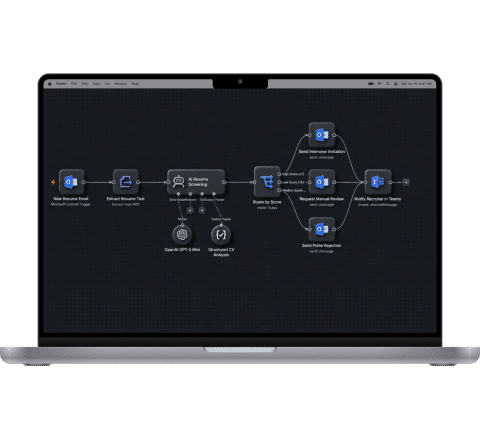
How Geniusee saved recruiters up to 25 hours in 2 weeks with AI agent
Geniusee partnered with an NDA-protected technology services company to automate one of the most time-consuming parts of its recruitment funnel: first-stage candidate screening. The resulting AI screening workflow evaluates inbound profiles against vacancy requirements, advances or disqualifies candidates, prepares personalized feedback, and gives recruiters a structured record of every decision. The resulting AI screening workflow evaluates inbound profiles against vacancy requirements, advances or disqualifies candidates, prepares personalized feedback, and gives recruiters a structured record of every decision.
Case details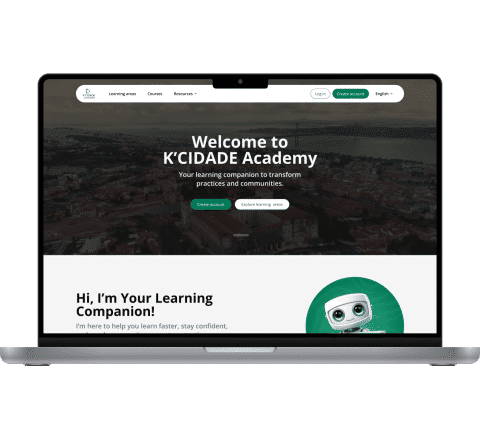
K’CIDADE Academy: How we built an AI-powered learning platform for AKF Portugal
K'CIDADE Academy is AKF Portugal's professional learning platform for civil society organizations, educators, and community leaders. Built on adaptive learning pathways, an AI virtual tutor, and a gamified progress system, it delivers personalized training to professionals working across social inclusion, education, and community development.
Case details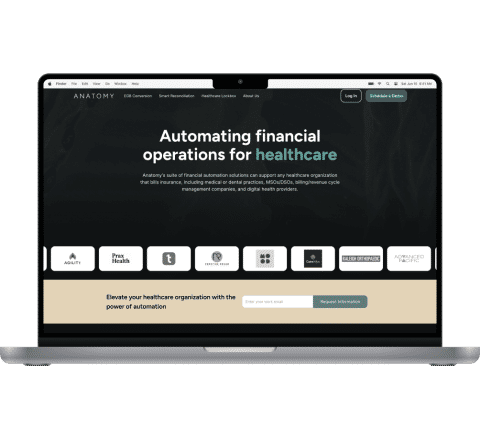
Anatomy Financial: Automated financial management software for healthcare
Anatomy introduces an innovative solution designed to automate document processing, compare various documents and banking transactions, and handle the intricacies of physical check processing. By conducting a thorough analysis, the system identifies discrepancies between the declared prices of medical procedures and the actual amounts received by the clinic.
Case details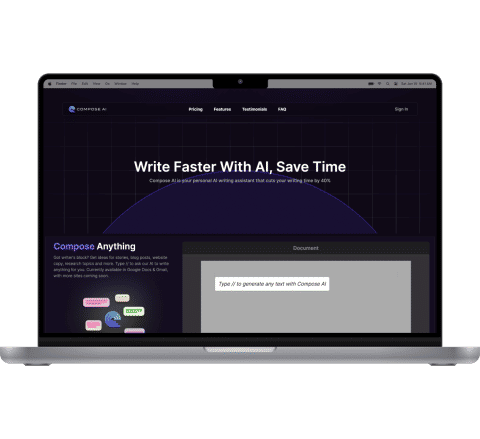
 Martech
Compose AI: Advanced content writing solution
We partnered with Compose AI to enhance their AI-powered writing platform through cloud migration, UX improvements, seamless integrations, and scalable feature development, upporting their growth from YC-backed startup to a widely adopted productivity tool.
Case detailsWhat AI can do inside your application
Each capability below can ship in a web application, a mobile app or both. For mobile apps, we decide at the architecture stage whether inference runs on the device or on your servers, based on latency, privacy and cost.
| What the application does | How it works | Example | Related service |
| Reads and extracts documents | Pulls fields from invoices, insurance EOBs and contracts, with human review for low-confidence results | Anatomy Financial | Generative AI development |
| Matches, ranks and screens | Scores candidates, leads or listings against your criteria and explains each decision | Imagine AI, AI screening agent | AI agent development |
| Answers questions over your content | Assistants and search grounded in your documents with retrieval-augmented generation | K’CIDADE Academy | AI chatbot development |
| Turns research into structured data | Extracts entities and properties from thousands of unstructured sources | Planck Technologies | Custom LLM development |
| Detects events in video | Computer vision on edge devices and live camera streams | QuantumEye | Computer vision |
| Flags patterns and recommends actions | Learns from usage data to spot underused resources and suggest changes | iotspot | AI development services |
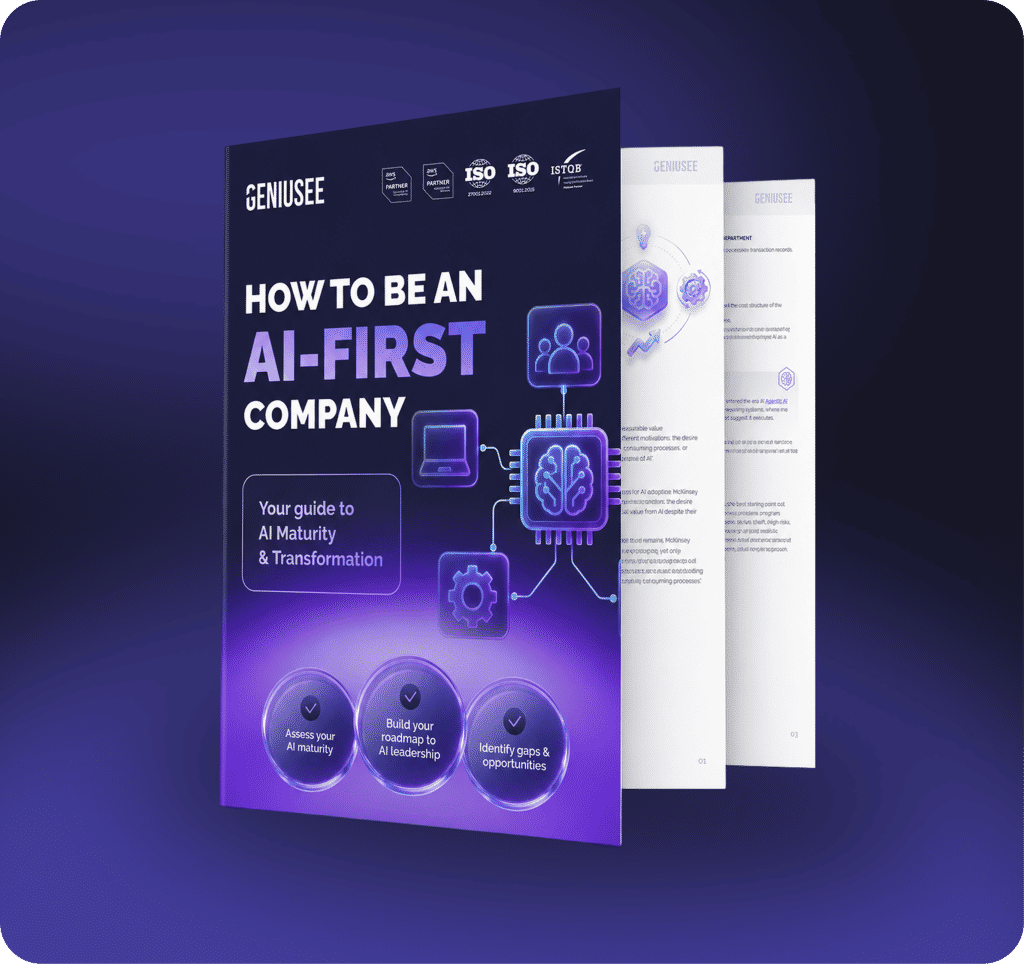
Check if your AI feature is worth building
A demo that works on 10 examples says little about whether a feature will earn back its inference bill. This whitepaper sets out the gates Geniusee used in its own AI transformation. You score readiness first. Then each use case passes a value gate, the PoC is validated, and only workflows with measurable value move to scale. One internal workflow that passed these gates saves up to 120 hours a month.
Inside the whitepaper:
- AI readiness score
- Use-case framework with value gates
- PoC validation steps
- Governance and scaling roadmap
Technology we use for AI application development
| Layer | Technologies |
| AI frameworks and orchestration | LangChain, LlamaIndex |
| Models | OpenAI, Claude, Gemini, open-source models served through Amazon Bedrock or vLLM |
| Application | React, Next.js, Node.js, NestJS, Python, React Native |
| Cloud and data | AWS, PostgreSQL with pgvector, Redis, Terraform |








Our AI app development process has 6 stages, and each one ends with something your team can review.

Discovery and use-case validation
We confirm the business case, check data readiness
and agree on success metrics in a discovery phase.
You get the scope, an estimate
and the criteria the AI feature must meet.
Solution and data architecture
Our architects choose between a hosted API model, a fine-tuned model or a self-hosted one,
map the integrations and design security and privacy controls.
Output: an architecture document.
Proof of concept
The core AI feature runs on your data,
and we measure it against the criteria from the beginning.
Product development
Engineers build the application, the AI feature
and its integrations together in 2-week sprints.
The evaluation set and guardrails grow alongside the code.
Testing and release
Our QA engineers run functional, performance and AI output tests.
Your team signs off in staging before deployment.
Monitoring and improvement
After launch, we track quality, latency and cost
and schedule prompt, model or retraining updates
when a metric crosses its threshold.
We settle these six areas at the architecture stage, before development starts.


Certified AWS Partner delivering secure, scalable cloud-native solutions.

ISO-compliant processes ensuring quality, security, and reliability.

Trusted integration partner for financial data connectivity and open banking.
Team of ISTQB-certified QA engineers for world-class software testing.

Consistently rated ★5.0 by clients for reliability and delivery excellence.

Accredited partnership supporting advanced testing and continuous QA automation.
Every result on this page links to a published case, and you can read more in our portfolio.
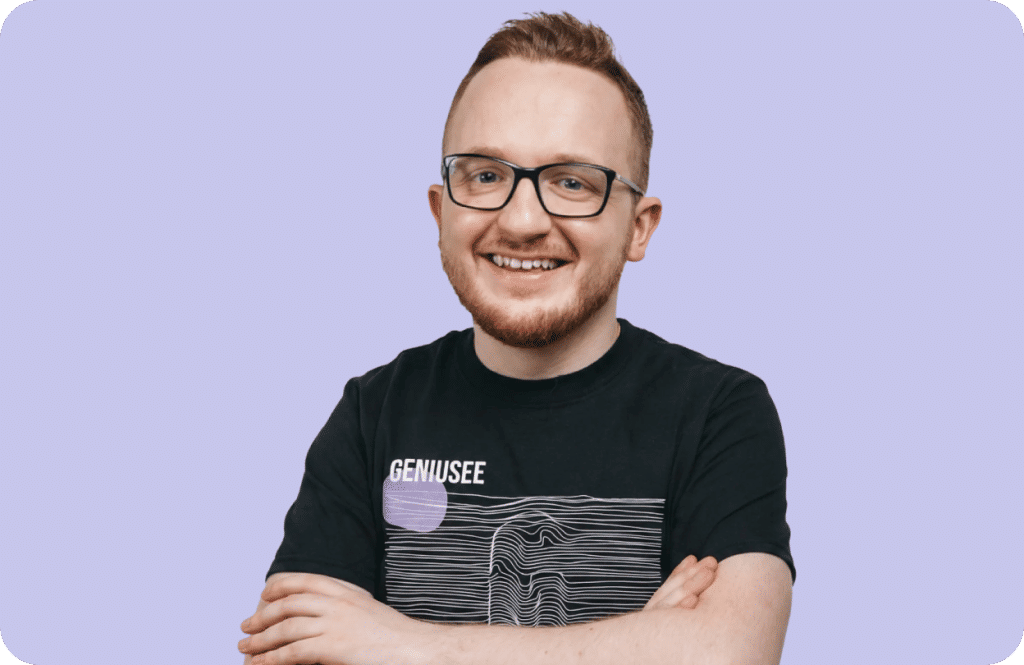
“An AI feature is ready when we can show its output-quality numbers before and after a change. A good demo proves much less. We build the evaluation set together with the feature, and that set is what lets our clients put it in front of customers.”
Nazariy Hazdun
CTO and Co-founder at Geniusee







What kind of AI-powered application can Geniusee build?
We build web and mobile applications where AI does part of the work, such as document extraction, candidate or record matching, assistants grounded in your content and computer vision. That includes new products and new features in live ones. Imagine AI, K’CIDADE Academy and the Planck research pipeline are examples running in production today.
Should we build a custom model, fine-tune one, or use an API?
Start with a hosted model through an API when you need to prove value quickly. Fine-tuning makes sense once outputs must follow your domain language or format. A self-hosted or custom model fits strict data-residency rules or high inference volume. We compare the three options in discovery, with cost and accuracy estimates for each.
What data do we need before we start?
You need examples of the inputs the feature will handle and examples of good outputs: past documents with the correct extracted fields, say, or screening decisions your recruiters agreed with. During the data readiness check, we assess volume, quality and access rights, and tell you what to collect if the current set falls short.
How long does AI app development take, and what sets the cost?
A PoC takes weeks and a production release takes months; K’CIDADE Academy went from kickoff to launch in 2.5 months. Cost depends on the number of AI features, data preparation, integrations, compliance requirements and expected usage, which drives inference spend. You get a written estimate after discovery, or a first range from our AI estimator.
How do you handle hallucinations and unreliable outputs?
We ground answers in your own data through retrieval, restrict what the model may answer and validate outputs against business rules before users see them. Each feature has an evaluation set that measures accuracy on real cases. Where an error carries risk, the application routes low-confidence results to a person for review.
How are AI features tested before release?
Testing covers both the application and the model output. QA engineers run functional, performance and security tests, and the evaluation set scores AI responses for accuracy and consistency. We rerun that set after each prompt or model change, so a regression shows up in staging before it reaches your users.
How is our data protected, and who owns the result?
Before development starts, we agree where your data is processed and which model providers may access it. Sensitive workloads can run inside your own cloud account, and Geniusee follows ISO 27001-certified processes. The code, any models trained for you, the prompts and the documentation belong to your company under the contract.
What happens after launch?
Post-launch support covers monitoring of output quality, latency and inference cost, plus updates when models or provider APIs change. We agree on the thresholds that trigger retraining or prompt updates, report monthly and keep building new features with your team. The engineers who built the product stay on to support it.