



When your AI product needs clear governance and compliance boundaries
When someone asks how the system handles personal data, the answer should not depend solely on the model’s behavior.
If an AI system is not explicitly instructed which frameworks apply, it will make its own assumptions about what is safe enough. We translate your privacy, security, and contractual requirements into concrete rules for data handling, access, logging, and retention, and then review the implementation against these rules. That is how obligations like GDPR or PCI DSS become testable controls.
1. Discovery and AI readiness
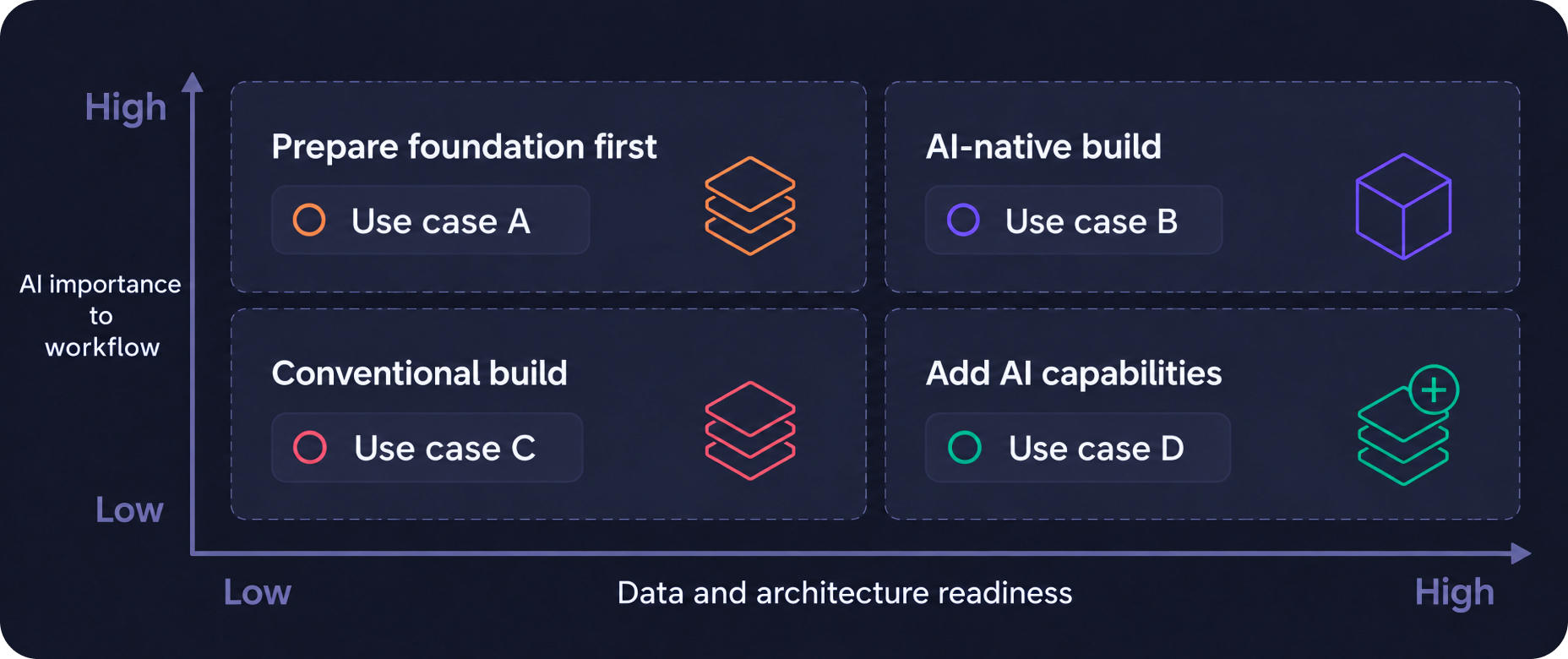
We decide which use cases justify AI-native development and which are better served by adding AI capabilities to what you already run.
- Architecture and data readiness review
- Use case selection and prioritization
- Compliance frameworks are named and recorded
- Integration points mapped across current systems
- Written assessment with a recommended sequence
2. Architecture and AI-ready specification
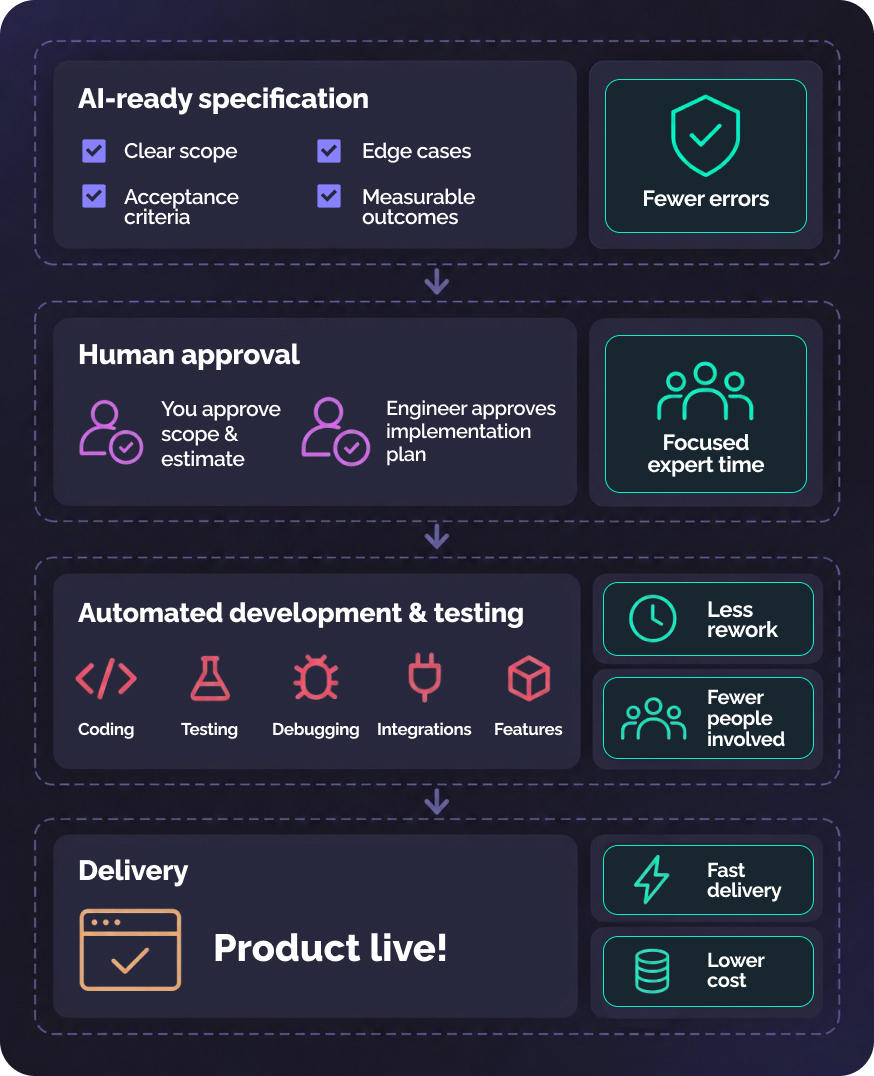
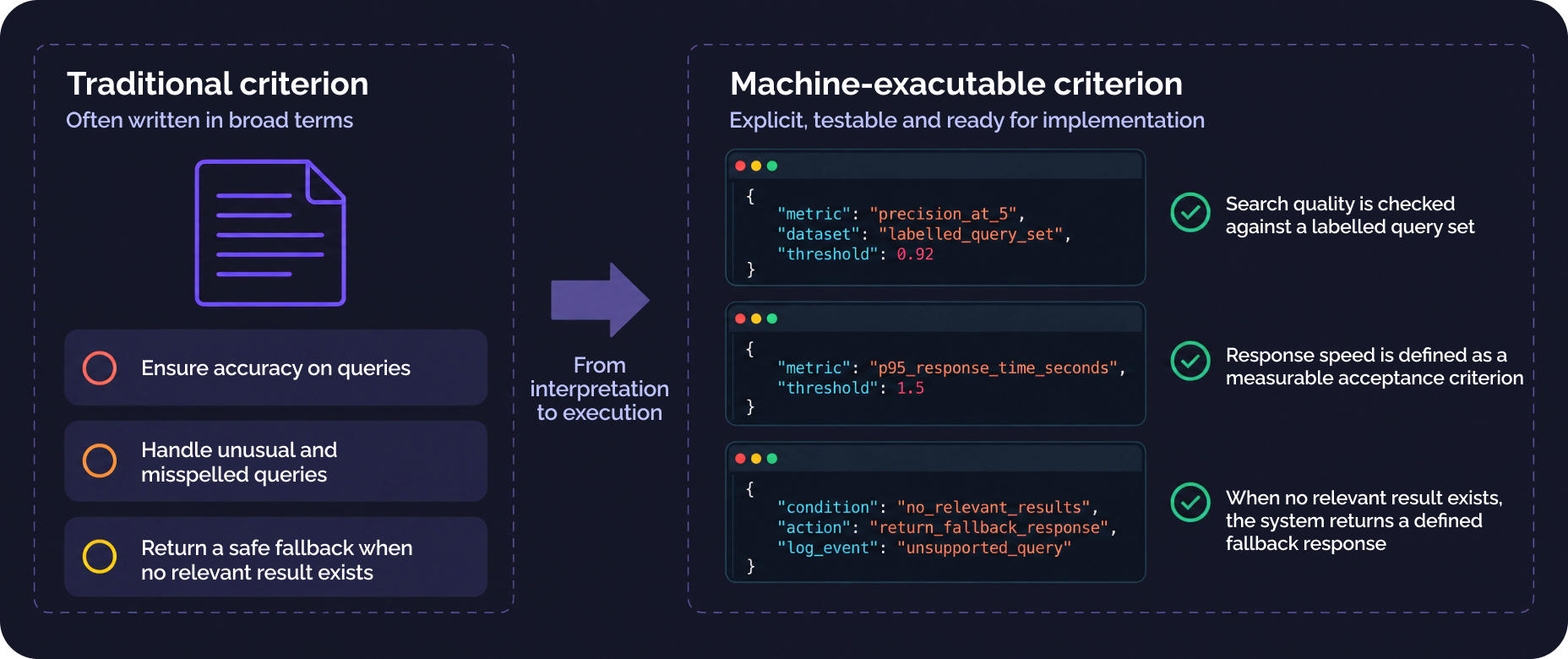
The scope becomes a specification detailed enough to estimate and precise enough for agents to execute, owned by our business analysis team. Where AI behavior can only be judged by testing it, the specification defines evaluation criteria and acceptance ranges rather than fixed outputs.
- Target architecture for models, data, and application logic
- Work breakdown with a full task list and estimates
- Acceptance criteria written for machine execution
- Security and compliance rules are attached to each area of the build
- Your approval of the scope and cost before development starts
3. Foundation and environment setup
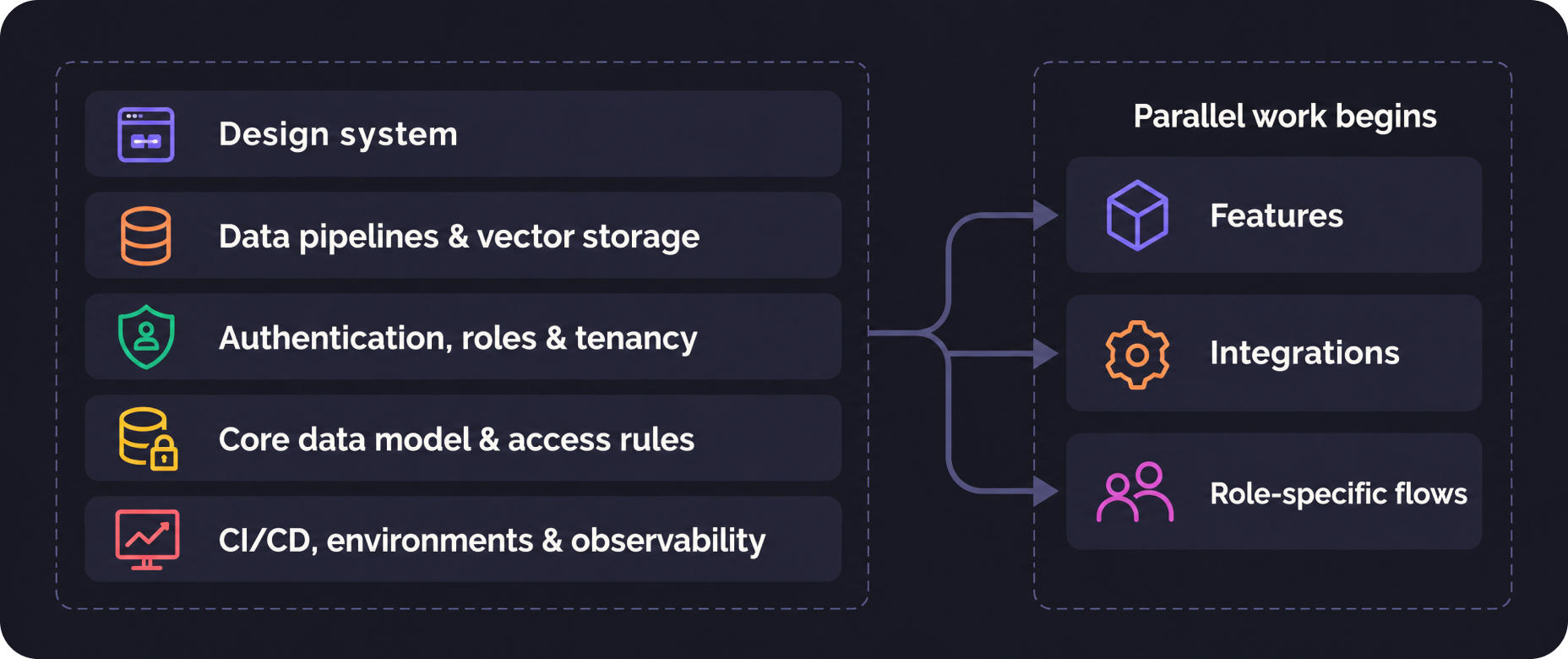
We assemble the shared components first, because most other tasks depend on them.
- Design system prepared as structured input for implementation
- Authentication, user roles, and tenancy boundaries
- Core data model and access rules
- Data pipelines and vector storage where retrieval is required
- CI/CD, environments, and observability
4. Parallel development with plan approval
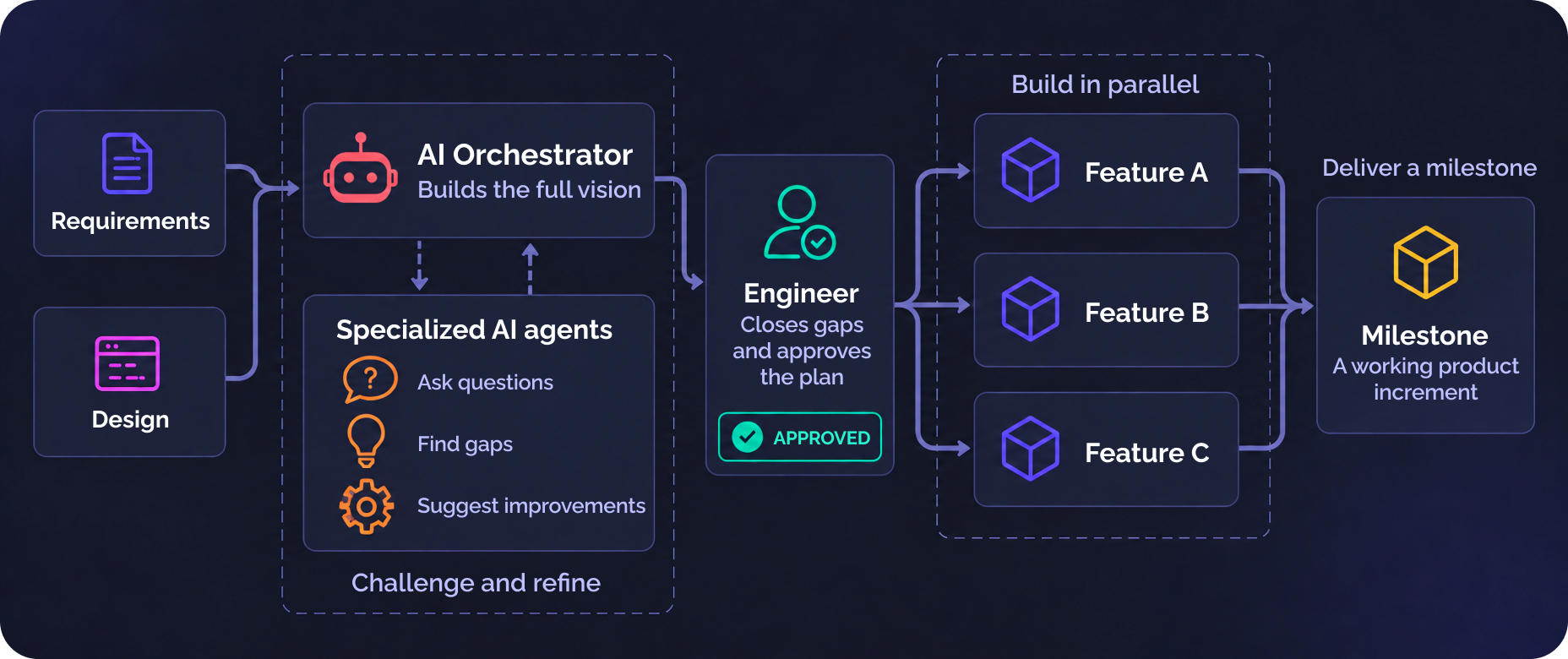
An orchestrator splits the specification into tasks and assigns them to agents to work on simultaneously.
- Implementation plan drafted per task from the specification and design
- The engineer signs off on every plan before code generation
- Parallel execution across features, integrations, and user roles
- Progress tracked against the approved work breakdown
- Change requests are tracked separately from the approved work breakdown
5. Review, testing, and hardening
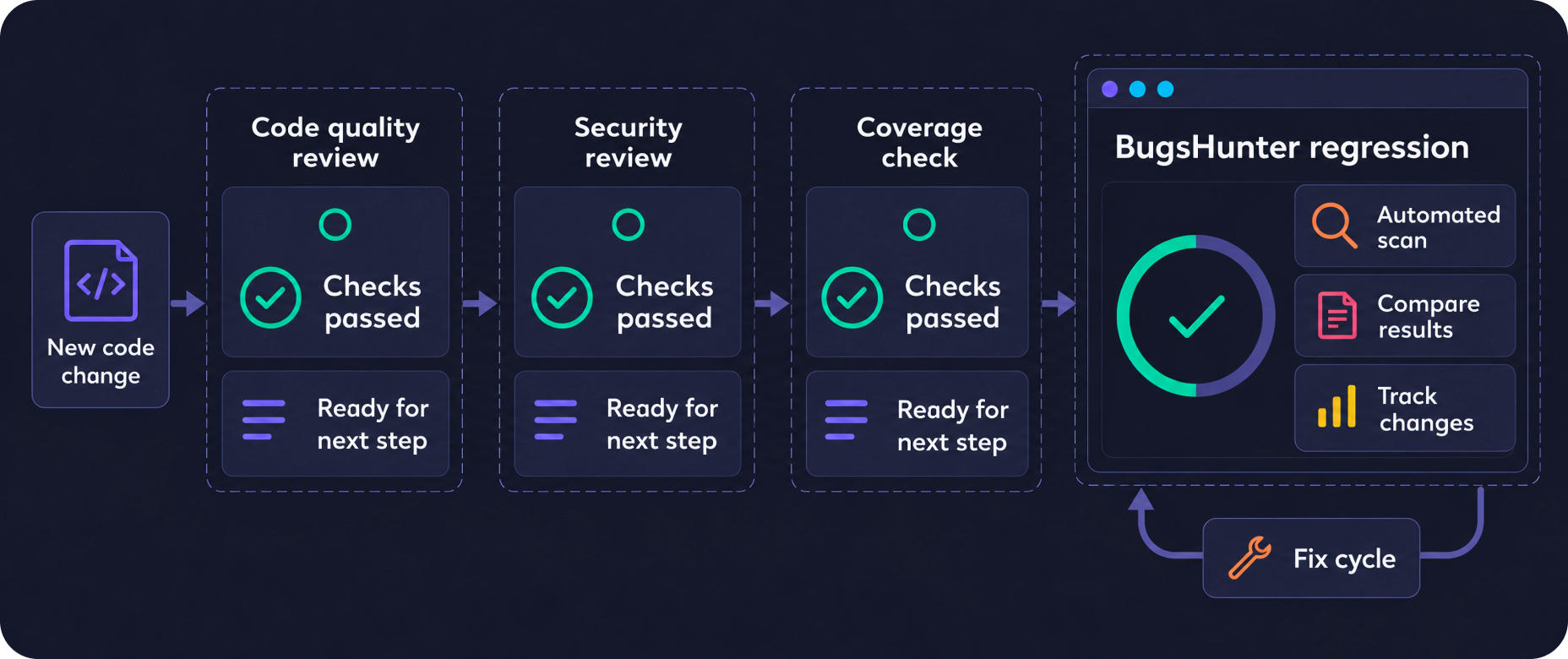
Every change passes three separate reviews before regression runs across the assembled build, with our QA practice involved throughout.
- Automated code quality review
- Security review against the frameworks captured at discovery
- Coverage check against the written specification
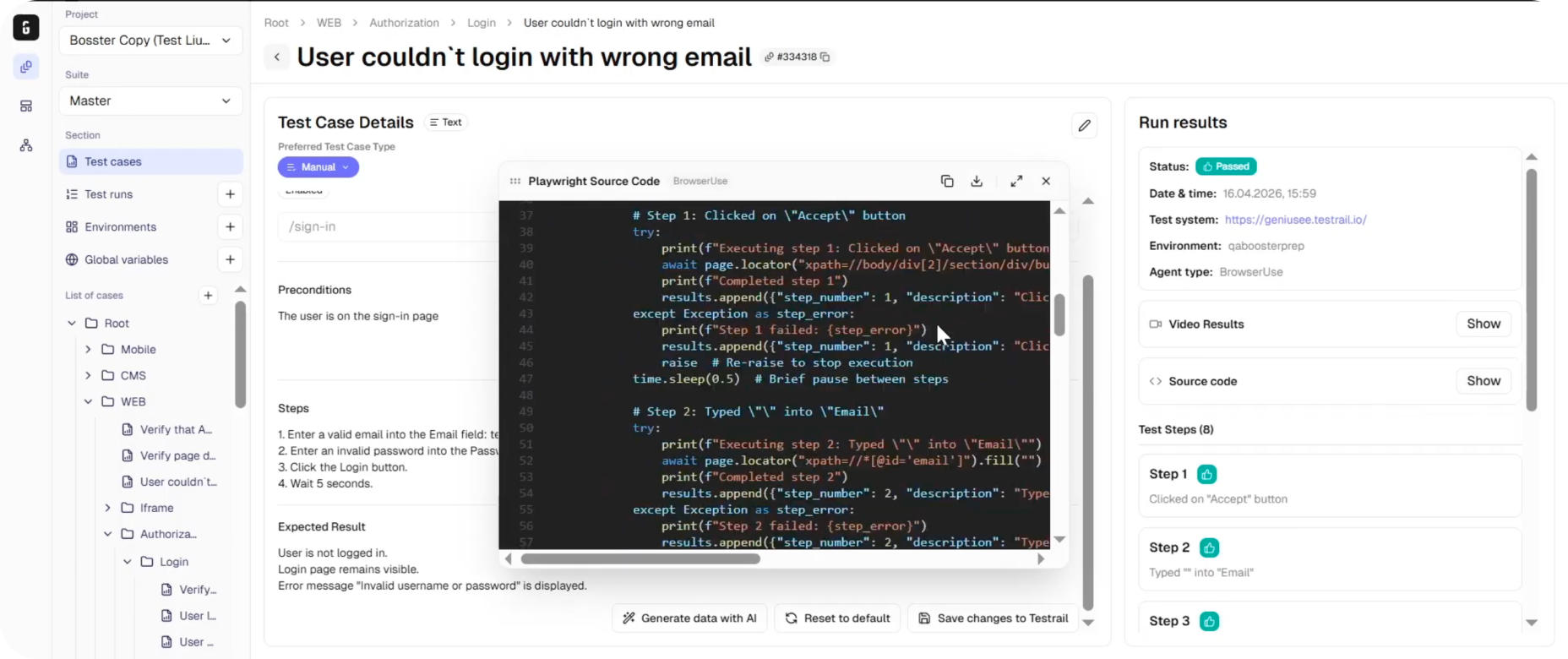
- Autonomous regression testing and reporting through BugsHunter
- Fix cycles until the full suite passes
6. Release, handover, and improvement
The build ships with the documentation and specification artifacts produced along the way, so your team can maintain it without having to reverse-engineer anything.
- Deployment into your cloud environment
- Handover of code, documentation, and specifications
- Monitoring for model performance and inference cost
- Feedback capture from user corrections and rejections
- Ongoing maintenance and support where required








Not every engagement should begin with a full build. An AI proof of concept is the lowest-commitment way to see that an AI-native software delivery model works on your actual use case
Enough evidence to scope the next step
You finish with working evidence and an architecture view, which gives you a clear basis for scoping a full build. If the answer is that AI-native development does not fit your case, the PoC is designed to show that as well.

Experts ready to start helping with your AI-native project







Certified AWS Partner delivering secure, scalable cloud-native solutions.

ISO-compliant processes ensuring quality, security, and reliability.

Trusted integration partner for financial data connectivity and open banking.
Team of ISTQB-certified QA engineers for world-class software testing.

Consistently rated ★5.0 by clients for reliability and delivery excellence.

Accredited partnership supporting advanced testing and continuous QA automation.
Two directions: how we build software, with AI agents working inside the delivery process, and what kind of AI-native software we build for you.

From fragmented travel requests to an AI-powered concierge platform
Geniusee partnered with a small travel company to develop an AI-powered concierge platform that integrates travel assistance and service management into a single digital environment. The MVP combines an AI-powered chatbot for travelers with an administrative platform for managing its content, users, data, and operations.
Case details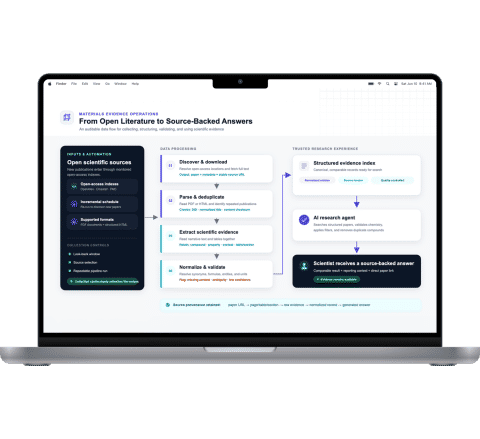
 Materials science
How Geniusee helped Planck Technologies process 10,000 scientific papers with an AI data pipeline
Planck Technologies develops AI-powered technology for materials discovery, helping researchers evaluate porous materials for industrial applications. They addressed Geniusee to build a scientific data pipeline that collects research publications, extracts and normalizes materials data, preserves source provenance, and supports AI-assisted scientific research.
Case details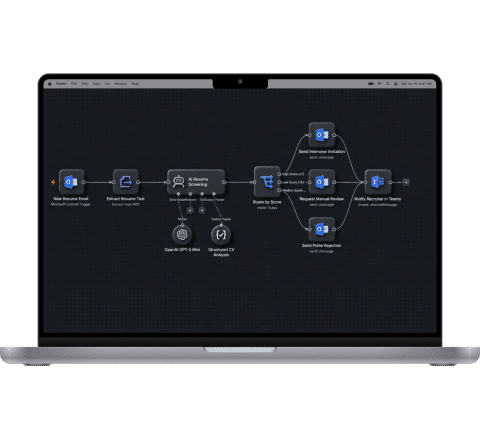
How Geniusee saved recruiters up to 25 hours in 2 weeks with AI agent
Geniusee partnered with an NDA-protected technology services company to automate one of the most time-consuming parts of its recruitment funnel: first-stage candidate screening. The resulting AI screening workflow evaluates inbound profiles against vacancy requirements, advances or disqualifies candidates, prepares personalized feedback, and gives recruiters a structured record of every decision. The resulting AI screening workflow evaluates inbound profiles against vacancy requirements, advances or disqualifies candidates, prepares personalized feedback, and gives recruiters a structured record of every decision.
Case details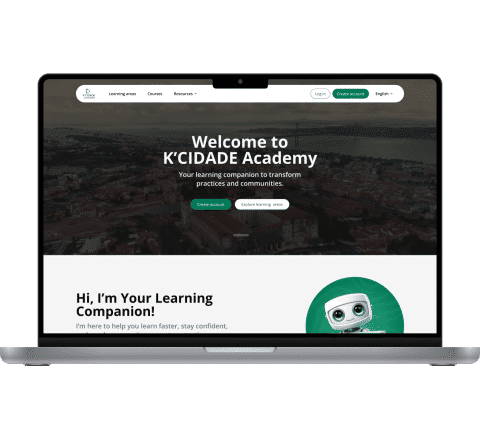
K’CIDADE Academy: How we built an AI-powered learning platform for AKF Portugal
K'CIDADE Academy is AKF Portugal's professional learning platform for civil society organizations, educators, and community leaders. Built on adaptive learning pathways, an AI virtual tutor, and a gamified progress system, it delivers personalized training to professionals working across social inclusion, education, and community development.
Case details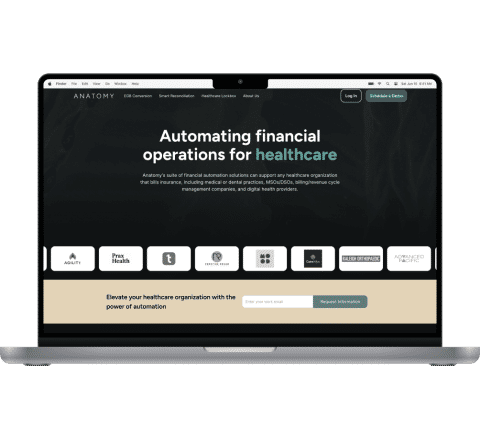
Anatomy Financial: Automated financial management software for healthcare
Anatomy introduces an innovative solution designed to automate document processing, compare various documents and banking transactions, and handle the intricacies of physical check processing. By conducting a thorough analysis, the system identifies discrepancies between the declared prices of medical procedures and the actual amounts received by the clinic.
Case details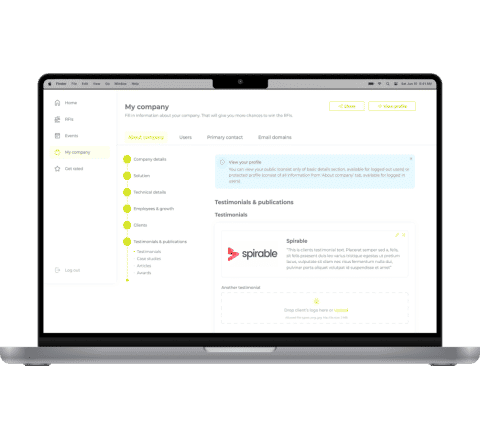

Validify – Retail vendor management platform
See how Geniusee built Validify’s scalable vendor management platform with advanced UX, data architecture, and automated RFI workflows.
Case detailsAI-native describes both the product and the delivery model. Geniusee builds AI-native products and custom AI-native solutions around a modular intelligence layer, so models, retrieval logic, policies, and infrastructure can evolve without forcing changes across the product. That separation is where the efficiency comes from.

Languages and frameworks
AI and data




Cloud and infrastructure

- Document processing for onboarding, KYC, and loan files
- Transaction monitoring and anomaly detection
- AI assistants for customer support with audit trails
- Risk scoring models with explainable outputs
- Reporting automation across regulated data sources
- Adaptive learning paths driven by learner behavior
- Automated content generation and curriculum assembly
- Assessment scoring with human review points
- Conversational tutors grounded in course material
- Engagement and retention analytics
- Product data enrichment and catalog automation
- Recommendation systems using behavioral signals
- Demand forecasting and inventory planning
- Conversational search across large catalogs
- Customer service agents connected to order systems
- Listing generation and enrichment from unstructured sources
- Document handling for contracts, leases, and disclosures
- Valuation support models
- Lead qualification and routing agents
- Portfolio and maintenance reporting
- Predictive maintenance models built on equipment and sensor data
- Production planning and demand forecasting
- Anomaly detection across production line telemetry
- Document handling for compliance, safety, and supplier records
- Agents coordinating across ERP, inventory, and scheduling systems






What does AI-native software development mean?
It covers two connected practices. The first is how software gets built: requirements become specifications that AI agents can execute, implementation runs in parallel under engineer approval, and testing runs autonomously before release. The second is what gets built: products in which models, data pipelines, and retrieval are part of the core architecture rather than added to a finished system. Geniusee applies both, and the delivery workflow works whether or not the product itself contains AI.
What is the difference between an AI-native product and software with AI features?
In an AI-native product, models, retrieval, and adaptive behavior participate directly in the core workflow, which shapes the rest of the system’s design. Software with AI features adds intelligence to an otherwise conventional architecture through isolated capabilities such as summarization, classification, or search, usually by calling an external model from an existing screen. AI-native applications in which intelligence drives the core workflow require retrieval, context handling, evaluation, and feedback loops designed as system components from the start.
Do we own the code you build with AI agents?
Yes. Ownership of the deliverable transfers to you under contract, on the same terms as any custom software development engagement with Geniusee. Every implementation plan is approved by an engineer before code is written, and the output goes through quality, security, and coverage review before it reaches you. We agree on the specific arrangements around model providers, data handling, and retention at the contract stage, and we can work within your own tooling and repositories.
Does our project information get used to train AI models?
Project materials are not used to train vendor models under the plans we run for client work. An AI-assisted pipeline necessarily reads your specifications, code, and product context, so we treat that information as data to protect: the tooling runs on commercial subscriptions that exclude customer content from model training, and project knowledge stays within the engagement. The specific providers and plan terms are agreed at the contract stage, and where your own vendor policies exclude a particular tool, the pipeline adapts.
Is AI-generated code secure enough for a regulated product?
Not on its own, which is why security review is a separate stage in our pipeline. Veracode’s 2026 research across more than 100 models found that syntax correctness now approaches 100 percent while the average security pass rate holds at 56 percent, so the fact that code compiles and runs tells you very little about its security. We capture your compliance frameworks at intake, test against them, and then run regression in BugsHunter before handover.
How long does an AI-native project take?
That depends on scope, integration count, data readiness, and the applicable compliance requirements, which is why we produce the estimate from the specification rather than a template. The work breakdown stage lists every task with its estimate, and you approve both before development starts. For teams who want a smaller commitment first, a proof of concept against your real data usually answers the feasibility question before a full build is scoped.
Can you work with our existing team and codebase?
Yes. We work as a dedicated team, as an extension of your engineering group, or as a fixed-scope module within a larger system. Our delivery model adapts to your repositories, review process, and release cycle. Where a codebase was generated quickly and needs remediation before new work begins, we handle that as a separate stream so the cleanup does not get mixed into feature delivery.