About the client
The client is a technology services company with an ongoing need to hire engineering talent across multiple vacancies. Its recruitment team manages a steady stream of inbound applications, making the first screening stage an important operational bottleneck when hiring demand increases.
Due to NDA restrictions, further company details remain confidential.
Business context
The top of the client’s recruiting funnel required significant manual effort.
Recruiters reviewed every inbound CV individually and wrote rejection messages themselves. At an average inbound volume of around 150 profiles per week, this consumed roughly 5 minutes per profile, or about 12.5 hours of experienced recruiter time every week.
The impact went beyond time spent reading CVs. Recruiters were investing capacity in profiles that would never move further in the process, rejection feedback was often generic or delayed, some website applications and submissions without attached CVs could fall outside the workflow, and hiring leads lacked an aggregated view of screening activity by recruiter or vacancy.
The client wanted to automate this stage while preserving the judgment recruiters apply when a candidate’s experience does not literally match the vacancy wording.
High manual screening workload
Recruiters spent hours each week reviewing inbound profiles and preparing rejection messages.
Relevance could not be reduced to keyword filters.
Candidates described equivalent experience, job titles, and language levels in different terms, so automatically filtering the funnel would have cut out relevant people. Screening stayed dependent on the recruiter’s judgment, and that judgment was the expensive part.
Inconsistent candidate feedback
Manual rejection writing made it difficult to provide specific, timely explanations at scale.
Applications falling outside the standard flow
Website applications and submissions without an attached CV could be missed.
Limited screening visibility
Hiring leads lacked a centralized view of decisions, recruiter workload, and vacancy-level activity.
A bottleneck that scaled with hiring demand
Screening capacity was fixed to available recruiter hours, so every additional open vacancy pushed the first stage further behind. Growth in hiring slowed down.
Solutions we implemented
Geniusee focused the engagement on a single recruitment step rather than attempting to automate the entire hiring function at once.
The team first mapped the existing screening workflow, identified where AI judgment was useful, defined matching criteria together with recruiters, and then ran the workflow on live inbound traffic during a 2-week pilot.
AI-powered CV screening
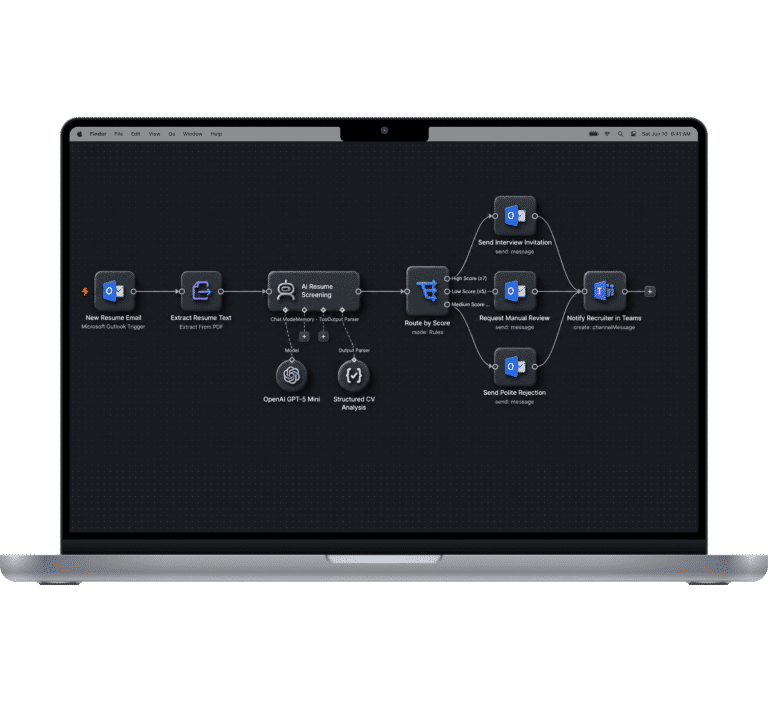
We implemented an AI screening workflow that automatically picks up inbound candidates as they enter the recruitment funnel. The system evaluates each profile against the requirements of the relevant vacancy and produces a reasoned assessment instead of relying on simple keyword matching.
Recruiter-defined matching logic
In collaboration with the recruitment team, we translated recruiter judgment into 12 explicit matching criteria. These criteria help the workflow recognize non-obvious equivalence, such as different job-title wording or alternative ways of describing language proficiency and technical experience.
Autonomous candidate routing
The workflow determines whether a candidate should advance to the next stage or be disqualified based on the defined evaluation criteria. Each decision includes a grade, a reason category, and a written rationale so that recruiters can understand how the system reached its conclusion.
Personalized candidate feedback
For candidates who do not meet the vacancy requirements, the workflow prepares a rejection based on the specific profile and role. Feedback is deliberately delayed by 1 day and sent only during working hours on business days, helping the communication feel more natural and considered.
Recruiter ownership and reporting
We implemented ownership-aware routing so candidate summaries reach the recruiter responsible for each vacancy. Every action is also logged centrally, while daily reports aggregate AI decisions by recruiter and vacancy, giving hiring leads a clearer view of screening activity.

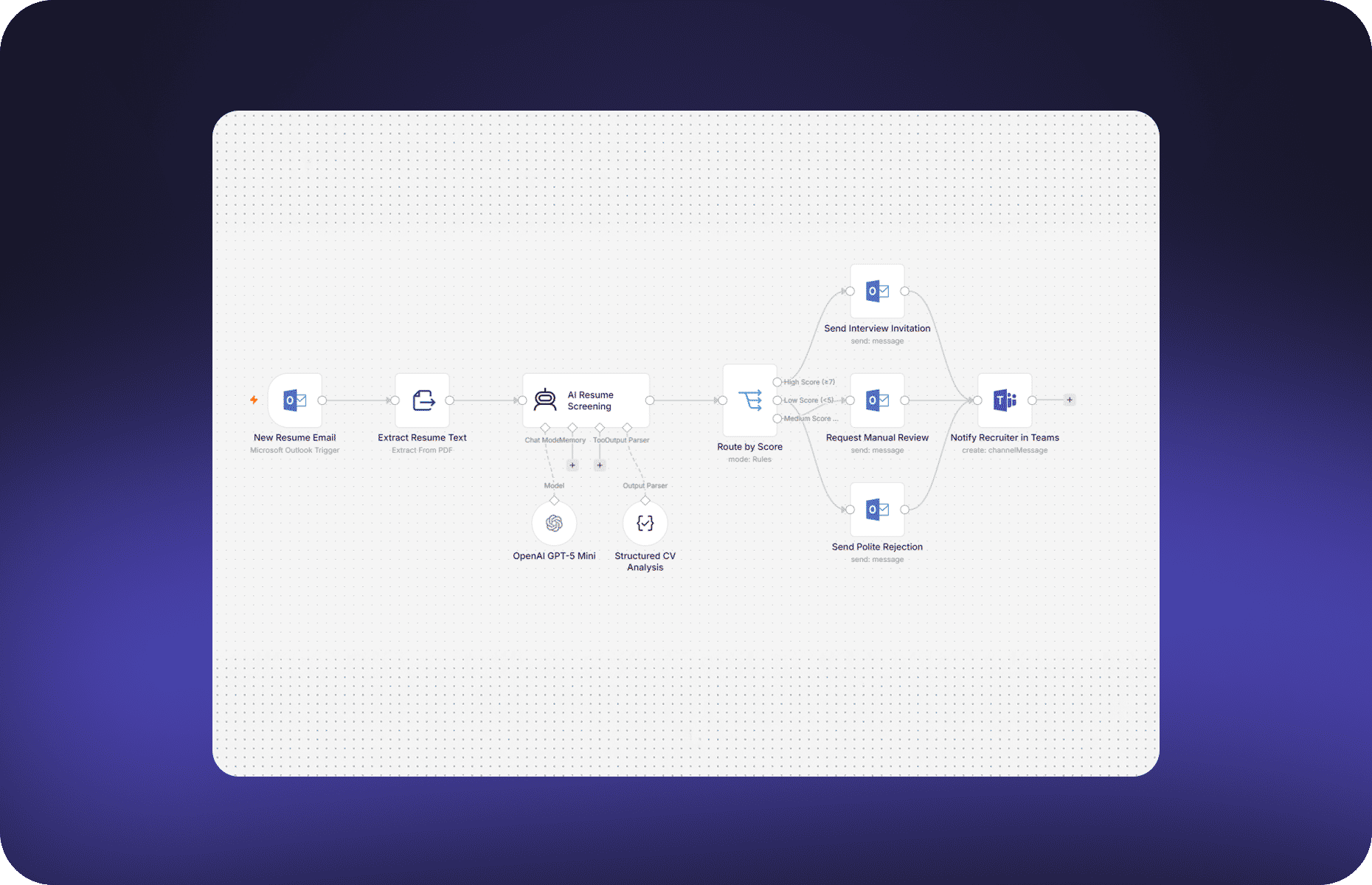
Automated intake and CV analysis
Inbound candidates are automatically picked up at the first recruitment stage, including website applications and submissions that lack an attached CV. Each profile is parsed and evaluated against the requirements of the vacancy it was submitted for.
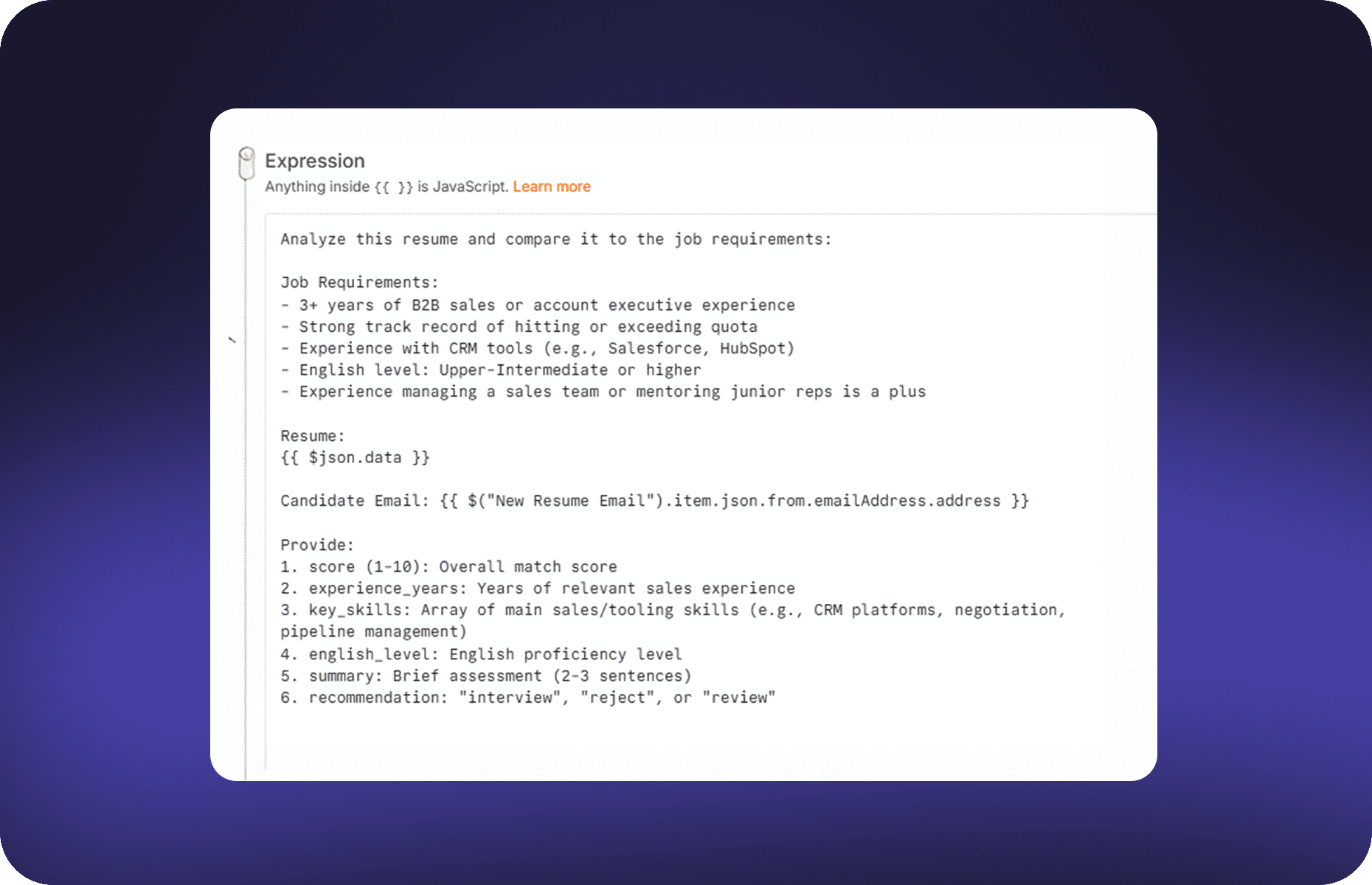
Reasoned assessment and routing
Every profile receives a grade, a reason category, and a written rationale for how that conclusion was reached. The workflow advances or disqualifies the candidate on that basis, and the reason categories make disqualified profiles reviewable later by pattern instead of one by one.
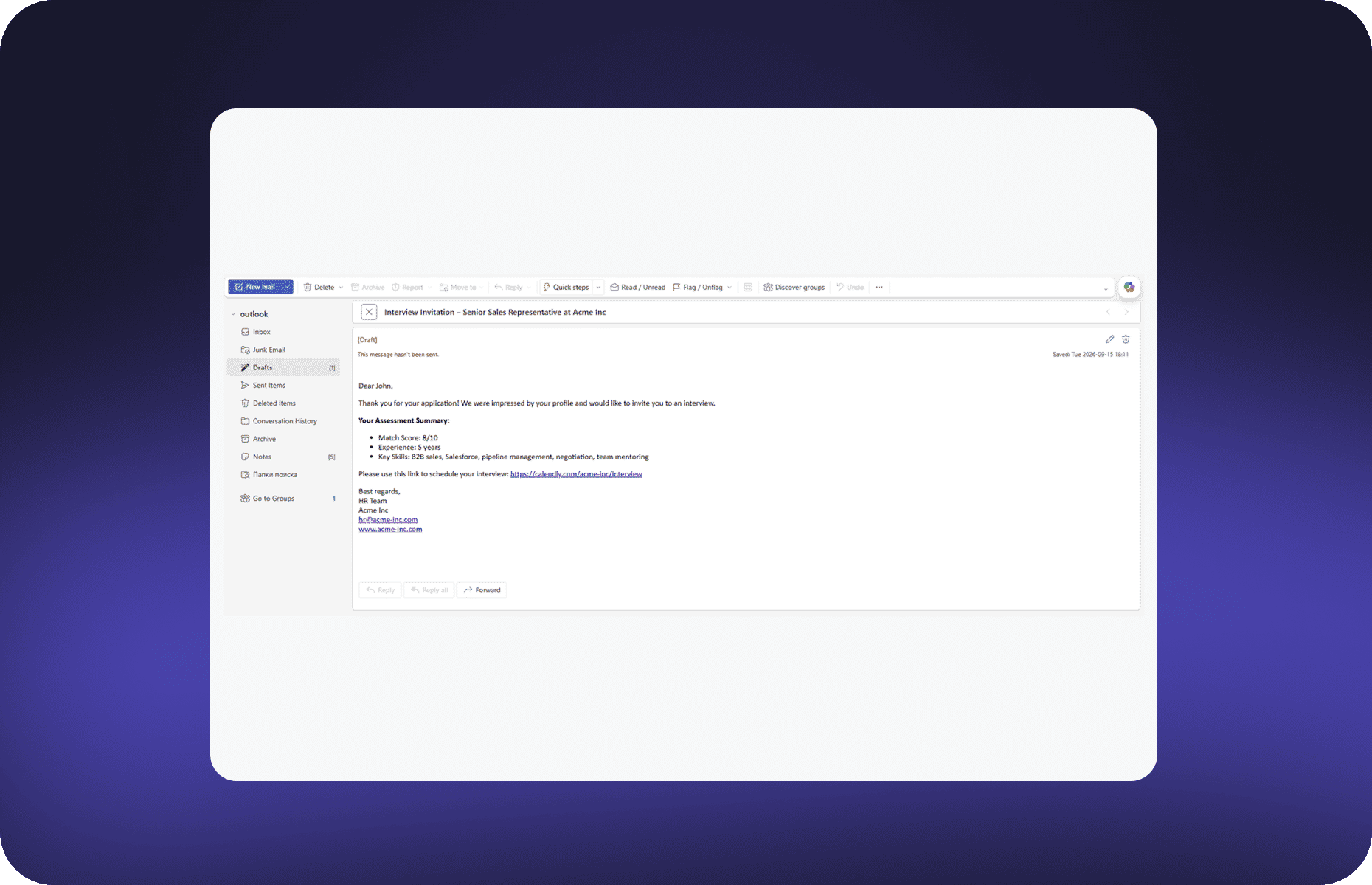
Personalized candidate feedback
Candidates who do not match receive an explanation written against their own profile and the role they applied for. Messages are queued and delivered on the next business day within working hours.
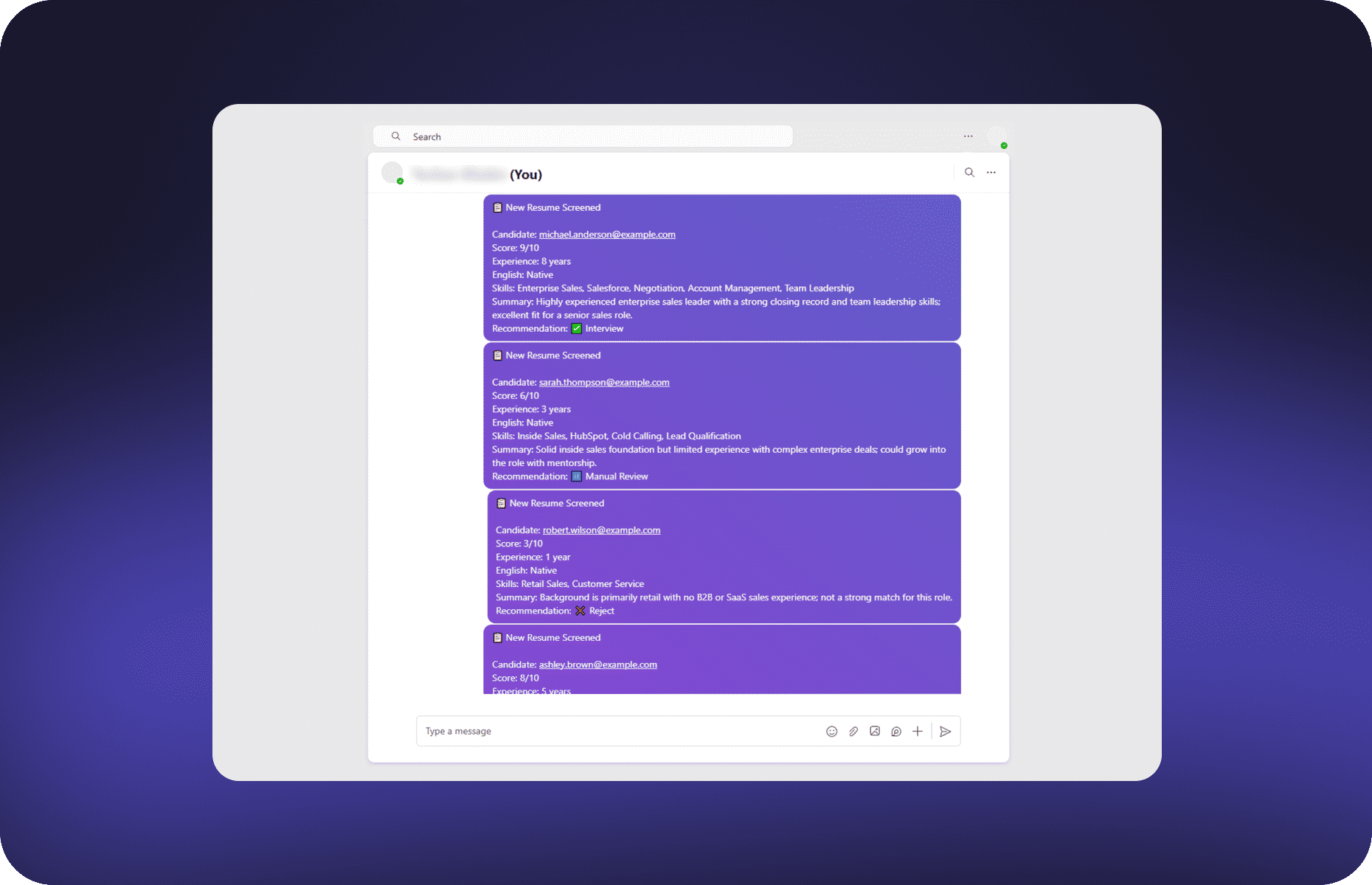
Recruiter routing and daily reporting
Each candidate summary is routed to the recruiter who owns the vacancy. Every decision is logged centrally, and a daily report groups screening activity by recruiter and by vacancy for hiring leads. These capabilities come directly from the implemented workflow described in the project questionnaire.
The 2-week live pilot showed that the workflow could remove a meaningful amount of repetitive first-stage screening work while giving recruiters more visibility into how decisions were made.
✅ Up to 25 recruiter hours returned per 2 weeks
Around 300 profiles passed through the workflow during the pilot.
Based on the documented screening baseline, the solution returned up to 25 hours of recruiter time over 2 weeks, equivalent to roughly 13 hours per week at the observed inbound volume.
✅ 100% of inbound candidates receive a reasoned assessment
Every inbound profile now receives a structured evaluation rather than passing through an inconsistent manual screening process. For non-relevant candidates, the workflow also generates personalized written feedback instead of relying on a generic rejection template.
✅ Zero drop-off for previously missed inbound applications
Website applications and submissions without an attached CV now pass through the workflow instead of falling outside the standard screening process.
✅ Better visibility into screening activity
Centralized logging gives the recruitment team a retained history of AI decisions. Daily analytics also provide hiring leads with a view of screening volume by recruiter and vacancy, adding operational visibility that was previously unavailable.
✅ More consistent candidate communication
Rejected candidates receive a specific explanation tied to their background and the vacancy requirements. This gives the client a more consistent way to handle candidate communication while removing manual rejection writing from recruiters’ daily workload.
CV file formats were inconsistent
Candidates submitted CVs in different formats, including files that the screening pipeline could not reliably process.
CV language did not always match the vacancy wording
Literal matching could incorrectly reject relevant candidates when equivalent skills or experience were described differently.
Reporting needed to be immediately readable
Integrating the orchestration workflow with the reporting channel required more configuration than expected, especially around field mapping and summary readability.
Recruiters needed visibility into autonomous decisions
The recruitment team was understandably cautious about allowing the system to reject candidates without manual review during calibration.
We expanded support across common formats. Some formats remain unsupported and should be treated as a known limitation rather than a fully resolved issue.
Together with recruiters, we implemented 12 explicit matching criteria focused on semantic equivalence rather than exact wording.
We refined the integration and structured each candidate summary so recruiters could quickly review the grade, decision reason, and rationale.
Every decision includes a grade, rejection category, and written explanation, while centralized logs and daily analytics provide ongoing oversight.