About the client
ALIGNMETRIX is a tech company focused on measuring internal human alignment through structured, data-driven assessments at the individual, organizational, and systemic levels.
The platform uses the Internal Alignment Score (IAS), a cross-domain metric that measures the alignment of internal systems and provides clear insights. It enables consistent comparison across contexts while preserving longitudinal relevance and individual integrity.
The platform provides assessment results without subjective interpretation, allowing users to see the patterns behind them and how the alignment shifts over time. It helps users identify patterns over time, including connections between strain and clarity, balance and capacity, and shifts in how alignment shows up day to day.
ALIGNMETRIX is used by individuals who want to better understand themselves and by organizations that need a consistent, neutral way to observe alignment among people over time.
Business context
Most existing tools are siloed, focusing on specific aspects of measuring health and cognitive performance rather than providing a holistic view of human alignment within the unified system. In addition to individual assessment, there is now a growing demand from organizations that want to better understand team wellbeing, define performance gaps, predict risks, and support their long-term resilience.
Alignmetrix is a tool that offers a new approach to understanding human alignment through a multidimensional model that converts complex human factors into measurable, trackable data.
The client needed a working digital platform that could transform their alignment methodology into a scalable product. Therefore, the client partnered with Geniusee to build an ecosystem that could:
Deliver structured assessments to users
Analyze and visualize alignment scores
Support mobile experiences
Enable enterprise account management
Handle subscription payments and billing models
Provide analytics and operational insights for the platform owner
Solutions we implemented
The project followed an Agile Scrum delivery model with structured collaboration between the client and the engineering team. The workflow included sprint planning sessions, daily stand-ups, backlog refinement, sprint reviews and demos, and retrospectives.
In addition, our business analyst and design team conducted regular requirements discovery sessions with the founder to translate the evolving methodology into functional product features. To maintain transparency and risk awareness, the team also held monthly risk identification sessions.
Geniusee designed and built the product ecosystem from the ground up, including:
- a landing website
- admin platform and founder analytics system
- mobile applications for iOS and Android
The architecture was designed to support real-time data analysis, subscription management, and enterprise-grade security.
Key elements of the solution included:
Admin and founder analytics platform
We developed a scalable internal platform that allows the founder and administrators to manage the product and analyze performance data. The platform includes:
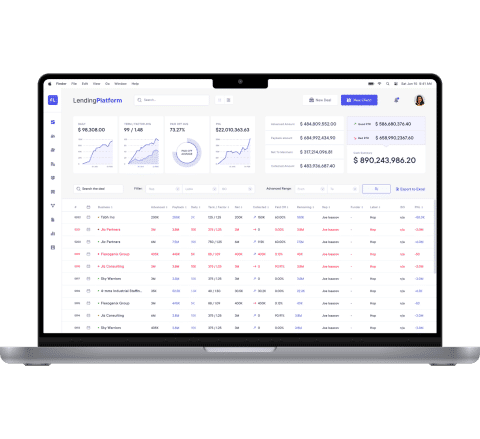
- advanced analytics dashboards
- interactive charts and data visualization
- dynamic data tables
- real-time data processing
- system monitoring and health tracking
This gives the platform owner full visibility into product performance and user activity.
Automated user subscription management system
Payments and subscription flows were integrated directly into the platform infrastructure. To support both individual and enterprise clients, the system includes:
- B2C and B2B billing models
- automated subscription management
- enterprise account management
- role-based access control (RBAC)
- real-time data fetching and caching architecture
Alignment assessment and scoring system
Mobile applications enable users to complete structured alignment assessments and track results over time. They can:
- complete the initial alignment assessment
- receive alignment scores
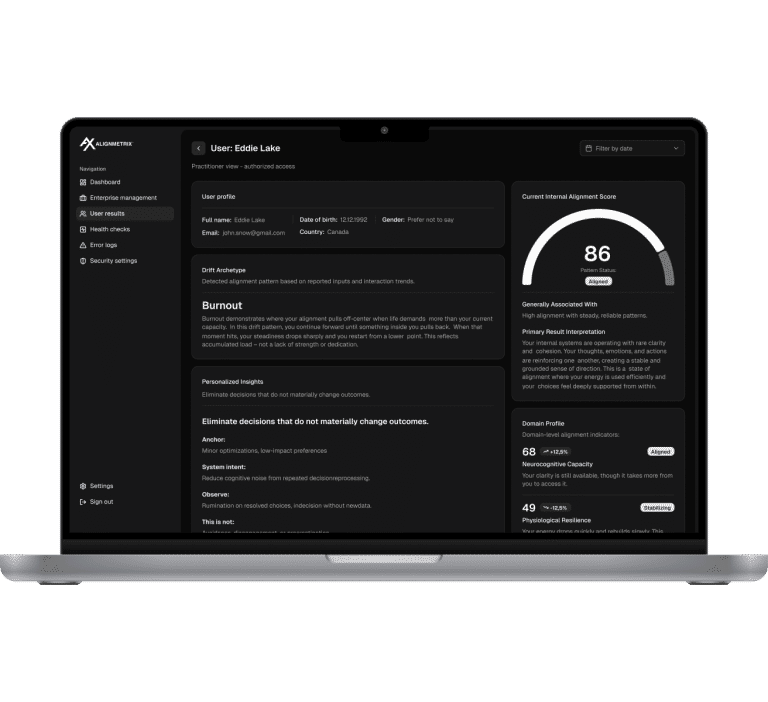
- identify drift archetypes
- track historical progress
- view analytics dashboards
The system allows users to monitor changes in their alignment state and better understand behavioral and cognitive patterns.
Security and data integrity
Since the platform processes sensitive personal and behavioral data, security was a core design principle. The system includes:
- multi-factor authentication (MFA)
- strict access control policies
- error tracking and monitoring infrastructure
- system health monitoring
- secure authentication flows
These measures ensure platform stability and protect user data.

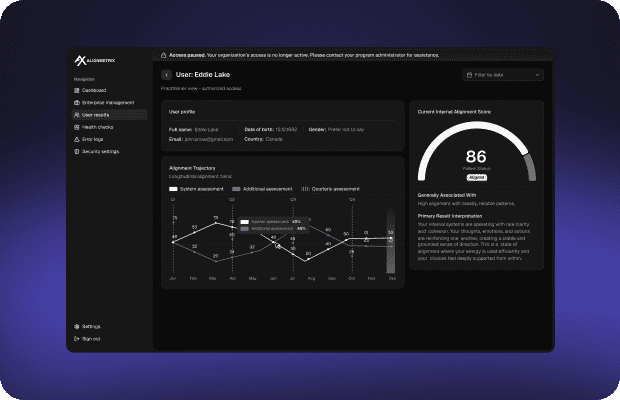
Alignment assessment
- Track historical progress over time
- Take the initial alignment assessment
- View the Internal Alignment Score
- Explore drift archetypes
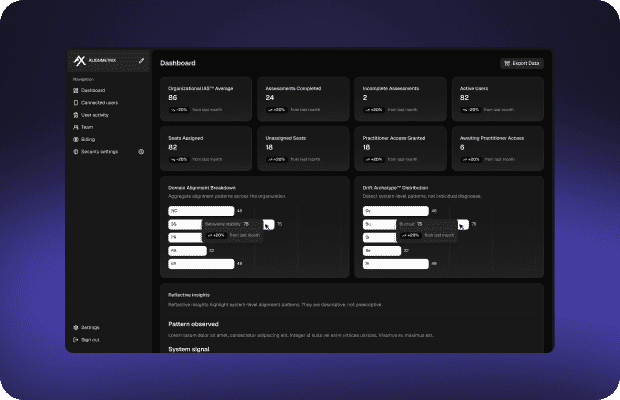
Analytics and insights
- Access dashboards with analytics
- Analyze alignment scores and progress
- Track user analytics events
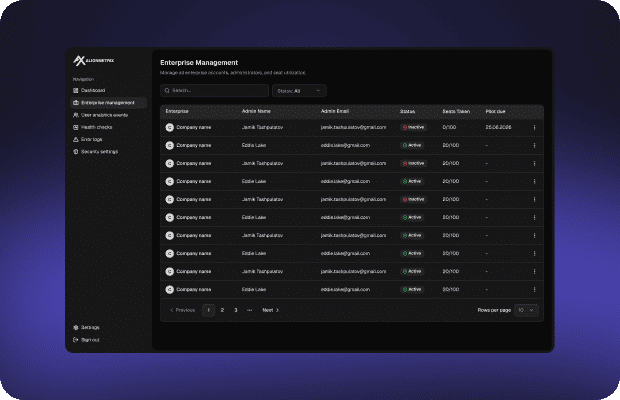
Admin and platform management
- Manage enterprise accounts
- View user results
- Monitor system health
- Rerun scoring processes when needed
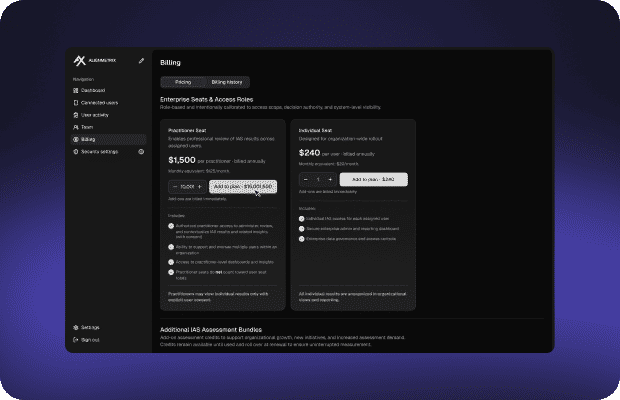
Payments and subscriptions
- Support B2C billing
- Support B2B billing
- Manage subscriptions across user types
A fully functional product ecosystem (mobile + admin platform)
A scalable backend architecture ready for growth
Structured subscription & enterprise management capabilities
.
A foundation for further product iteration and fundraising
Difficulties faced during project implementation
Challenge
The core challenge during implementation was translating a highly precise, evolving methodology into a digital product without oversimplifying its underlying logic. Because ALIGNMETRIX is built around a structured alignment model, the product required careful, founder-led refinement throughout development to preserve methodological accuracy, consistency, and integrity. This added complexity to solution design, validation, and feature implementation, as the system had to reflect a high standard of precision across assessments, scoring, analytics, and user flows.
How we resolved it
We worked closely with the founder to translate the methodology into clear product logic and implementation priorities. Regular discovery sessions, iterative validation, and structured sprint planning helped the team refine features without compromising the model’s integrity. This approach allowed us to build a platform that stays aligned with the underlying methodology while maintaining delivery discipline, system stability, and product scalability.