

Professionals waste hours daily on repetitive work on browsers: checking competitor prices, product specifications, finding technical libraries in a niche, or restarting the same workflow to identify bugs. Such operations involve continuous switching of tabs, typing, and re-typing.
This cannot be addressed using traditional tools such as Google, which only give links but not actions. They do not filter duplicate content and even perform steps on your behalf. If you do a repetitive task weekly or even daily, the process quickly becomes inefficient. And this is where browser-based agents come in.
But what, what would happen if it did not only present information to you, but also performed it reliably, securely, and intelligently?
Key takeaways
- Browser-based agents are light AI tools in a web browser.
- Perplexity and similar tools already perform persistent web analytics in the background, providing automated research updated in real time. It’s a good example of sustained, agentic browsing.
- They use web automation and large language models (LLMs) to communicate with websites and online applications.
- 2026 is the confirmed breakthrough year for browser-based agents, driven by enterprise-ready solutions now in full production: Amazon Bedrock AgentCore, OpenAI Atlas, Perplexity Comet, and Google Chrome Auto Browse.
- The open-source ecosystem has exploded: Browser Use reached 78K GitHub stars in months, and MCP (Model Context Protocol) is now the industry-standard way LLMs connect to external tools, with 75+ connectors available.
- Although they are accessible and cost-efficient, data privacy, CAPTCHA, and reliability remain problematic.
Why is 2026 the breakthrough year of browser-based agents?
Automation is no longer replacing entire roles, it’s breaking work down into tasks. According to the World Economic Forum, 23% of existing jobs will change by 2027, driven largely by task redistribution rather than full job elimination. Between 2025 and 2030, automation is expected to displace around 5 million more roles than it creates, forcing organizations to redesign workflows instead of job titles.
Besides, NVIDIA’s State of AI Report (March 2026) found that 44% of companies were already deploying or assessing AI agents, with experimentation having transitioned into full-scale production deployments in early 2026. The global agentic AI market, valued at $7.55 billion in 2025, is projected to reach nearly $200 billion by 2034 at a 43.8% CAGR.
Improvement of LLMs and web automation
Web automation was primarily based on scripts and macros only three years ago. They were weak, crushing every time the site updated. The current browsers have LLMs that comprehend context. They don’t just follow rules but reason, change, and justify their actions. This makes them useful to both users and companies.
The open-source ecosystem reflects this maturity. Browser Use went from zero to 78K GitHub stars in months, among the fastest-growing open-source projects ever. Crawl4AI hit 51K stars and became the default for feeding web content into LLMs. These aren’t experiments; they’re infrastructure.
A new standard for agent-to-tool connectivity
MCP (Model Context Protocol), originally created by Anthropic in November 2024, was donated to the Linux Foundation’s Agentic AI Foundation in December 2025 and is now the de facto standard way LLMs connect to external tools and data sources: with 75+ connectors already available in Claude alone. OpenAI and Google both support it. For browser-based agents, this matters: MCP is how agents reliably authenticate to and interact with enterprise SaaS, internal tools, and APIs without fragile custom glue code.
Expanding enterprise adoption
Huge corporations understand that they don’t have to automate everything. Web-based agents directly integrate with the SaaS platforms employees already use. Managers can deploy agents in a browser tab instead of asking developers to do custom workflows.
Mobility between standalone apps and in-browser ecosystems
Most of the time, employees are browsing Gmail, Salesforce, Google Drive, Notion, or HubSpot. Rather than balancing independent applications, web-based agents deliver intelligence to the workspace. The reason is that convenience is increasing adoption.
AI agents are rapidly moving from experiments to default product features. Gartner predicts that by the end of 2026, 40% of enterprise applications will include built-in, task-specific AI agents, up from less than 5% in 2025. This shift explains why browser-based agents are gaining traction faster than traditional automation tools. They align with how modern enterprise software is already evolving.
How enterprises are operationalizing browser agents
Enterprises are no longer running pilots. They are deploying browser-based agents on core platforms at production scale.
Amazon Bedrock AgentCore: from preview to full production platform
The Amazon Bedrock AgentCore uses agents in a controlled, isolated browser process, with a reasoning layer kept apart from the browser layer to minimize failure propagation. Authentication is based on temporary sessions rather than embedded credentials, and all interactions are logged and auditable.
In 2026, AWS added:
- Browser profiles (February 2026): persistent authentication state across sessions, reducing setup time from minutes to seconds for enterprise customers running hundreds of daily sessions.
- Chrome Enterprise policies and custom root CA (March 2026): 100+ configurable policies for URL filtering, kiosk-mode operations, and connecting agents to internal services like Jira and finance portals using SSL certificates.
- OS-level interaction capabilities (April 2026): mouse operations, keyboard shortcuts (including Ctrl+A, Ctrl+P), native system alerts, print dialogs, and full desktop screenshots: going beyond what Chrome DevTools Protocol alone can handle.
- Managed payment capabilities (May 2026): a preview feature enabling AI agents to autonomously pay for APIs, MCP servers, web content, and other agents: built in partnership with Coinbase and Stripe, with session-level spending limits. This unlocks agents that can, for example, purchase real-time market data mid-task or call paid APIs without manual intervention.
Epsilon (Publicis Group) has already deployed AgentCore in production, reducing campaign setup time by 30%, increasing personalization by 20%, and saving marketing teams 8 hours weekly. Ericsson uses AgentCore across their 3G/4G/5G/6G codebase, spanning millions of lines of code across thousands of subsystems.
How do web-based agents operate?
Brower agents are, in essence, artificial intelligence (AI) combined with automation. They perceive what appears on a web page, analyze it, and determine the next step.
- Core principles are based on natural language comprehension to read and automation structures to take action (e.g., click, type, extract).
- Key elements include reasoning LLMs, browser automation frameworks such as Playwright or Puppeteer, and API connectors, which facilitate more extensive integrations.
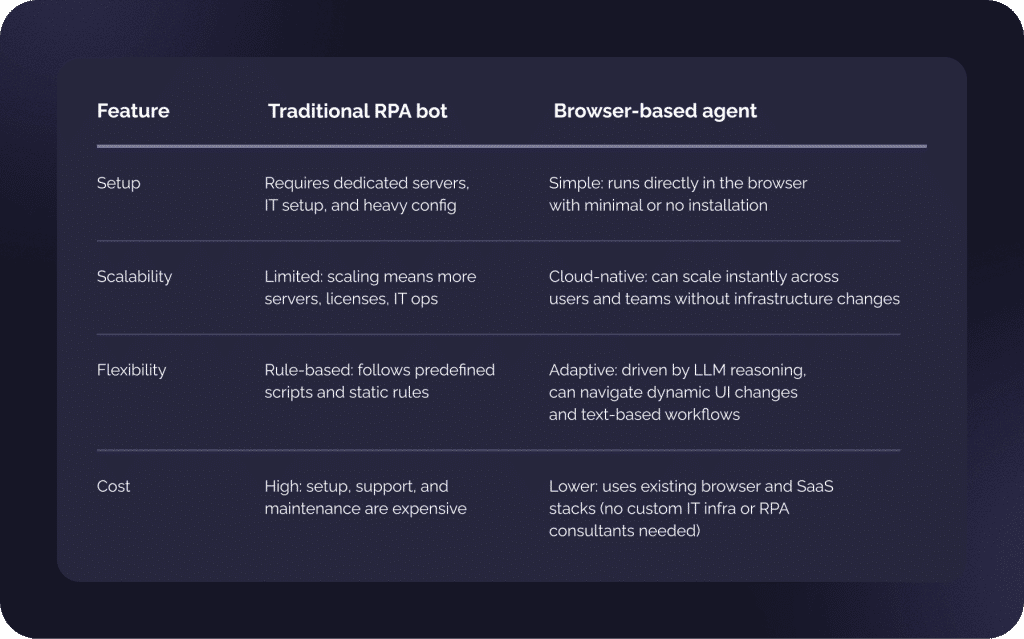
- Compared to traditional bots, RPA bots usually need servers, scripts, and lengthy installations. Browser agents exist within your browser and evolve immediately.
IDC reports a shift toward intelligent process automation (IPA), where workflows combine traditional automation with generative AI and agent-based decision-making. IDC projects the IPA software market to reach $65.3 billion by 2027, with strong acceleration visible through 2026.
The benefits of browser-based agents
Current major players include OpenAI Atlas, Amazon Bedrock AgentCore, Perplexity Comet, and BrowserAgent. All demonstrate the mainstream shift to browser-based automation.
| Feature | OpenAI Atlas | Amazon AgentCore | Perplexity Comet | BrowserAgent |
| Availability | ChatGPT Plus/Pro (macOS GA, Windows early access Mar 2026) | Enterprise (AWS, GA) | Free (was $200/month until Oct 2025); iOS, Android, macOS, Windows | Extension + SaaS |
| LLM used | GPT-4o / Atlas reasoning | Amazon Titan + custom LLMs | Claude Opus 4.6 on Max tier; multi-model | Open-source + API support |
| Scalability | Auto-deploy via ChatGPT or internal API | Enterprise-scale via AWS | Cross-device, cross-platform | Works across teams via browser |
| Control & logging | Limited logging | Built-in governance, IAM, CloudWatch, full audit | Full cross-device sync; Amazon lawsuit pending on shopping automation | Full audit logs for compliance |
| Best for | Research + SaaS task automation | Enterprise workflows + teams | Consumer tasks + research; max-tier knowledge work | Mid-market automation workflows |
Easy setup
Conventional automation systems require an IT team, infrastructure, and dedicated servers. Browser agents cut through this. One can open Chrome, download an extension, and begin automating things in a few minutes. Accessibility democratizes automation. It is no longer just for large IT departments. Now, small businesses and individual professionals can also access it.
Scalability and web apps integration
There are dozens of SaaS tools that modern businesses rely on. A browser agent will be able to access Salesforce, HubSpot, Shopify, and Google Workspace directly in a tab. You don’t need additional integration efforts. This allows companies to easily scale automation across teams, even where each team uses different applications.
The same scaling logic already exists in physical automation. According to the International Federation of Robotics, global robot installations are expected to reach ~575,000 units in 2025 and surpass 700,000 by 2028. Browser-based agents apply this proven automation mindset to digital workflows inside SaaS tools.
Economic savings and convenience
Enterprise RPA projects are expensive to implement and maintain. Browser agents cut those expenses since they use what is already available in the browser. Employees can engage with an agent through plain language, without hiring specialists. That decreases implementation costs and training time.
Security, compliance & considerations
Security is one of AI’s largest issues. Browser agents solve this by storing sensitive actions in the browser. They do not have to export the data to third-party services as they communicate with web portals. Other solutions, such as BrowserAgent, also offer compliance logging, enabling enterprises to demonstrate what the agent has done. This is a major concern in regulated industries.
Challenges and limitations
Naturally, browser-based agents are not ideal. They encounter some problems:
Browser limitations
Contemporary browsers restrict the management of automation tools with cookies and sessions. CAPTCHAs prevent automated access, and agents still can’t avoid them without human assistance. This makes certain workflows incomplete. As an example, an e-commerce agent can track the product prices but stop short at checkout.
Data privacy concerns
A crawling agent can easily retrieve personal information from Instagram or LinkedIn. This results in compliance risks under GDPR, HIPAA, or CCPA without strict controls. Companies must establish guardrails to prevent agents from overstepping their boundaries. The fact that OpenAI has a Browser Agent that crawls platforms to help users find information is clear in the screenshot. This reveals its strengths and potential dangers.
Prompt injection attacks
A newly recognized category of risk: indirect prompt injection. Security researchers have demonstrated that LLMs inside browser agents can struggle to distinguish between user instructions and malicious instructions embedded in webpage content. A widely-discussed case in 2025 showed that Perplexity Comet was vulnerable to this vector.
Even with mitigations now in place, the fundamental challenge, teaching an agent to distrust webpage content that tries to hijack its behavior, remains an active area of research. For enterprises deploying browser agents on sensitive internal systems, this is now a compliance and security design consideration, not a theoretical concern.
Consistency and error correction
Websites are dynamic. A button can be moved, a form redesigned, or content loaded in different ways. Although LLM-powered agents are more adaptive than scripts, they are not foolproof. In some cases, they need user interaction to execute a task. An example of this is the Browser Agent by OpenAI, which, in most cases, takes a while to submit multi-step forms due to the required confirmation.
Use cases across industries
E-commerce
E-commerce teams have an unlimited number of manual tasks, including competitor price tracking, stock management, and customer reviews. One practical challenge is validating large volumes of dynamically generated storefronts and campaign landing pages. In a single client project, the marketing team created hundreds of autogenic promotional websites to determine demand and traffic.
Agents continuously tested critical scenarios: whether they could actually buy the contents, end-to-end checkout flows, and whether the pages resembled the original prompts and settings.
The agent automatically identified broken or misleading flows, rather than relying on manual QA across dozens of near-identical sites. This is the same way larger traffic arbitrage platforms operate: thousands of lightweight sites are created and tested on the fly.
Finance
Browser agents are particularly useful in the financial sector when it’s not feasible to integrate systems via APIs. For one enterprise client, it was necessary to transfer critical financial data between two internal platforms that lacked third-party integration options. Manual copy-pasting was time-consuming, error-prone, and not scalable.
A lightweight browser plugin enabled an AI agent to navigate both systems visually, retrieve structured data, and transfer it reliably. The agent was also robust to UI and layout changes, making it much more stable than traditional scripting. This enabled continuous data synchronization without having to recreate legacy systems or vendor APIs.
Customer support
New internal tools or UI changes that break established workflows are frequent causes of issues for customer support teams. In our case, a browser agent was implemented as an on-screen assistant rather than retraining employees through documentation or lengthy orientation.
The agent observed the interface in real time and answered user questions such as “How do I create a ticket?” or “Where do I find escalation settings?” It guided employees step by step through the actual system. This minimized onboarding and enabled teams to adjust to new or modified platforms (without slackening operations).
Marketing & sales
Innovative uses of browser-based agents are being applied beyond lead scraping. In one project, an automated outreach and aggregation tool was developed to market to and acquire customers. In healthcare, we independently developed an aggregation platform. It compared services across providers, e.g., which offered CT scans, which accepted payment, and how they charged.
This data was continuously collected and normalized using browser agents across sites with varying structures. The outcome was a single, searchable interface for end users, enabling more informed decisions without manually researching or searching across multiple locations.
Healthcare
Healthcare organizations encounter disjointed portals, manual scheduling, and repetitive administrative processes. These gaps can be closed by enabling browser agents to communicate with patient portals, appointment systems, and insurance dashboards. They help book visits, pre-complete claim forms, and access patient data without the need for complex integrations with the system.
This reduces administrative costs and helps create sensitive workflows within regulated browser environments, which is particularly valuable in regulated healthcare facilities.
A good example from Geniusee’s own work is WayWiser — a platform that connects older adults with caregivers and family members to coordinate care and protect financial assets. The AI layer monitors transactions for fraud signals, tracks medication and daily patterns to flag emerging health needs, and analyzes communication to detect changes in cognitive wellbeing. Caregivers get smart reminders based on the senior’s habits and their own availability — less admin, more actual care.
It’s built on AWS, React Native, and Node.js, and is live on both the App Store and Google Play. A real case of AI reducing friction in a high-stakes, regulated environment — which is exactly where browser-based automation earns its place.
Education and LMS adoption
Browser agents have a growing role in learning management systems. When institutions deploy new platforms — or update existing ones — teachers and administrators face a steep adaptation curve. Rather than running retraining sessions, browser agents can serve as real-time in-platform guides: helping educators navigate grading tools, submit assignments, manage attendance, or access analytics within the interface they’re already using.
Geniusee has direct experience here. Across projects, including MyTutor, our interactive e-learning platform builds, and custom virtual classroom software, we’ve seen firsthand how adoption friction inside LMS environments costs institutions time and money. Browser agents are a natural layer on top of these systems — one that eliminates the gap between a platform’s capability and a user’s confidence in it.
General productivity
At the individual level, the browser agents can manage daily processes: arranging appointments, inbox, or subscriptions to SaaS. For example, a person can automatically sort incoming email by urgency, draft replies, and block time for focused work.
Real-world cases
Several tools are already proving the value of browser-based agents:
Rewind AI
This agent tracks every user action in the browser and can be searched immediately. Imagine losing a document or forgetting a step in a workflow. Rewind AI enables users to quickly rewind their online activity, find what they need, and return to work. It’s beneficial for designers, analysts, and content creators who open multiple tabs at once.
WebPilot
WebPilot is a research assistant that summarizes web pages, analyzes content, and can even respond to forms. It helps marketing teams to extract insights about competitor websites and allows content creators to find information quickly. And all that without copy and paste from dozens of websites.
Perplexity Comet
Comet evolved from a $200/month premium product to fully free in October 2025, dramatically expanding its user base. Now available across iOS, Android, macOS, and Windows, it’s the furthest-along consumer browser agent in terms of cross-platform reach. However, it carries a notable legal footnote: Amazon launched the first-ever lawsuit against an agentic browser in January 2026, challenging Comet’s automated shopping capabilities. The case is ongoing and will likely shape the regulatory framing for all browser-based agents.
Opera Neon
Opera was the first major browser to ship a native agentic feature (Browser Operator, March 2025), then rebuilt the concept into a standalone product: Opera Neon, launched September 2025, now at $19.90/month. Neon includes four specialized agents: Do (web automation), Make (code and content generation), ODRA (deep research), and Chat (standard assistant). As of March 2026, it added MCP Connector support, allowing Claude and ChatGPT to control the browser directly.
What’s next: AI + browser agents and where the field is heading
Several converging forces will shape the next 18 months:
- MCP as default agent infrastructure. With MCP now an open standard under the Linux Foundation, expect every major enterprise SaaS platform to expose MCP endpoints within the year. Microsoft, Salesforce, and ServiceNow’s Open MCP Agent Platform (launched May 2026) are already doing this. The agent that wins inside the enterprise will be the one with the cleanest authentication story, not the highest benchmark score.
- Google Chrome as the default agent surface. Chrome’s WebMCP early preview points toward Google eventually shipping Gemini-powered agentic mode by default in Chrome stable, likely Chrome 150 or 152 in late 2026. When that lands, the available user base for browser-agent interactions effectively doubles overnight.
- Agentic payments. Amazon’s May 2026 preview of managed payment capabilities for AgentCore, enabling agents to transact autonomously with spending limits, represents a qualitative shift. Agents that can pay for what they need mid-task are no longer just automation tools; they are autonomous participants in digital commerce.
- Enterprise governance tooling maturing. AgentCore Evaluations (GA March 2026), AgentCore Policy (GA March 2026), and the AWS Agent Registry (preview April 2026) signal that the infrastructure layer around agents — observability, compliance, lifecycle management — is now a first-class product concern, not a custom-build problem.
For organizations still evaluating whether to start, the window for low-stakes experimentation is narrowing. The teams deploying now are building operational knowledge that will be difficult to replicate once these tools are embedded as the default enterprise infrastructure.
Conclusion
Browser-based agents address a pain point that most professionals recognize immediately: manual, repetitive digital work. They reduce costs, scale across industries, and unlock productivity that lives directly in the browser.
2026 is the year early movers are building competitive separation. The infrastructure is production-ready. The major platforms have shipped. The open standards are in place. Begin with a contained use case, automate research or reporting, then move to enterprise workflows. The organizations that move deliberately now will be more efficient and more competitive by 2027.
We support businesses in discovering and implementing AI solutions at Geniusee, such as browser-based agents. Our team guarantees security, compliance, and tangible outcomes from the proof of concept through to implementation in your company.
If you would like to change your workflow using browser-based agents, contact us today!
How do browser-based agents make decisions on what to do next?
Their prediction of the next logical step is based on a combination of visual page perception and LLM reasoning. They don’t follow strict scripts — instead, they analyze the page and select the most effective action. This helps them adapt even when layouts or elements change.
Do browser-based agents need constant supervision?
Most operations are automated, but specific workflows — particularly those involving sensitive actions or payment — benefit from human approval steps. Guardrails allow companies to decide when human oversight is required, balancing automation, control, and security.
Are browser agents mobile-friendly?
Support varies. Perplexity Comet is now available on iOS, Android, macOS, and Windows — the fullest cross-platform reach of any current browser agent. Other agents still perform best in desktop environments for complex multi-tab automation.
What are the security risks of browser-based agents?
Beyond standard concerns like CAPTCHA handling and data privacy, prompt injection has emerged as a distinct threat in 2025–2026. Malicious instructions embedded in webpage content can hijack an agent’s behavior if the system doesn’t properly distinguish between user instructions and page content. Enterprises should require agents that implement clear sandboxing, explicit action logging, and user confirmation for high-stakes operations.
How is Geniusee involved in browser-based agent development?
Geniusee has delivered browser agent implementations across e-commerce, finance, healthcare, and education sectors — including an automated storefront QA agent, a cross-platform financial data transfer tool, and real-time LMS user guides. As an AWS Advanced Tier Service Partner, we also build on Amazon Bedrock AgentCore for enterprise-grade deployments. Contact us to discuss your specific use case.