
If you’re managing inventory across multiple locations, you’ve likely felt the pressure of stockouts that kill revenue, overstocking that ties up capital, and planning teams drowning in spreadsheets. AI inventory management software solves exactly these problems by shifting your operations from reactive to predictive.
In this article, you’ll learn:
- How AI is applied across core inventory challenges
- Which AI technologies power modern inventory systems
- How demand forecasting, automated replenishment, and stockout prediction work in practice
- What a real-world implementation looks like — and what pitfalls to avoid.
How AI transforms inventory management
Conventional rule-based and enterprise resource planning (ERP)-only inventory systems rely on fixed reorder points, constant lead times, and manual adjustments. These systems respond to existing events rather than anticipate future ones — and they simply don’t keep up with changes in demand.
This is a radical change from the shape of AI inventory management software, which drops in an overlay for control atop your existing WMS (warehouse management system), ERP platforms, and supply chain tools. AI models do not apply rigid rules — they look at past trends, current indicators, and contextual factors (e.g., weather) to forecast demand, reorder stock levels efficiently, or trigger automated responses.
Machine learning (ML), deep learning, computer vision, natural language processing (NLP), and reinforcement learning are opening new possibilities that were once unimaginable. Analysts predict the global AI-in-inventory-management market will reach $24.96 billion in 2029, growing at a remarkable 27.2% compound annual growth rate (CAGR). Achieving that kind of impact requires clean data infrastructure, seamless integration, and consistent model retraining for reliable, long-term results.
AI solutions to core inventory management problems
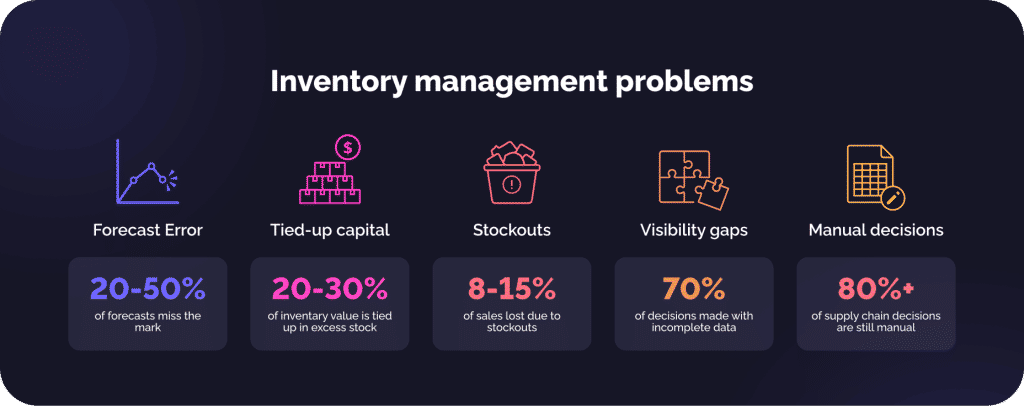
Forecast error and demand volatility
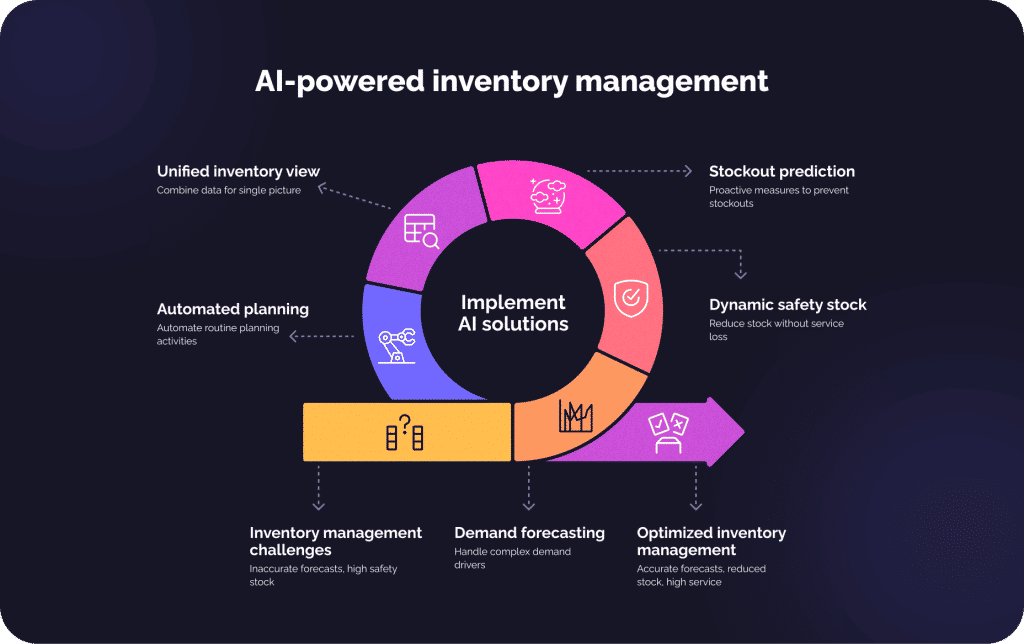
Demand is rarely a straight line. Seasonal changes, promotional bursts, competitor activity, and external influences create volatility that traditional forecasting tools struggle to model. AI handles a large number of demand drivers simultaneously and identifies complex interactions among price variations, marketing campaigns, weather patterns, and economic indicators.
Unnecessary safety stock and free working capital
Safety stock in companies mitigates demand uncertainty and supplier delays. Without proper demand forecasting, planners will overcompensate and tie up millions in stock. AI determines dynamic safety stock levels based on the actual demand variability and supplier performance patterns. An average 15-20% decrease in safety stock liberates working capital without a reduction in service levels.
Stockouts and service-level failures
AI applications can forecast days or weeks of a stockout before it occurs based on demand patterns, on-hand inventory, and inbound shipments. They can be warned early and then take proactive measures, such as issuing urgent orders or transferring stock.
Lack of inventory visibility
Multi-location operations struggle with fragmented inventory information. AI combines information from the WMS, transportation systems, and IoT sensors to provide a single inventory picture. Machine learning algorithms are used to predict stock movements between locations to match availability and demand.
Spreadsheet-based decision-making
Inventory planners waste hours updating spreadsheets and reconciling data across systems. AI automates routine planning activities, such as computing reorder points, order quantities, and handling exceptions.
AI technologies used in inventory management
Machine Learning (ML) & auto ML
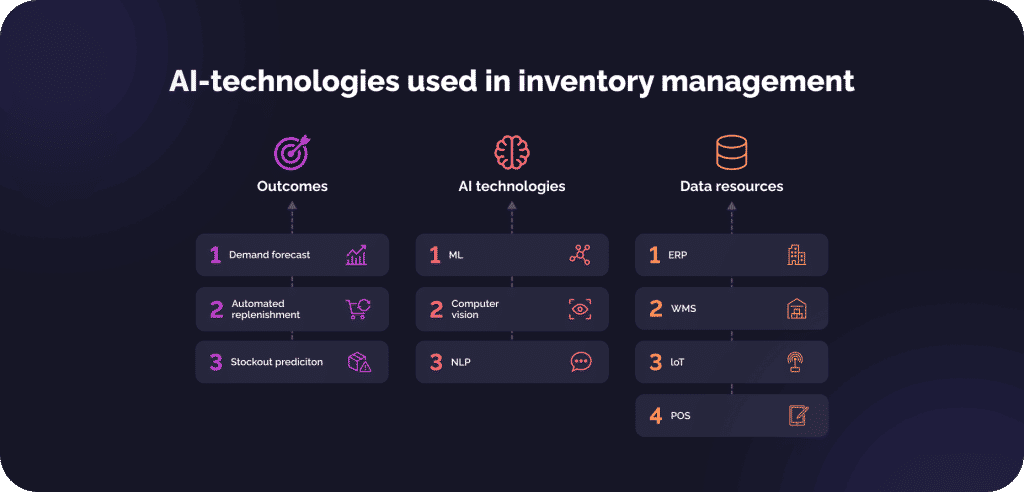
The inventory systems powered by AI rely on machine learning. Supervised learning models study historical sales, advertising, and other external factors to predict future demand and determine the most appropriate stock levels. Trends and seasonality are provided by the time-series forecasting models, including ARIMA, Prophet, and seasonal decomposition.
The most sophisticated algorithms, such as XGBoost, LightGBM, and neural networks, can be used to detect nonlinear interactions between demand drivers. It’s possible to predict SKU-level demand using a combination of weather, competitor pricing, and marketing campaigns.
Enterprises’ AutoML systems make it easier to deploy the same: AWS SageMaker Autopilot allows one to create time-series predictions with DeepAR, and GCP Vertex AI and Azure ML have similar automated systems for demand prediction. These solutions reduce the time from data to insight and ensure high accuracy.
Computer vision
Computer vision is changing how warehouses and stores track inventory. Cameras or moving robots capture images of shelves and storage locations, and AI algorithms count products, identify misplacements, and flag discrepancies in real time. Solutions such as AWS Rekognition, Ultralytics YOLO, and AutoML CV offer pre-trained or customized models that can be directly integrated with WMS systems and eliminate manual counting and auditing cycles.
Natural Language Processing (NLP)
NLP systems extract structured data from unstructured sources, such as email communications, PDFs, chat messages, and social media. This helps identify delayed deliveries, order variations, or early signals of demand shifts from customer feedback.
Solutions such as AWS Comprehend, AWS Bedrock, GCP Natural Language API, and Azure Cognitive Services can parse text, classify documents, and extract critical inventory details to help plan early, before problems manifest in sales data.
Critical AI applications in inventory management
AI-based demand forecasting
Demand forecasting has become such a sophisticated practice in the modern world. Whereas a traditional AI system uses a single historical trend, today’s underlying technology takes in dozens at once, including competitors’ price elasticity and even promotional sales history. In addition, you factor in external forces that could affect future behavior, such as weather patterns and economic indicators (more on this below), social media trends, and upcoming events.
The AI models assess how strongly each of these factors drives demand for specific products across geographies and assign a live weight based on real-world outcomes. This results in an agile forecasting engine that can be used for both short-lead-time (days/weeks) replenishment decisions and long-lead-time capacity planning spanning months or quarters.
Inventory optimization
With greater clarity into demand, AI can continuously adjust stock levels to balance carrying costs and stock-outs. Reorder points will be adjusted when demand patterns or supplier lead times change. Safety stock levels are automatically calculated based on forecast accuracy and consumption variability, optimizing the safety margin without over-inventory. These features work hand in hand to ensure your organization won’t have to compromise on service levels, avoid excess waste, or incur unnecessary operational costs.
Automated replenishment
When inventory positions get below optimum reorder levels, AI systems automatically generate a purchase order. The system considers supplier lead times, minimum orders, shipment restrictions, and storage. It also tracks suppliers’ actual performance and adjusts safety stock accordingly — creating resilience in your replenishment process.
Stockout and overstock prediction
By leveraging trends in inventory, inbound shipments, and demand forecasts, AI models can anticipate risks days or weeks before they occur. It then recommends certain steps: expedite a shipment, transfer stock from one warehouse to another, change the production plan, or apply a markdown to move the items through the system.
Multi-location Inventory balancing
AI optimizes stock distribution in warehouses, stores, and distribution centers. The system identifies the most advantageous opportunities for earning from stock transfers, based on the costs of holding and transporting the stock, and on anticipated sales at each location. This continual balancing maintains stock levels where they’re needed.
AI in warehouse inventory operations
Walmart is setting the standard for AI in retail worldwide: by 2026, the retail giant predicts that entirely automated distribution hubs will service 60% of its outlets. In addition to these macro-trends, AI is changing specific processes in the warehouse by:
Geniusee case: Nimble AI warehouse automation
Geniusee partnered with Nimble AI — a robotic 3PL powering autonomous warehouse fulfillment — to build the data infrastructure behind their AI-driven operations. The engagement centered on a robust data pipeline that aggregated delivery and operational data from multiple fulfillment services into a single source of truth. Powered by AI-enabled monitoring and analytics, the solution enabled real-time inventory tracking across Nimble’s warehouse network, anomaly detection for operational exceptions, and forecasting predictive analytics models to enhance demand planning.
The outcome: Nimble centralized its data operations, increased warehouse efficiency, and reduced operating costs by 3x. This project illustrates exactly how the combination of automated robotics and a well-engineered AI data layer turns a warehouse from a labor-dependent operation into a responsive, self-optimizing system.
Real-time inventory tracking
RFID tags, weight sensors, and location beacons produce continuous information on inventory movements. This sensor data is combined with WMS transaction data in AI systems to monitor inventory in real time, identify discrepancies as they occur, and allow hourly inventory accuracy measures.
Computer vision for counting and audits
Mobile robots or drones with cameras drive through a warehouse aisle, taking photos of storage spaces. Computer vision models detect products, quantities, and comparisons with system records.
Slotting and space optimization
AI examines pick frequency, product size, co-picking pattern, etc., and proposes the most effective storage allocation. Fast-moving products are placed in easy-to-retrieve locations close to packing stations.
Data architecture and integration
Data sources
AI-powered inventory systems use multiple data sources to make accurate, timely decisions. These systems are designed to integrate data from various internal systems, including ERP, warehouse management, point-of-sale systems, IoT devices, and supplier portals, rather than relying on a single system. Meanwhile, they combine external data sources that affect demand and supply, such as weather forecasts, economic indicators, event calendars, and social media trends. AI combines operational data with context, giving it a big-picture view of inventory dynamics that traditional tools can’t match.
Data quality and preprocessing
But raw data is not always available for immediate incorporation. However, to yield meaningful results, information must be carefully cleaned, standardized, and prepared before it is used in AI models. This process involves consolidating disparate formats, resolving naming issues, and imputing missing values using suitable methods. Anomalies, or outliers, that might bias the prediction must be detected and accounted for so that the model learns from patterns, not anomalies. In reality, the pre-processing step can take up 60-80% of the total implementation, and it is this that determines the success and effectiveness of the entire AI solution.
System integration
Contemporary integration relies on the REST APIs to communicate between systems. Middleware platforms coordinate data flows, perform authentications, and handle error recovery.
The trade-off in architecture is between meeting real-time requirements and managing costs. To achieve real-time performance, you need simpler algorithms. At the same time, the latter uses deep learning models in batch processes, which achieve higher accuracy.
AI models: training, deployment, and maintenance
Model training
To capture seasonal trends, demand forecasting models require 2-3 years of past sales records. The feature engineering takes inputs and transforms them into predictive features: lag features, rolling statistics, trend features, promotional flags, and holiday effects.
Therefore, in 2021, Amazon created an internal dataset that was thoroughly tested. After trying several combinations of data sources, the team found the model that, when refined, consistently achieved their desired 95% accuracy.
Model deployment
Cloud implementation provides scalability and controlled infrastructure. On-premises deployment is data-sovereign and offers reduced latency. A common strategy is to use hybrid solutions:
- training in the cloud with computational power
- and on-premise inference with low latency.
Continuous learning and model retraining
AI models degrade under changing conditions. Drift-detection algorithms control the model’s performance and indicate when it becomes inaccurate. New data is also used to update the models through regular retraining schedules (monthly or quarterly).
Explainability and trust in AI inventory decisions
Explainable AI (XAI) for inventory planning
XAI tools such as SHAP illustrate the contribution of each input feature to predictions and can therefore demonstrate the impact of promotional activity, seasonality, and trends on forecasts. This visibility is beneficial for making recommendations, as planners can notice when models are fallacious.
Human-in-the-loop decision models
AI automatically manages the routine replenishment of 80-90% of SKUs. Exceptions, new products, or unusual demand patterns are directed to planners. This is a hybrid solution that leverages AI efficiency while leaving complex decisions to humans.
Auditability and decision traceability
All predictions, recommendations, and actions provided by AI are tied to a specific time and associated data. This auditability will meet compliance requirements and assist with root cause analysis if the outcomes are not as expected.
Security, compliance, and risk considerations
Data security and access control
The AI systems introduce role-based access control, which restricts the audience of forecasts or access to supplier information. Information is safeguarded through data encryption. Regular security audits detect vulnerabilities before they are exploited.
Model bias and data leakage risks
Biased training data results in biased predictions. When historical demand records include times of stockout, models underestimate demand. Strict train-test splits and temporal validation eliminate data leakage when training data has accidentally captured future information.
Operational and regulatory compliance
Industries like pharmaceuticals have very rigid inventory-tracking requirements. Regulations such as 21 CFR Part 11 mandate validated software, audit trails, and regular compliance reviews, which AI systems must adhere to.
Real-world case: Walmart’s AI-driven inventory transformation
One of the clearest examples of AI delivering tangible results in inventory management comes from retail giant Walmart. Instead of relying only on manual planning and historical patterns, Walmart has deployed machine learning and predictive analytics across its supply chain to support real-time demand forecasting and inventory optimization. Walmart’s use of AI isn’t limited to demand prediction, its global supply chain now leverages automation and intelligent systems to reroute inventory, improve replenishment velocity, and optimize fulfillment processes across regions from Costa Rica to Canada. These technologies turn real-time data into actionable decisions, reducing waste and minimizing the need for manual intervention by associates.
Through AI-driven demand forecasting, Walmart lowered stockouts by 30%, reduced surplus inventory by 20–25%, and significantly improved forecast accuracy. Walmart’s experience demonstrates that AI is more than a technical experiment: when integrated into existing operations with clean data and intelligent models, it can unlock measurable benefits in cost, efficiency, and customer satisfaction — turning inventory challenges into a competitive advantage.
Business impact and KPIs
Reduction in inventory turnover and carrying cost
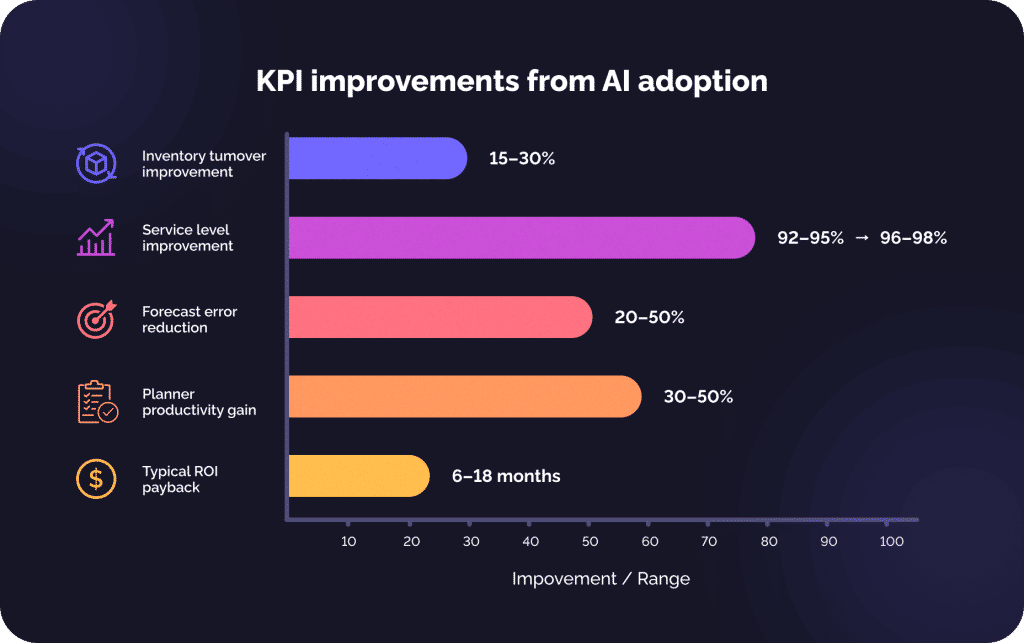
Reducing safety stock and improving ordering accuracy can increase inventory turnover by 15-30% with AI optimization. A company with 50 million in inventory and a 20% yearly carrying cost will save 2 million/year by reducing its inventory by 20%.
Service level and fill rate improvements
AI demand forecasting reduces stockouts, improving service levels from typical baselines of 92-95% to 96-98%. In e-commerce and retail, each percentage-point improvement in availability drives measurable revenue gains.
Forecast accuracy and planning efficiency
To McKinsey, an AI-powered demand forecasting system is the key to addressing global supply chain complexities. According to their reports, AI has the potential to reduce forecast errors by 20-50%, thereby reducing lost sales by up to 65%. Planner productivity improves 30-50% as automation handles routine forecasting and replenishment tasks. You can explore the broader business implications of AI in our enterprise AI development overview.
ROI measurement for AI inventory initiatives
AI investment ROI combines direct savings and revenue gains against implementation costs:
- Direct benefits: Working capital reduction, carrying cost savings, reduced expediting costs, lower obsolescence
- Revenue benefits: Increased sales from better availability
- Typical payback: 6-18 months for mid-size to enterprise deployments
Common pitfalls and limitations
Poor data quality expectations
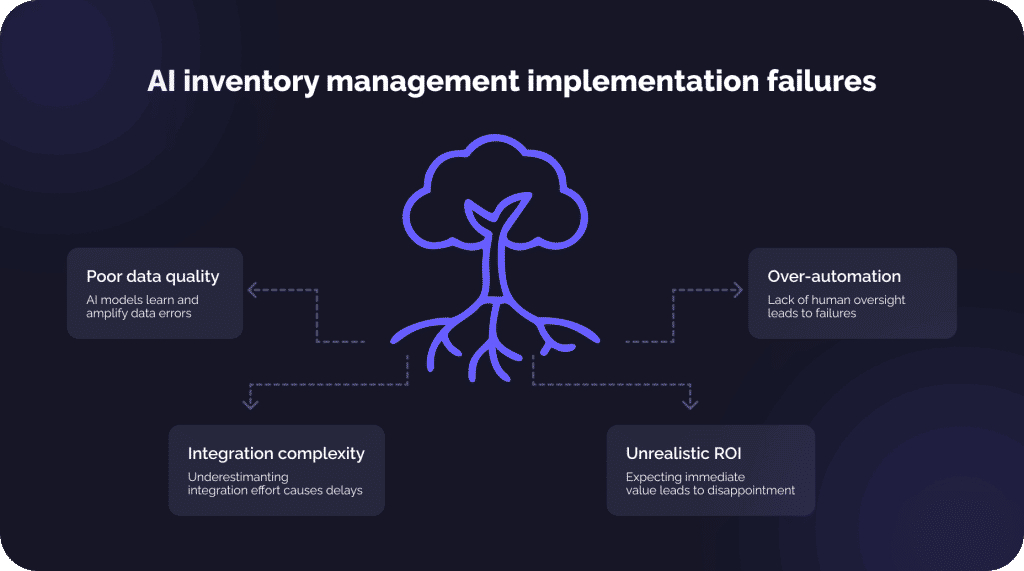
AI models amplify data problems. If sales data contains errors, location misclassifications, or incomplete transaction records, models learn these errors. Organizations underestimate the data cleanup effort required before AI delivers value. Successful implementations invest 6-12 months in data quality improvement before expecting production-ready models.
Over-automation without human oversight
Fully automated decisions seem appealing, but create risk. Models occasionally produce nonsensical recommendations due to data anomalies or edge cases. Organizations that automate everything without exception handling experience spectacular failures. Successful deployments automate standard cases while routing exceptions to human review.
Underestimating integration complexity
AI doesn’t replace existing systems; it augments them. Integration with ERP, WMS, and other enterprise software consumes 40-60% of implementation effort. Legacy systems with limited API capabilities require custom integration work. Organizations that treat integration as an afterthought face extended timelines and budget overruns.
Unrealistic ROI timelines
AI projects don’t deliver full value immediately. Models require training data, accuracy improves through iteration, and organizations need time to build trust in AI recommendations. Expecting full ROI in 3-6 months sets up disappointment. Realistic timelines show initial results at 6 months, meaningful impact at 12 months, and full value realization at 18-24 months.
Conclusion
AI inventory management software shifts inventory operations from reactive to predictive. Instead of responding to stockouts after they occur, AI-powered systems anticipate demand changes, dynamically optimize stock levels, and automate routine decisions — delivering measurable improvements in working capital efficiency, service levels, and operational costs.
The technology is mature, and the results are documented. Custom AI inventory solutions make the most sense when off-the-shelf software cannot address your specific constraints — complex supply chains, regulatory requirements, or highly specialized demand patterns.
Start by identifying your most expensive inventory problem: forecast accuracy, safety stock levels, stockout frequency, or planning efficiency. Prove value at a small scale, then expand. At Geniusee, we help companies build demand forecasting, inventory optimization, and automated replenishment systems tailored to their specific supply chains. Contact us to discuss your inventory goals and design a solution that delivers measurable ROI.
What is AI inventory management software?
AI inventory management software uses machine learning, predictive analytics, and automation to optimize stock levels, forecast demand, and automate replenishment. Unlike traditional rule-based systems, it continuously learns from real-world data — reducing stockouts, cutting excess inventory, and improving operational efficiency across your entire supply chain.
How does AI improve demand forecasting accuracy?
AI improves demand forecasting by analyzing dozens of variables simultaneously — including historical sales, promotions, competitor activity, weather, and economic indicators. According to McKinsey, AI-powered forecasting can reduce forecast errors by 20–50%, which in turn cuts lost sales by up to 65%.
How long does it take to implement AI inventory management software?
Most mid-size to enterprise deployments show initial results within 6 months and full value realization within 18–24 months. A significant portion of that timeline — often 6–12 months — goes into data quality improvement and system integration before models go into production.
What are the biggest risks when adopting AI for inventory management?
The most common risks are poor data quality, over-automation without human oversight, underestimating integration complexity, and setting unrealistic ROI timelines. Successful implementations address all four by investing in data infrastructure, maintaining human review for exceptions, planning integration as a primary workstream, and setting realistic milestones from the start.
Is AI inventory management software suitable for regulated industries?
Yes, but with additional requirements. Industries such as pharmaceuticals must ensure AI systems comply with regulations like 21 CFR Part 11, which mandates validated software, full audit trails, and regular compliance reviews. AI systems designed for these environments need built-in auditability and traceability from day one.