
If you’ve ever watched a delayed shipment cascade into a missed SLA, a compliance audit, and a frustrated client, you already understand why transportation software choices matter far beyond IT.
The top transportation software companies in 2026 aren’t just selling tracking dashboards. They’re building the operational backbone for logistics firms, fleet operators, and mobility platforms trying to scale without losing control.
This guide cuts through the vendor marketing to show you what separates strong platforms from the rest, and which companies are worth a serious conversation.
In this article, you’ll learn:
- What the transportation software market looks like in 2026
- Which criteria matter when you’re choosing a technology partner
- The key trends shaping software investment this year
- A detailed breakdown of 7 leading vendors — including honest strengths and limitations
- A comparison table to speed up your shortlisting
The state of transportation software in 2026
Transportation is no longer just about moving goods from A to B. It’s a real-time, data-intensive ecosystem — connecting fleets, warehouses, carriers, and customers through AI, IoT, and cloud infrastructure.
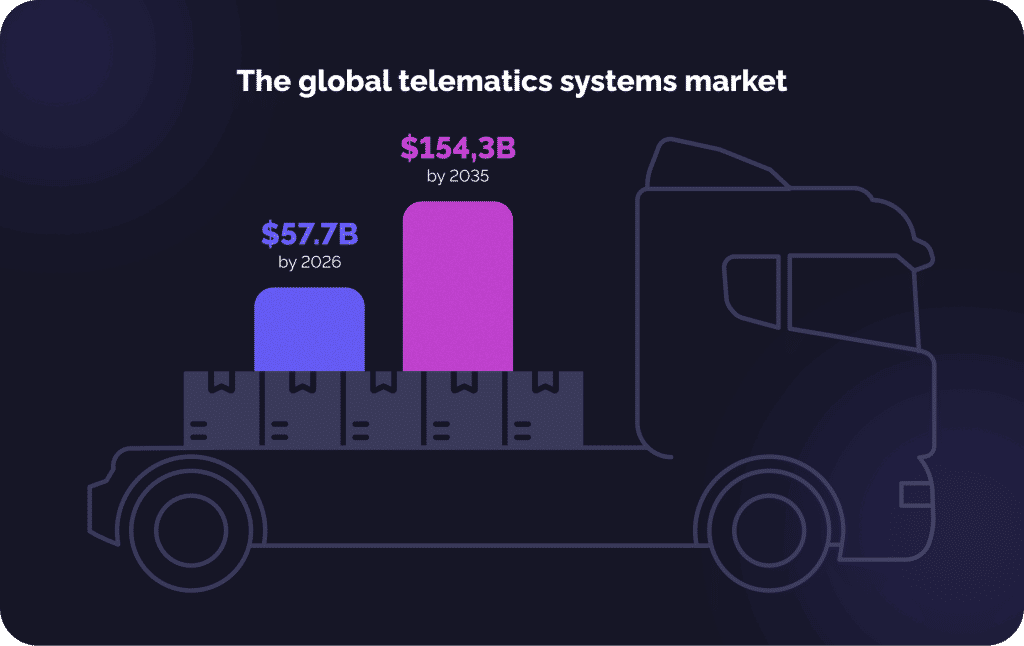
The numbers reflect the urgency. The global telematics systems market is projected to reach $57.7 billion by 2026 and $154.3 billion by 2035, according to industry research. That growth isn’t driven by feature upgrades — it’s driven by operators who can no longer afford to run blind.
Rising fuel costs, tighter regulatory requirements, and customer expectations shaped by e-commerce have pushed transportation businesses to demand more from their software: not just visibility, but prediction and automation.
If you’re evaluating transportation software right now, you’re not making a technical decision. You’re making a business one.
What to look for in a transportation software partner
The market is full of platforms promising similar things. The real question is whether a solution fits your operational model. The strongest partners understand how transportation businesses operate and build technology around those realities.
When evaluating vendors, focus on 6 areas that determine long-term ROI:
Operational fit matters more than feature count
Many transportation platforms promise extensive functionality. Unfortunately, more features do not necessarily equate to more value. When teams must adapt their tried and tested workflows to accommodate the software, it can become challenging to adopt and hinder efficiency. The right transportation solution is one that aids the existing business model, and can present opportunities for automation and optimization, where it is appropriate.
Real-time visibility should drive action
Visibility has become one of the most overused terms in transportation technology. It’s no longer sufficient to track vehicles on a map. Modern platforms enable operations teams to gain insight into the current situation, anticipate potential issues before they impact operations, and make quicker decisions when conditions shift. Real time data is only really useful if it’s used for something.
Integration capabilities are critical
Transportation businesses rarely operate from a single platform. The majority of organizations use a mix of ERP systems, warehouse management software (WMS), telematics devices, accounting software, customer portals, and internal tools. How these systems are able to be integrated can make the difference between an operation that is streamlined or another silo.
Automation should reduce workload, not add complexity
Artificial intelligence and automation are becoming standard features across transportation software. What matters isn’t whether a platform uses AI. What matters is whether it eliminates manual work. The most effective solutions automate routing, dispatching, scheduling, reporting, and planning without introducing additional operational complexity.
Scalability should support future growth
Transportation networks evolve constantly. As new customers come on board, fleets grow, new service areas expand and customers’ needs change, software systems that aren’t designed for growth can become severely constrained. The best transportation platforms ensure growth without the need for expensive migrations every 2-3 years.
Top transportation software trends in 2026
The use of technology for transportation is no longer solely a matter of innovations. It is getting more and more operational driven. In a rapidly changing environment of high fuel prices, labor scarcity, increasingly aggressive delivery expectations and increased compliance requirements, transportation organizations are finding themselves needing to modernize more rapidly than ever before.
The software sector is seeing several trends in software investments across the industry.
AI-powered operational intelligence
AI is leapfrogging over rules-based automation. Now machine learning is used by the top transportation platforms to anticipate delays, dynamically reroute vehicles in real time and optimize resources in the whole fleet in real time.
Predictive maintenance and connected fleets
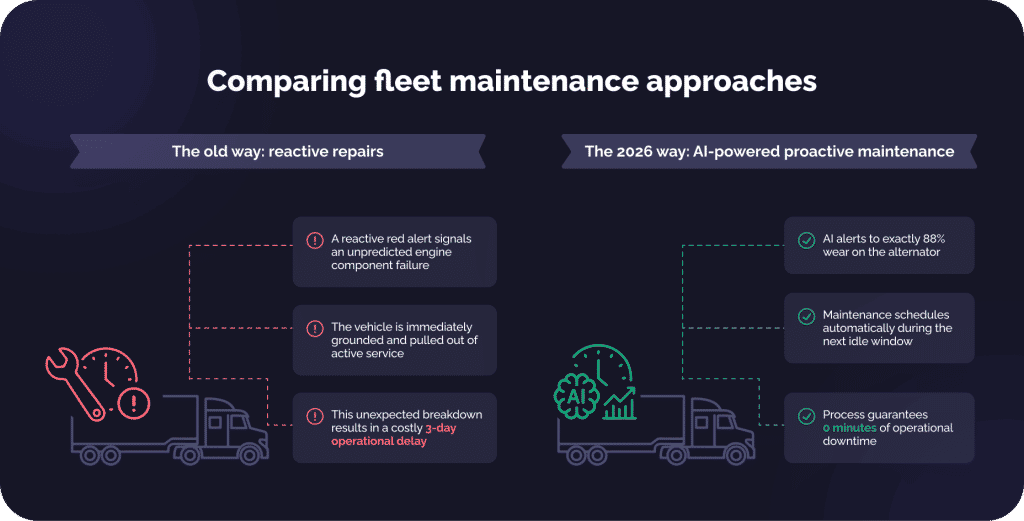
IoT sensors embedded in vehicles and infrastructure are enabling a shift from reactive maintenance to predictive models. Identifying a potential failure 2 weeks before it grounds a vehicle is the difference between a 30-minute software alert and a 3-day operational disruption.
End-to-end supply chain visibility
Transportation data is often siloed in various systems. Businesses are increasingly seeking solutions that give them a single view of the business’s transportation, warehouse, inventory, and delivery operations to seek more efficiency. Having accurate information throughout the supply chain can enable organizations to act more quickly and make better plans.
Sustainability-driven optimization
Compliance teams are not the only ones setting the agenda for environmental goals. New business metrics are being measured for fuel efficiency, route optimization, emissions tracking, and resource use. Consequently, transportation software is becoming more sophisticated with features to support organizations in tracking and enhancing their sustainability performance in addition to other operational KPIs.
Automation of operational workflows
The dispatching, load planning, and carrier communication are becoming more and more automated. It will enable teams to concentrate on strategy rather than routine operational activities.
Shift toward platform ecosystems
Rather than adopting disconnected tools, enterprises are moving toward unified transportation ecosystems that combine planning, analytics, execution, and collaboration in a single environment. Software vendors that provide integrated ecosystems are emerging as long-term strategic partners.
Top transportation software companies
Our list below identifies the best transportation software companies to help logistics and mobility businesses update operations, scale, and remain competitive in a fast-changing environment.
Geniusee
Best for: Logistics companies, transportation platforms, and organizations that need purpose-built software — not off-the-shelf compromises.
If your operations have genuinely complex requirements that generic platforms don’t address well, Geniusee is worth serious consideration.
Founded in 2017 in Kyiv, Ukraine, with engineering teams and client relationships across Europe and the U.S., Geniusee works as a strategic software development and consulting partner. The focus isn’t on selling a pre-built product — it’s on building the right one for how your business operates.
That means custom transportation management systems (TMS), cloud-based logistics platforms, AI-driven route optimization engines, and telematics dashboards designed around your workflows, not a generic template.
Geniusee holds AWS Advanced Tier Service Partner status — a designation that requires demonstrated cloud expertise and a track record of successful enterprise implementations. Combined with ISO 9001 and ISO 27001 certifications, this matters if you’re evaluating vendors for enterprise-grade infrastructure with genuine security standards.
With 200+ delivered projects across logistics, mobility, fintech, and AI-driven platforms, the team brings cross-industry pattern recognition alongside deep transportation domain knowledge. You can explore some of that work in the Geniusee portfolio.
Core strengths:
- Cloud-native and AI-ready architecture built on AWS
- Full product lifecycle support: from discovery and architecture to MVP and long-term scaling
- Transportation and logistics domain experience, including cloud migration and delivery workflow optimization
- Enterprise security via ISO-certified processes
- Engineers who function as product partners, focused on operational ROI
Industries: Transportation & Logistics, FinTech, EdTech, Retail, AI & Data-driven platforms.
Honest caveat: If you need an off-the-shelf solution deployed in 2 weeks, Geniusee isn’t the right fit. The value proposition is tailored, high-quality software — which requires an upfront investment in discovery and scoping.
Itransition
Best for: Enterprises modernizing legacy logistics systems and implementing large-scale ERP/TMS integrations.
Itransition was founded in 1998 and has grown since then to be a conventional software engineering provider into a worldwide enterprise technology partner in the support of sophisticated digital transformation efforts in all sectors.
For organizations running multi-region supply chains on aging infrastructure, the company’s depth in ERP modernization and enterprise system integration is a genuine differentiator.
Itransition doesn’t specialize exclusively in transportation, but its core strength — reconstructing legacy systems and integrating fragmented platforms into scalable cloud environments — maps well to the challenges facing large logistics operations mid-modernization.
Industries: Logistics & Supply Chain, Transportation, Retail & Distribution, Manufacturing, Enterprise IT
Trimble Transportation
Best for: Large fleet operators and logistics organizations looking for established transportation management, compliance, and fleet optimization solutions.
Trimble Transportation has been in the transportation technology market since 1978. That longevity is both its brand and its proof point: the platform has been refined through decades of real-world fleet operations, and it shows in the stability of its core features.
The Trimble ecosystem brings together fleet management, telematics, compliance solutions, fuel-efficient solutions, and electronic logging devices (ELDs) all into one platform. When the demands for compliance, process standardization, and extended vendor stability are paramount, as in the case of large-scale trucking applications, Trimble is a viable solution.
Industries: Transportation & Logistics, Trucking Fleets, Freight & Supply Chain Operations, Field Services

Intellias
Best for: Transportation and mobility companies building large-scale fleet, telematics, and automotive platforms.
Since its inception in 2002, Intellias has built a strong reputation in mobility and automotive engineering — and that domain expertise carries real weight when you’re integrating IoT with a backend infrastructure handling large volumes of operational data.
This company caters to OEMs, fleet operators, and logistics companies that work within a data-rich environment. Their core competencies are related to the development of connected vehicles, telematics systems, and logistics automation. When there is a significant automotive technology component to your transportation challenge, Intellias has depth.
Industries: Transportation & Logistics, Automotive, Mobility, Fleet Technology, Enterprise Digital Platforms
Verizon Connect
Best for: Small to mid-sized fleets seeking comprehensive features with enterprise-grade reliability and support.
Verizon Connect (formerly Fleetmatics) carries an unusual advantage: it combines the operational focus of a fleet software company with the infrastructure credibility of a major telecom provider. This translates to 99.9% uptime availability coupled with infrastructure across the globe that is built to ensure it works as intended — something of a differentiator for enterprises where even a minute of downtime costs them money.
The platform excels in workforce coordination, such as dispatching and scheduling, mobile job flows, and digital forms for field teams. For businesses like service companies with hundreds of appointments to deal with daily, it is an actual efficiency improvement.
Industries: HVAC, Plumbing, Electrical, Landscaping, Delivery Services, Property Maintenance
Mind Studios
Best for: Mid-market logistics companies and transportation startups building product-oriented platforms.
Established in 2013 as a product-oriented software development firm, Mind Studios approaches logistics software from a product design perspective — which makes them a strong partner for mid-sized companies and startups that want a purpose-built platform with strong user experience, not just a functional backend.
The company’s business centric discovery process and scalable cloud architecture support the company’s backing for TMS platforms, fleet management apps and mobile first logistics tools. Mind Studios does a great job of developing products that are high-quality and move quickly for organizations that are ROI-driven and need to be fast.
Industries: Transportation & Logistics, Fleet Operations, Delivery Platforms, Marketplace & Mobility Startups
Omnitracs
Best for: Private fleets and large carriers requiring proven reliability, advanced analytics, and mature platform stability.
Omnitracs has been operating since 1988 — they were commercializing telematics before most of the other companies on this list existed. Decades of real-world deployment by Fortune 500 organizations have produced a platform that handles operational complexity with consistency: multi-stop routes with varied service requirements, driver compensation across multiple rate structures, and mixed-freight load optimization.
For large private fleets running high volumes of daily movements, the ability to maintain operational consistency without surprises is worth more than a shiny feature roadmap.
Industries: Food Distribution, Retail Logistics, Manufacturing, Hazmat Transportation, Flatbed Trucking
Comparison table
| Company | Fleet size | Best for | Key differentiator |
| Geniusee | Custom | Custom TMS development and digital transformation | Purpose-built solutions tailored to unique operational requirements with AI-enhanced route planning |
| Itransition | 500+ | Large enterprises modernizing legacy logistics ecosystems | Expertise in ERP/TMS modernization and complex enterprise system integration |
| Trimble | 100+ | Enterprise carriers needing full TMS ecosystems | End-to-end platform from dispatch to settlement eliminates data silos |
| Intellias | 200+ | Automotive, telematics, and connected fleet platforms | Strong mobility engineering and high-load telematics architecture |
| Verizon Connect | 10-500 | Field service businesses and delivery operations | Telecom-grade reliability (99.9% uptime) backed by their infrastructure |
| Mind Studios | 50–200 | Product-oriented logistics platforms and MVP launches | UX-driven development with business-focused discovery process |
| Omnitracs | 100+ | Large private fleets and dedicated carriers | 35+ years of enterprise stability with sophisticated driver workflow and pay automation |
What is the cost of transportation software?
Simple GPS tracking costs $20-30 per vehicle per month, while full-fledged platforms with AI dash cams and compliance start at $ 40-70 per vehicle per month. Enterprise TMS solutions cost over 100 per vehicle, and the systems include comprehensive management. Project-based solutions are custom and deliver ROI by offering features that generic platforms cannot.
What’s the implementation timeline?
It becomes live on small fleets after 1-2 weeks using cloud solutions. Medium-sized operations require 3-6 weeks to complete. Enterprise systems require 3-6 months, especially for legacy migrations. Technical setup is less important than proper driver onboarding.
Does this mean that we should make or purchase off-the-shelf?
Get off-the-shelf when standard workflows suit your purposes–deploy faster, less expensive to buy. Custom build when your operations are unique, and you must work around them to achieve high cost. The break-even point is usually 100 or more special processes vehicles.
Do these systems integrate with the existing software?
Yes. Nowadays, there are pre-built connectors in SAP, Oracle, NetSuite, and QuickBooks. The quality of Check API documentation, the frequency with which data is synced, and the field mapping are more important than the number of connectors. In complex integrations, custom development will result in workflows that are not tied to processes