
Your computer systems are either working for your business or quietly working against it. An IT health check (ITHC) is how you find out which one is true — and how to close the gap before a security breach, a compliance failure, or costly downtime does it for you.
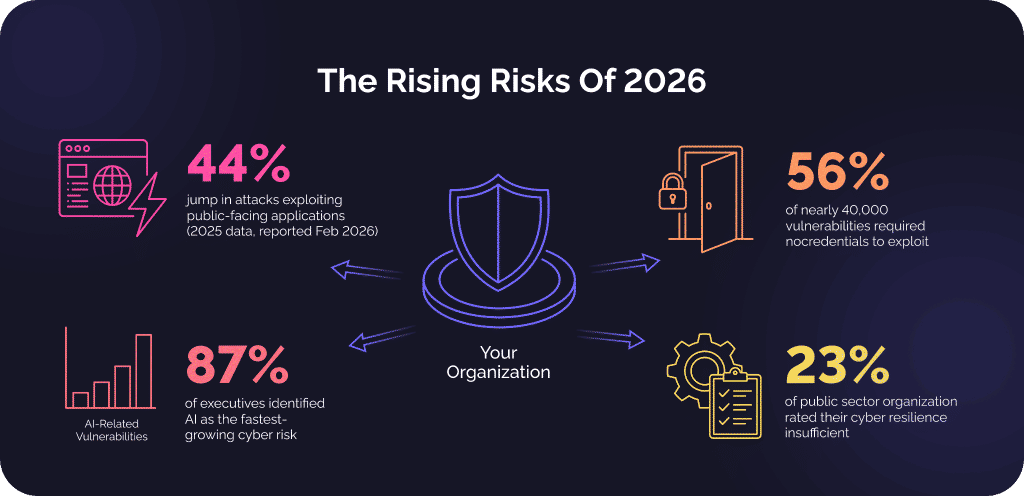
The 2026 data make the stakes hard to ignore. Companies left basic authentication controls unpatched, resulting in a 44% surge in attacks exploiting public-facing apps in 2025, according to the IBM Threat Intelligence Index (X-TI) 2026 release, published in February. Last year, 56% of the vulnerabilities tracked by X-Force required no credentials. A study by the World Economic Forum (WEF) of 804 executives from 92 countries found that 87% of respondents identified AI-related vulnerabilities as the country’s fastest-growing cyber threat, while 23% of public sector organizations felt their cyber resilience was inadequate.
That last number matters. You can’t fix what you haven’t measured. A health check is the measurement.
In this article, you will learn:
- Why the IT health check has shifted from optional to essential
- What the real costs are for organizations that skip one
- What a thorough ITHC service covers — including internal and external systems
- The concrete benefits, grounded in the current 2026 data
- How the ITHC process works for public sector organizations and PSN compliance
- How Geniusee approaches security assessments in practice
Why IT health checks matter more than ever in 2026
The environment most organizations run today looks nothing like it did five years ago. Hybrid infrastructure that mixes on-premises systems, SaaS platforms, microservices, CI/CD pipelines, and public cloud is now the norm — often without a clear, auditable picture of what connects to what, who has access, or which components haven’t been reviewed since the last team change.
IBM X-Force 2026 put it plainly: “The issues that plague organizations are not emerging threats; they reflect persistent gaps in fundamental controls.” Attackers aren’t breaking through sophisticated defenses. They’re walking through doors that were never properly locked.
Three structural pressures are making regular IT health checks a baseline requirement:
Complexity has outpaced visibility
Every new layer — a third-party supplier integration, a SaaS tool adopted by one team, an AI agent added to a workflow — creates more dependencies and more potential failure points. X-Force found that attackers increasingly target the environments where software is built and deployed rather than the end products themselves. CI/CD platforms, open-source registries, and cloud identity integrations are now prime attack surfaces.
If your organization isn’t regularly conducting a comprehensive security assessment of what’s running in its environment, it cannot effectively defend it. Our overview of common types of cybercrime shows how these entry points translate into real incidents.
The threat is faster, not just bigger
Vulnerability exploitation became the leading cause of attacks, accounting for 40% of all incidents in the IBM X-Force dataset. The WEF Global Cybersecurity Outlook 2026 reports that 94% of leaders identify AI as the most significant driver of change in cybersecurity — because AI is now accelerating both reconnaissance and exploitation at a scale no human attacker could match.
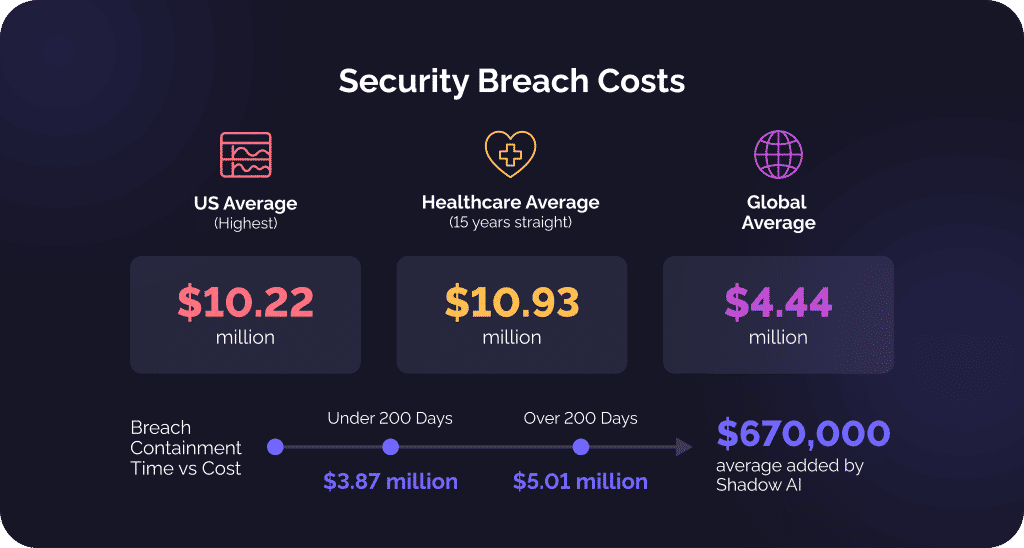
Shadow AI inside your organization creates its own risks: per the IBM Cost of a Data Breach Report 2025, shadow AI added an average of $670,000 to breach costs when involved, and 63% of breached organizations had no AI governance policies in place. These are gaps that a health check is built to surface. For more on the regulatory implications of AI adoption in business operations, see our dedicated overview.
Regulation has caught up to the risk
GDPR (General Data Protection Regulation), HIPAA (Health Insurance Portability and Accountability Act), PCI DSS (Payment Card Industry Data Security Standard), NIS2 (Network and Information Security Directive 2022), and DORA (Digital Operational Resilience Act) require documented, defensible controls. The same works for public sector organizations connecting to the Public Services Network (PSN), the NCSC CHECK, and CREST check schemes. Under NIS2, senior management can be held personally liable for inadequate cybersecurity risk management. The ITHC is how you produce that documentation — and how you stay compliant between audits, not just during them. Our article on how businesses navigate emerging technology regulation covers what this means in practice across sectors.
Who needs an ITHC, and why do public sector organizations face specific requirements
An IT health check is relevant to any organization that runs digital infrastructure and cares about uptime, data security, and compliance. But public sector organizations face a specific, mandatory version of this requirement.
Any organization that wants to access the Public Services Network (PSN) — the UK government’s secure network used to deliver public services — must conduct an ITHC as part of the PSN Code of Connection. As GOV.UK guidance states that companies must commission regular IT health checks to test their infrastructure for vulnerabilities, and that the ITHC report submitted must be no older than 12 months. This applies to central and local government bodies, NHS trusts, police forces, and any service provider supplying digital services to government clients.
The ITHC process under the PSN framework must be delivered by an approved CREST-accredited or NCSC CHECK scheme tester. These check schemes exist to ensure that individuals carrying out security assessments of government systems meet a defined standard of technical competency. For organizations handling OFFICIAL-SENSITIVE, SECRET, or TOP SECRET data, the NCSC CHECK scheme applies. For other public sector organizations seeking assurance against the PSN Code of Connection, CREST-accredited health check services are the standard route.
If the ITHC report identifies any critical or high issues, the organization must either provide evidence that these issues have been resolved or submit a Remediation Action Plan (RAP) — per the PSN compliance certificate guidance on GOV.UK — detailing how and when they will remediate them. If your organization is a service provider offering systems that provide internet services or connect to PSN infrastructure, those systems must be included in scope.
For private sector organizations, the same rigor applies even without the formal PSN mandate — because clients, partners, and regulators increasingly run their own vendor security questionnaires before signing contracts.
What happens when you skip an IT health check
If the company decides not to check IT health in time, it may lead to some problems:
Undetected security vulnerabilities — and unauthorized access
IBM X-Force 2026 found that 56% of tracked vulnerabilities could be exploited without authentication. A system that hasn’t been assessed may provide an unauthorized entry point that no one knows about. Weak network devices, misconfigured remote access configurations, exposed APIs, and unmonitored third-party connections all create paths for unauthorized access that a vulnerability scan and manual testing would surface. Without an ITHC, those paths stay open.
When credentials are involved, the damage window extends further. The Verizon 2025 DBIR (Data Breach Investigations Report) — covering 22,052 incidents and 12,195 confirmed breaches, the largest dataset in DBIR history — found that third-party involvement in breaches doubled year over year, now accounting for 30% of all cases. The median time to remediate leaked secrets discovered in a GitHub repository was 94 days. These are not exotic attack paths — they are the natural consequence of complex, unaudited environments. Understanding how to implement zero trust security is one architectural response, but the health check comes first: it tells you what needs to be hardened and where to prioritize.
Security breach and its cascading costs
The IBM Cost of a Data Breach Report 2025 puts the global average at $4.44 million per breach — down from $4.88 million the prior year, the first decline in five years, driven by AI-assisted detection. But averages obscure sector-specific reality: healthcare organizations face $10.93 million per breach (the highest of any industry for 15 consecutive years), financial services face $6.08 million, and the US average overall sits at $10.22 million — the highest of any country. Breaches contained within 200 days cost $3.87 million on average; those that run longer cost $5.01 million. Every day of dwell time adds to the final bill.
The Verizon 2025 DBIR adds a critical SMB (Small and Medium-sized Businesses) dimension: 88% of breaches at SMBs involved ransomware, compared to 39% at large enterprises. Attackers are explicitly targeting organizations with weaker incident response capabilities and slower patch cycles — exactly the profile of an organization that hasn’t run a recent health check. For more context on how financial services firms specifically manage these exposures, see our piece on continuous authentication in fintech.
Regulatory and compliance exposure
Non-compliance surfaces at the worst possible moment — during a funding round, a client audit, or an incident investigation. For PSN-connected organizations, a missing or non-compliant ITHC report means failure to meet the Code of Connection and loss of access to government networks. For NIS2-regulated organizations across the EU, it means personal executive liability. For HIPAA-covered healthcare entities, it means per-violation fines with no annual cap for willful neglect.
The WEF Global Cybersecurity Outlook 2026 found that only 64% of organizations are now actively assessing the security of AI tools they use — up from 37% the previous year, but still leaving more than a third without any formal process. Regulators are moving faster than most governance frameworks. The health check is the mechanism that keeps your documented controls aligned with what your systems are actually doing. Our AI compliance overview covers the specific frameworks now applying to AI-integrated workflows.
Costly downtime
ITIC’s 2024 Hourly Cost of Downtime Survey found that 91% of mid-size and large enterprises report one hour of downtime now costs over $300,000, with 41% reporting between $1 million and $5 million per hour. The CrowdStrike Falcon update failure in July 2024 cost the Fortune 500 a combined $5.4 billion, with individual affected companies averaging $44 million in losses, and most were uninsured, according to a Parametrix analysis.
Downtime stems from configuration issues, legacy systems, and architectural weaknesses that a health check would have flagged. Understanding how to work with legacy code is relevant to teams already carrying this debt — but the health check is what surfaces it in the first place.
Hidden costs and strategic stagnation
Unused software licenses, misconfigured cloud resources, redundant integrations, and over-provisioned network infrastructure continuously drain the budget without appearing on any risk register. And beyond cost, unaudited technical debt becomes a ceiling on what’s strategically possible. You cannot confidently adopt AI, pursue digital transformation, or integrate new platforms on top of a system you haven’t assessed. Organizations that skip this step reliably carry their old problems into their new environment. Understanding your IT department’s organizational structure and responsibilities is part of ensuring accountability doesn’t fall through the gaps during periods of change.
What an IT health check covers: the full scope
A rigorous IT health check is not a single vulnerability scan. It is a series of controlled tests and actions designed to identify vulnerabilities across your entire environment. Here is what a thorough ITHC process covers:
Infrastructure and network assessment
Server and storage performance, network devices, bandwidth and latency, cloud resource utilization, and hardware lifecycle status. For PSN-connected organizations, this includes all individual systems connecting to or adjacent to the PSN, firewall configurations at every boundary, and remote access infrastructure. GOV.UK’s Code of Connection guidance requires a properly configured firewall with appropriate rule sets at all network boundaries — the health check verifies this is genuinely in place, not just documented.
Our AWS and DevOps teams regularly use ITHC findings as the baseline for infrastructure modernization and cloud optimization projects. If you’re looking at migrating VMware workloads or reducing infrastructure licensing costs, an ITHC first establishes what you’re actually running.
External and internal systems assessment
The external assessment covers all systems that provide internet services: email servers, web servers, firewalls, remote access entry points, and inbound connections, including VPNs. The internal assessment covers your organization’s internal systems: network infrastructure, individual systems, authentication controls, data management practices, and access governance within your environment. Together, the assessment of external and internal systems produces a complete picture of your attack surface.
For PSN compliance, this dual scope is mandatory. The ITHC must show the PSN team which vulnerabilities exist across your organization’s external and internal systems, and what actions you have taken or plan to take to fix or mitigate them. For software engineering teams managing complex application estates, this scope also covers application-layer security and integration points.
Cybersecurity review and vulnerability scan
Automated tools run a vulnerability scan across your systems — identifying unpatched software, weak configurations, and exposed services. Manual penetration testing goes further, simulating how an attacker would chain those issues together to achieve unauthorized access. The tester follows agreed rules of engagement throughout, with scope and approach documented before any testing begins.
IBM X-Force 2026 confirms authentication misconfigurations remain the most exploited category — and they are among the most straightforward to remediate once identified. Our penetration testing guide covers how the two practices — broad health check and targeted pen test — complement each other. For mobile application security, the same principles apply: both layers are needed for comprehensive assurance.
Compliance and governance review
Mapping current controls against the frameworks relevant to your organization: GDPR, HIPAA, PCI DSS, NIS2, DORA, the PSN Code of Connection, or NCSC guidance, depending on your sector. This includes data security policies, encryption standards, logging and monitoring readiness, audit trail completeness, and AI governance posture.
Per the IBM Cost of a Data Breach Report 2025, 20% of studied breaches involved shadow AI, and 97% of organizations experiencing AI-related incidents lacked proper access controls. A health check establishes which AI tools are running, whether they’re sanctioned, and whether appropriate controls are in place. For edtech platforms and LMS deployments handling student data, this intersects directly with FERPA (Family Educational Rights and Privacy Act), GDPR, and sector-specific accreditation requirements.
Software, application, and data management review
License and version compliance, application performance benchmarking, integration health between platforms, and identification of shadow IT. Data management is also in scope: how data is stored, classified, retained, and disposed of — and whether those practices meet what your stakeholders, regulators, and accreditation bodies require. Organizations that automate data pipelines without formal governance often encounter issues. Our MLOps practices overview covers how to build governable, auditable data workflows from the ground up.
Operational processes and IT governance
Incident response procedures, change management practices, vendor and third-party supplier oversight, and staff training adequacy. The Verizon 2025 DBIR found third-party involvement in breaches doubled to 30% of all cases — making supplier oversight a primary part of any ITHC. Rules of engagement for every test, scope agreements with the tester, and clear documentation of what is and is not in scope are all part of a professionally run ITHC process.
For fintech organizations operating under DORA, incident response and third-party risk management are now explicit regulatory requirements — not just best practices. The health check is where you verify your processes are actually compliant, not just documented as such.
Future-readiness assessment
Cloud adoption opportunities, scalability planning, and alignment between current infrastructure and upcoming business requirements. This section matters most when AI integration, a platform migration, or product expansion is on the roadmap. Our AWS migration services team uses ITHC findings as the starting input — you need to know what you’re migrating before you can migrate it securely. For organizations managing school management systems or other high-availability platforms, this section also addresses scalability and redundancy planning.
The concrete benefits: what a health check delivers
Though IT check presents concrete benefits:
Security: identify vulnerabilities and mitigate them before they become incidents
The most direct benefit is the ability to identify and mitigate security vulnerabilities on your own terms. IBM X-Force 2026 is direct: most damaging incidents trace back to basic, preventable gaps. A health check — conducted by a qualified tester using a combination of automated tools and manual techniques — closes those gaps systematically and produces a report outlining results and recommendations your team can act on immediately.
Organizations using AI and automation in security operations saved an average of $1.9 million per breach and detected incidents 51 days faster, per the IBM Cost of a Data Breach Report 2025. Those tools need an accurate baseline to operate against. The ITHC builds that baseline.
Assurance: provide confidence to every stakeholder
A formal ITHC provides documented assurance that your environment has been independently assessed and that your systems are protected from unauthorized access. For PSN-connected public sector organizations, the ITHC report is the document by which you demonstrate compliance with the Code of Connection to the PSN team. For private sector organizations, it is increasingly the document that enterprise clients, investors, and accreditation bodies expect to see as part of due diligence. The health check helps provide assurance relevant to your organization’s specific context — not a generic scan output, but a risk-prioritized assessment mapped to your actual environment.
Compliance: stay documented and audit-ready
A health check ensures your documented controls reflect what your systems are actually doing — and produces the evidence trail that regulators require. The NCSC Cyber Governance Code of Practice makes clear that boards and directors across both public sector and private organizations carry responsibility for cyber governance. The ITHC is the mechanism by which that responsibility is discharged with evidence, not just intention.
Performance: find the strain before it causes downtime
A health check identifies where pressure is building — stale databases, underperforming network infrastructure, cloud capacity running unnecessarily high, legacy integrations creating latency — and surfaces it before it causes an outage. You leave with a clear assessment of your IT infrastructure, a prioritized list of issues identified, and enough detail to act immediately on the highest-risk findings.
Cost efficiency: make hidden overhead visible
Organizations that haven’t audited their infrastructure since a cloud migration or a period of rapid growth are typically paying for services they’re not using or paying more than necessary for those they are. The health check makes this visible. For many organizations, the findings more than offset the cost of the assessment — particularly on cloud spend and licensing. Our infrastructure cost-optimization practice is built around these findings.
Geniusee’s approach to ITHC services
At Geniusee, we treat the ITHC process as a business diagnostic, not a compliance checkbox. A report full of findings is not useful on its own — it needs to connect to what your organization is trying to do, and give both technical teams and leadership something concrete to act on.
Our ITHC service covers:
- Network infrastructure, CI/CD (Continuous Integration / Continuous Deployment) pipelines, and development environment hygiene
- Code quality, architecture review, and technical debt assessment — drawing on our software engineering and legacy software modernization practices
- Cyber security review: vulnerability scanning, manual penetration testing, and access control auditing, benchmarked against IBM X-Force 2026 findings on authentication gaps and supply chain exposure
- Assessment of both internal and external systems: web servers, remote access infrastructure, firewall configurations, and third-party supplier connections
- Compliance mapping against GDPR, HIPAA, PCI DSS, NIS2, DORA, SOC 2 (System and Organization Controls 2), and NCSC guidance
- AI governance posture: identifying shadow AI, assessing access controls, aligning with the WEF Global Cybersecurity Outlook 2026 expectations on AI security governance
- Infrastructure performance, cloud cost optimization, and scalability planning via our AWS migration services and DevOps teams
- A full report outlining issues identified, risk-rated findings, and a prioritized remediation plan relevant to your organization
We work with fintech, edtech, and enterprise clients, including organizations supplying digital services to central and local government. Our IT audit services team delivers two outputs: a detailed technical report for engineering teams, and an executive summary with recommendations tied to business impact.
We don’t stop at the report. Our security practice provides hands-on support to remediate security vulnerabilities — patching, hardening network devices, and closing access control gaps — and establishes continuous monitoring to maintain visibility between assessments. Where organizations need to automate security monitoring or integrate vulnerability management into their DevOps workflows, we build those capabilities as part of the engagement.
When to conduct an ITHC
Annual assessments are the baseline. For PSN-connected public sector organizations, annual ITHC is a formal requirement under the Code of Connection. Beyond that cycle, several situations make it urgent:
- After rapid growth, expansion creates technical debt that goes unmonitored, especially in access management and third-party oversight
- Before a cloud migration, an AI adoption initiative, or a major platform integration, you need a baseline assessment of your IT infrastructure before changing it
- Before or after connecting to PSN or another government network, the check scheme accreditation process requires a current, compliant ITHC report
- After a security incident, outage, or compliance warning, incidents typically point to a wider pattern of issues requiring systematic identification
- Before a funding round, acquisition, or major contract, enterprise clients and public sector stakeholders increasingly require a current security assessment as part of due diligence
- After adopting AI tools at scale, the IBM Cost of a Data Breach Report 2025 found 20% of studied breaches involved shadow AI; the WEF 2026 found that only 64% of organizations are formally assessing AI tool security
- When key IT staff leave — undocumented infrastructure knowledge is a security risk, not just an operational inconvenience
Conclusion
ITHC cannot be optional because they are key to ensuring business continuity, staying in compliance, minimizing costs, and allowing innovation. Companies that ignore IT health risk lose to competitors, miss growth opportunities, and fall prey to costly attacks.
With Geniusee, you are getting more than an IT wellness check-up; you are getting a strategic partner who thinks about both business and technology. Whether a startup, a mid-sized company, or an industry leader, conducting regular IT health checks is crucial for resilience and growth potential.
Get your business ready to face the future by contacting Geniusee for an ITHC service. This health check helps provide assurance for internal and external systems, mitigate security risks, and ensure your organization’s external systems are resilient.
What is an IT health check (ITHC)?
An IT health check is a comprehensive security assessment of an organization’s IT infrastructure, covering both internal and external systems. It is a series of controlled tests and actions designed to identify security vulnerabilities, assess compliance, and provide assurance that systems are protected from unauthorized access. For public sector organizations connecting to the Public Services Network (PSN), conducting an annual ITHC is mandatory under the Code of Connection.
How often should an organization conduct an ITHC?
Annual assessments are standard. For PSN-connected public sector organizations, the annual ITHC is a formal Code of Connection requirement. For all other organizations, annual is the baseline — with additional assessments triggered by significant infrastructure changes, AI adoption, security incidents, or major contract or accreditation requirements.
What is the difference between an IT health check and a penetration test?
A health check is a broad assessment across your entire IT environment — infrastructure, security posture, compliance, data management, and processes. A penetration test is a focused adversarial exercise on specific systems or attack surfaces. They are complementary: the ITHC identifies and prioritizes where to look; the pen test validates how exploitable those specific areas are.
What does the ITHC process cover for PSN compliance?
A PSN-compliant ITHC must cover both the organization’s external systems — web servers, email servers, firewalls, and remote access infrastructure — and internal systems connected to or communicating with the PSN. The assessment must be delivered by a CREST-accredited or NCSC CHECK scheme tester. The resulting report is submitted to the PSN team as part of the compliance certificate application, with a Remediation Action Plan required for any critical or high findings per GOV.UK guidance.
What does Geniusee include in its ITHC service?
Our ITHC covers vulnerability scanning and manual penetration testing of internal and external systems, network infrastructure review, security controls and access management auditing, AI governance assessment, compliance mapping, and a full report outlining issues identified with prioritized remediation recommendations. We also provide hands-on support to remediate security vulnerabilities found during the assessment. See our IT audit services page for full details.
Does an IT health check disrupt business operations?
A well-scoped ITHC runs with minimal disruption. Rules of engagement and scope are agreed with your team in advance. Testing is coordinated around business-critical windows, and any activities carrying operational risk are flagged and scheduled separately. Most organizations complete a full ITHC without any impact on day-to-day business operations.