
What is this article about?
This article provides a practical guide for enterprises on engineering multi-agent AI systems in which specialized AI agents collaborate within a single workflow to solve complex, multi-step business problems.
You will learn how to design these systems to improve operational efficiency, ensure safety through orchestration and human-in-the-loop controls, and effectively implement solutions for multi-agent AI use cases like financial risk analysis, customer support, and corporate education. It also explains what multi-agent system development services usually cover, from workflow discovery and agent architecture to integration, testing, and production monitoring.
A multi-agent system is a group of AI agents that work together within a single workflow. One agent might read an internal policy, another might check customer data through an application programming interface (API), a third might review the result, and an orchestrator decides what happens next. The orchestrator (or lead agent) is a coordinating AI component that assigns tasks and manages agent collaboration.
The difference becomes clearer when you compare a basic AI chatbot with an AI agent…
A chatbot only answers a query. An AI agent can plan, use tools, call APIs, follow business rules, and execute steps toward a goal. A multi-agent system takes this further by assigning different responsibilities to multiple agents, enabling the system to solve complex problems that are too broad, sensitive, or multi-step for any single agent to handle well.
The key takeaways:
- Multi-agent systems move beyond basic chatbots, orchestrating complex, multi-step workflows by assigning specialized responsibilities to individual agents.
- Large enterprises are signaling deep commercial commitment, evidenced by major moves like Salesforce’s $3.6 billion acquisition of Fin and the projection that 33% of enterprise software will include agentic AI by 2028.
- Strategy must prioritize risk management, as Gartner forecasts that over 40% of current agentic AI projects will face cancellation by 2027 due to unclear value and insufficient oversight.
- Successful implementation depends on centralized orchestration to coordinate agent dependencies, enforce guardrails, and maintain the critical balance between autonomous execution and human-in-the-loop governance.
- Focus on high-friction workflows, such as financial compliance or personalized training, where multi-agent coordination provides clear, measurable operational improvements.
Why enterprises are moving past single AI agents
Agentic AI is now becoming part of how large companies think about customer service, internal operations, research, software delivery, and business process automation.
These AI transformation numbers show both momentum and caution.
Gartner expects 33% of enterprise software applications to include agentic AI by 2028. The same forecast also expects 15% of daily business decisions to happen autonomously by then. That is a big shift from today’s mostly human-led systems.
Salesforce is another strong signal. In June 2026, Reuters reported that the company agreed to acquire Fin, an autonomous agent platform, for about $3.6 billion. The move strengthens Salesforce’s Agentforce strategy and shows how seriously U.S. enterprise software vendors are treating AI agents. Agentforce reportedly reached $1.2 billion in annual recurring revenue in the first quarter, indicating this is not only a technology story. It is already a commercial one.
Anthropic’s own engineering work gives a useful technical benchmark. Its multi-agent research system uses a lead agent and several subagents to investigate complex topics in parallel. In an internal research evaluation, the multi-agent setup outperformed a single-agent version by 90.2%. The key reason is simple: multiple agents can explore different paths simultaneously and return condensed findings to the lead agent.
That sounds powerful. It also creates a new problem.
📉 More agents do not automatically mean better performance. Gartner expects more than 40% of agentic AI projects to be canceled by the end of 2027 due to high costs, unclear value, and weak risk controls.
A 2026 industry study reached a similar conclusion from a different angle: many companies can build experimental agents, but only a small share can deploy them into production workflows because they lack verification, governance, and reliable output checks.
That is the real enterprise question, and it’s no longer: “Can we build an autonomous agent?” The accurate question is: “Can we build an agent system that improves a measurable workflow, stays inside policy boundaries, and gives people enough visibility to trust the result?”
Where multi-agent systems already make sense
A multi-agent system works best when the task has several moving parts. If the job is simply “summarize this document,” one agent is usually enough. If the task includes research, data retrieval, validation, decision support, and a final action, multiple agents can add value.
Here are 3 use cases where this structure already makes sense.
1. Banking, fintech, and financial operations
Financial workflows rarely involve one clean step. A wire transfer review, onboarding check, or suspicious activity investigation might require customer data, Know Your Customer (KYC) rules, transaction history, sanctions screening, risk scoring, and human approval.
That is where FinTech AI agent development and orchestration start to matter:
- One agent can collect the facts.
- Another can check compliance rules.
- A third can compare the transaction with historical patterns.
- A reviewer agent can flag missing evidence before a human analyst makes the final decision.
Research on agentic finance workflows already points in this direction. A 2025 FinRobot study proposed an agent framework for enterprise resource planning in finance, including bank wire transfers and employee reimbursement workflows. The system coordinated specialized agents for planning, risk checks, and execution, reporting shorter processing times and fewer errors in the tested scenarios.
The broader banking market is also moving fast. Bank of America has said its AI investments help bankers prepare client briefing documents, personalize wealth management advice, and streamline software testing tasks. Its Erica assistant has handled billions of customer interactions since launch. That does not mean every banking workflow is ready for autonomous execution. It shows that large financial institutions are already building the data, governance, and operational foundations that multi-agent systems need.
➡️ Learn more: AI/ML use cases in modern banking
2. Education and training operations
EdTech AI faces a different problem: too much work on personalization and not enough instructional capacity.
A basic chatbot can answer a student’s question, but a multi-agent system can support a fuller learning workflow:
- One agent can review the learner’s level.
- Another can retrieve course materials.
- A third can generate practice tasks.
- A fourth can check whether the explanation fits the curriculum.
- A teacher-facing agent can summarize progress and suggest intervention points.
This matters for universities, corporate training platforms, and learning management systems that need to support many learners without reducing quality.
Recent research on instructional agents shows how this can work. A multi-agent LLM framework was tested for course material generation across 5 university-level computer science courses. The system used role-based agents to create syllabi, lecture scripts, slides, and assessments, with different modes for autonomous work and faculty feedback.
The important lesson is not that AI should replace instructional teams.
It should not.
The useful pattern is role separation. When different agents handle planning, content drafting, review, and feedback, the workflow becomes easier to inspect. That makes the system more useful for academic teams that care about consistency, accessibility, and pedagogical quality.
3. Back-office and customer operations
Back-office workflows are full of handoffs. A support ticket may touch customer data, billing systems, product logs, internal policies, and a service-level agreement. A procurement request may involve vendor records, budget rules, approval chains, and compliance checks.
That is exactly the kind of dependency-heavy process where multiple agents can help.
ServiceNow is a strong public example of this direction. The company tested internal AI applications before turning the lessons into customer-facing tools. By late 2025, it had built more than 240 internal and external AI use cases, and nearly 3,000 customers were using its AI tools. One internal success focused on agentic AI for the IT service desk, which later influenced its Autonomous Workforce product for automated IT resolution.
In customer service, Fin and Salesforce Agentforce present different versions of the same use case. An agent can classify the request, another can retrieve the right answer, another can update the customer record, and another can decide when to escalate to a human specialist.
The win is not getting rid of human involvement in the process. The win is cleaner coordination. A well-designed agent system can automate repeatable steps, reduce manual context switching, and keep people focused on exceptions that need judgment.
How multi-agent architecture works
The easiest way to understand multi-agent architecture is to think of it as a small digital team.
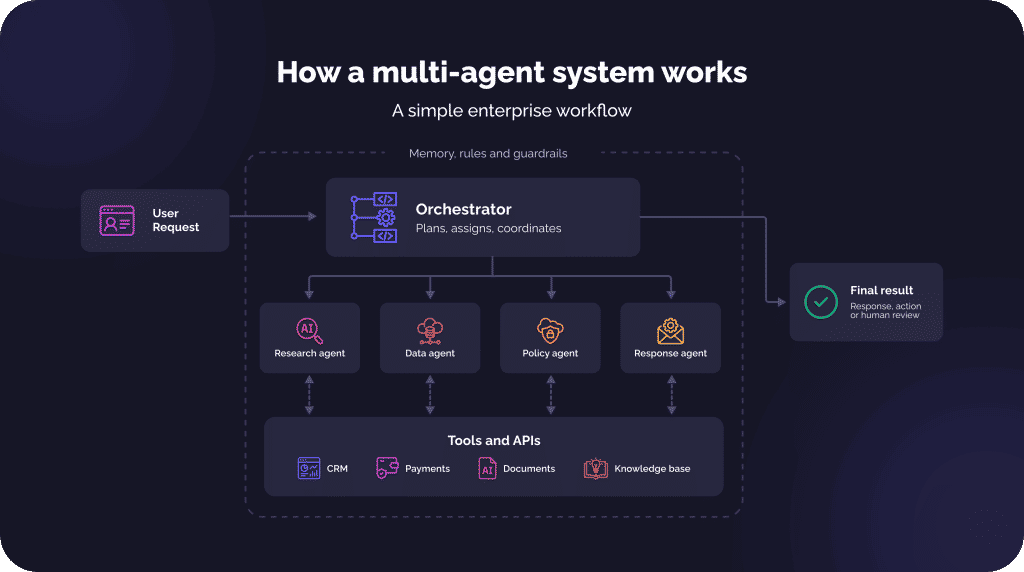
A user, employee, or system sends a query. The query enters the agent orchestration layer. This is where the orchestrator decides what the request means, which agents should work on it, and what tools they can use.
The orchestrator is not always the “smartest” agent. It is the coordinator: Its job is to break complex tasks into smaller parts, assign them to the right agents, track progress, and combine the outputs into one useful result.
A typical enterprise architecture includes 5 simple parts:
- The user request
This can come from a chat interface, a workflow trigger, a form submission, a support ticket, a dashboard, or a system event. - The orchestrator
This agent plans the work. It decides whether the request requires a single agent, multiple agents, or human review. - Specialized agents
Each agent has a clear role. A research agent finds information. A data agent checks records. A compliance agent reviews policy. A writer agent prepares the response. A reviewer agent checks quality. - Tools and APIs
Agents need controlled access to business systems. That may include customer relationship management software, banking systems, document storage, analytics dashboards, ticketing tools, or internal knowledge bases. - Memory, rules, and guardrails
The system needs context, permissions, audit logs, and boundaries. This is where agent behavior becomes manageable instead of random.
Here’s the practical difference.
In a single-agent setup, one agent tries to understand the whole task, find the data, make the decision, and write the answer. That can work for simple requests. It becomes fragile when the workflow spans multiple systems or requires separate checks.
In a multi-agent setup, the system divides the work.
For example, a fintech support query about a failed payment may trigger several steps:
- The orchestrator reads the request and creates a plan.
- A customer data agent checks the account.
- A payment agent reviews transaction status through an API.
- A policy agent checks refund rules.
- A response agent drafts the message.
- A reviewer agent checks whether the answer is complete and safe to send.
Good agent architecture makes autonomy easier to control. Each agent has a defined role, a limited set of tools, and a clear output format. The orchestrator can coordinate the whole workflow without giving every agent full access to everything.
This is also where deployment gets serious. A prototype can run in a sandbox with sample data. A production system needs role-based permissions, real-time monitoring, fallback logic, and human approval for sensitive actions. It also needs observability, which means your team can see what the system did, which agents acted, which APIs were called, and where the final answer came from.
The strongest enterprise teams do not start by asking how many agents they can deploy. They start with the workflow.
If the workflow has many parallel steps, separate knowledge sources, and clear review points, a multi-agent system can be the right framework. If the workflow is linear and simple, one agent — or even a standard automation script — may be enough.
That distinction saves money, reduces risk, and keeps agentic AI tied to business value instead of novelty.
Use cases of multi-agent systems in real business workflows
So, how to create multi-agent systems in business?
Start with a workflow that already has too many handoffs. That is usually where multi-agent systems work best. The task should be sufficiently complex to warrant coordination: multiple data sources, distinct decisions, validation steps, and a clear business outcome.
A simple customer question may not need an agentic system. A financial investigation, an urgent delivery change, or a personalized corporate learning plan often does.
1. Fintech risk analysis for a suspicious transaction
Potential flow:
The transaction monitoring agent detects unusual behavior ⟶ the customer data agent checks account history ⟶ the compliance agent reviews Know Your Customer (KYC) and anti-money laundering (AML) rules ⟶ the risk scoring agent compares similar cases ⟶ the lead agent summarizes the evidence and sends it to an analyst.
Imagine a fintech platform flags a $14,000 transaction from a business account. The payment is not automatically fraudulent, but it looks different from the company’s usual pattern. The amount is higher than average. The destination account is new. The transaction happens outside normal business hours.
A single AI agent could summarize the alert. That helps, but not enough.
A multi-agent system can perform complex tasks around the alert before an analyst even opens the case.
- The transaction agent checks the event
It reviews payment amount, time, destination, device data, and recent account behavior. - The customer profile agent adds context
It checks whether the company has sent similar payments before, whether the business recently changed ownership, and whether the account has pending verification issues. - The compliance agent reviews policy rules
It compares the case against internal thresholds, AML indicators, sanctions screening results, and escalation rules. - The risk agent builds a case summary
It explains why the transaction looks unusual, what evidence supports the alert, and which signals look normal. - The reviewer agent checks the output
It looks for missing evidence, weak reasoning, and unsupported assumptions before the lead agent prepares the final analyst view.
That is where agentic AI becomes useful. It does not replace the financial crime team. It removes the need for manual context chasing.
The analyst receives a structured case file instead of opening 6 systems and reading fragmented logs. The agent system shows what happened, which sources it checked, what looks risky, and what still needs human judgment.
The most important part is control.
For this type of workflow, guardrails to prevent risky action are non-negotiable. The system should not freeze funds, reject customers, or file regulatory reports autonomously unless the company has strict approvals in place. In most fintech environments, the safer design is decision support: AI agents can also prepare evidence, draft a recommendation, and route the case to the right person.
2. Late-night customer support for a delivery order
Potential flow:
Customer message enters support chat ⟶ the intent agent understands the request ⟶ the catalog agent answers product questions ⟶ the order agent checks what can be changed ⟶ the pricing agent recalculates the basket ⟶ the policy agent confirms delivery rules ⟶ the lead agent updates the order or sends it for confirmation.
This is where multi-agent systems can feel surprisingly powerful.
Picture a customer visiting a provider’s website at 11:40 p.m. The office is closed. The customer already placed a delivery order for several home appliances, but now wants to change it. They want to add a dishwasher, remove a microwave, compare 2 washing machines, ask whether installation is available, check whether the delivery slot can stay the same, and confirm whether the total price changes.
A basic chatbot may answer a few product questions. Then it gets stuck.
A real agentic workflow has to do much more:
- Understand a messy request
The customer does not send a clean instruction. They ask several questions, change their mind, and expect the system to remember the conversation. - Check product availability
The catalog agent verifies whether the requested appliances are in stock, compatible with the delivery region, and available for the original delivery window. - Compare capabilities
The product agent explains the difference between appliance models in plain language: capacity, energy use, installation requirements, warranty, and delivery constraints. - Modify the order safely
The order agent checks which items can be removed, which can be added, and whether the provider’s system allows changes after payment authorization. - Recalculate the final basket
The pricing agent updates the total, checks discounts, recalculates taxes or delivery fees, and shows the customer what changed. - Validate the policy
The policy agent confirms whether the change affects delivery, installation, cancellation rules, or refund timing. - Prepare the final action
The lead agent gives the customer a clear summary: removed items, added items, new total, delivery time, installation status, and the next step for confirmation.
This is not just “answering chat.”
It is an AI agent orchestration across catalog data, pricing logic, delivery rules, payment status, and customer communication. The system consists of multiple agents because no single agent should own every part of that decision.
The order agent should not invent appliance specifications. The catalog agent should not change the payment status. The response agent should not override the delivery policy.
That separation matters.
It keeps the workflow accurate, auditable, and easier to fix. If the final order summary looks wrong, the team can inspect which agent created the issue: product lookup, pricing, policy validation, or response generation.
In a production setup, the system can still keep a human fallback. If the customer requests something outside policy, the lead agent can inform the customer that the request requires manual review and create a ticket for the morning team. The customer still gets progress, and the provider avoids a bad automated decision.
3. Personalized EdTech program for a business team
Potential flow:
Training request enters the learning platform ⟶ the needs analysis agent reviews business goals ⟶ the skills agent checks learner profiles ⟶ the content agent maps course modules ⟶ the assessment agent creates checkpoints ⟶ the lead agent builds the learning path for the organization.
EdTech workflows can look simple from the outside. A company wants a course. Employees take the course. Managers review completion.
The real workflow is more complicated.
A business organization may need to train 120 employees across sales, operations, and customer success. Some employees already know the subject. Others need fundamentals. Managers want progress reports. The learning team wants assessments that prove the training worked.
This is a good use case for building multi-agent systems because it involves personalization, content planning, skills analysis, and measurement.
A multi-agent workflow might look like this:
- The needs analysis agent reads the business goal
It identifies what the organization wants to improve: product knowledge, compliance readiness, sales enablement, data literacy, or onboarding speed. - The learner profile agent segments employees
It checks roles, previous course history, assessment results, and skill gaps. - The curriculum agent builds learning paths
It maps course modules to each audience group, so senior employees do not waste time on beginner lessons and new employees get the right foundation. - The content agent adapts the material
It prepares role-specific examples, short explanations, practice questions, and optional reading. - The assessment agent creates checkpoints
It builds quizzes, scenario-based tasks, and progress checks that match the course goals. - The lead agent prepares the rollout plan
It provides the learning manager with a structured program that includes timelines, learner groups, required and optional modules, and reporting logic.
AI agents can also support the course after launch. One agent can answer learner questions. Another can detect where learners drop off. A third can suggest content updates when many learners fail the same checkpoint.
Again, the goal is not to remove instructors or learning managers.
The goal is to reduce repetitive planning work and help teams create better training programs with less manual coordination. In corporate education, that can mean faster onboarding, more relevant course paths, and clearer evidence that learning connects to business goals.
Tech framework for multi-agent systems
A multi-agent system does not live in one magical AI box.
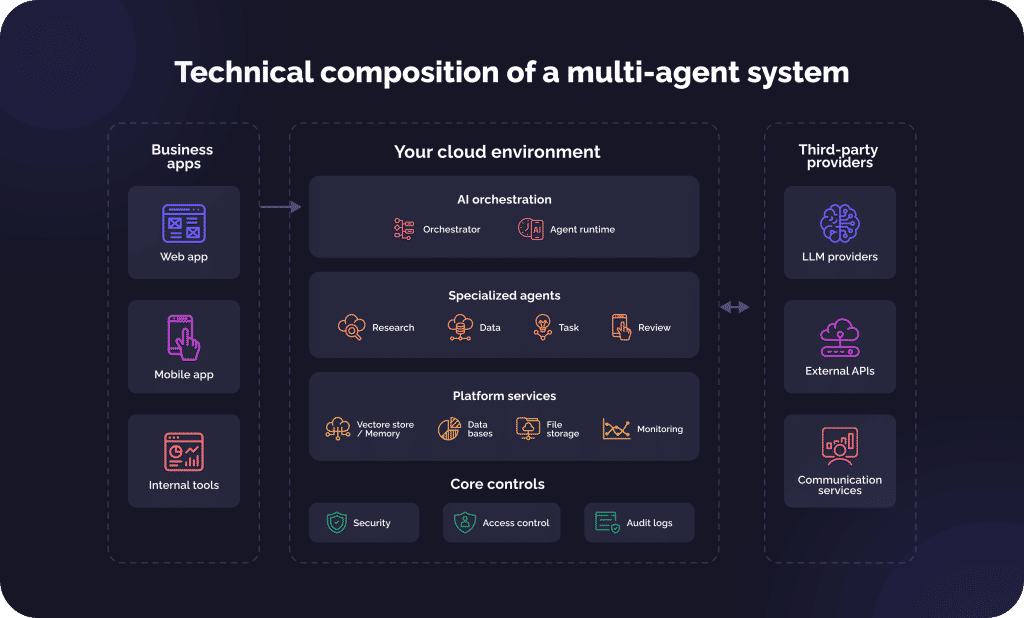
It usually runs across several layers. Some parts sit in the cloud. Some connect to the company’s internal systems. Some come from third-party AI providers. Some must be designed by the organization’s own engineering team.
That is why the technical framework matters.
A good framework explains where the agents run, what they can access, how they use large language models, how the organization controls them, and how the team tests the whole setup before deployment.
Where the AI part usually comes from
Most enterprise teams do not train a foundation model from scratch. That would be expensive, slow, and unnecessary for most business workflows.
Instead, they usually use large language models from providers such as OpenAI, Anthropic, Google, Microsoft, or AWS. These models provide the reasoning and language capabilities behind an AI agent: understanding a request, planning steps, writing a response, summarizing evidence, or deciding which tool to call next.
Cloud platforms also provide surrounding services. For example:
- Model access through a managed cloud environment
- Agent development tools
- Knowledge base connections
- Guardrails to prevent unsafe or off-policy responses
- Monitoring and logging
- Deployment infrastructure
In layman’s terms, the model is the “thinking engine,” but the enterprise still needs a full working environment around it.
What the company has to build or connect
The agents need a business context. That context usually comes from the organization’s own systems.
For example, a fintech agent may need account data, transaction records, risk rules, and analyst workflows. A customer support agent may need order data, product catalogs, payment status, delivery rules, and a customer relationship management (CRM) system. An EdTech agent may need learner profiles, course content, assessment results, and manager reporting.
The company does not simply give an agent unlimited access to all of this.
It creates controlled connections.
Those connections usually happen through APIs, secure data connectors, retrieval systems, or middleware. Middleware is a software layer that sits between the AI system and business systems. It determines which data the agent can request, which actions it can take, and when the workflow requires human approval.
That is how agentic systems become safe enough for real business use.
Where orchestration fits
AI agent orchestration is the layer that coordinates the whole workflow.
The orchestration framework decides:
- Which agent should handle the next step
- Which tool the agent can use
- Whether the answer needs review
- When to stop the workflow
- When to escalate to a person
- What information should appear in the final output
Think of orchestration as the operating model for the digital team. Without it, every agent may act like an isolated assistant. With it, agents can divide work, pass results to each other, and complete complex tasks in a controlled sequence.
This is where many prototypes fail.
They prove that one agent can call a tool. They do not prove that multiple agents can coordinate safely across changing business scenarios. The gap between a demo and a production agent system often comes down to orchestration, permissions, testing, and monitoring.
What runs in the cloud and what stays inside the organization
The exact setup depends on security requirements, cloud strategy, and industry regulations. Still, most enterprise AI multi-agent systems follow a similar pattern.
The AI model and agent runtime may run in a cloud environment. The organization’s core systems may stay where they already are: cloud databases, internal enterprise systems, software-as-a-service platforms, or private infrastructure. The agent layer connects to them through approved APIs and security controls.
For sensitive industries, the company may keep more components inside its controlled environment. That can include private data stores, vector search indexes, logs, permission logic, and human approval workflows.
A practical enterprise setup often includes:
- A cloud AI layer
This layer provides access to large language models and managed AI services. - An orchestration layer
This layer routes tasks between agents and tools. - A business systems layer
This includes CRM, enterprise resource planning (ERP), payment, learning, document, analytics, or ticketing systems. - A data and knowledge layer
This includes approved documents, policies, structured records, search indexes, and retrieval systems. - A control layer
This includes permissions, guardrails, logs, testing, human review, and monitoring.
Training and testing also need their own environment. Before deployment, teams should test the system against realistic scenarios, edge cases, missing data, conflicting instructions, and hostile prompts. This is especially important when agents can update records, trigger notifications, calculate prices, or prepare regulated reports.
The simple rule is this: give every agent the minimum access it needs to complete its role.
That keeps the system useful without making it reckless.
| Layer | What it does |
| Model layer | Provides the reasoning and language capabilities through large language models |
| Orchestration layer | Coordinates agents, assigns tasks, manages sequence, and escalates when needed |
| Agent layer | Handles specialized work such as research, data lookup, policy review, response drafting, or quality checks |
| Tools and API layer | Connects agents to CRM, payments, documents, analytics, learning platforms, and other business systems |
| Knowledge layer | Gives agents approved context from policies, documentation, product data, training materials, and records |
| Guardrails and security layer | Controls permissions, blocks unsafe actions, protects data, and defines human approval points |
| Testing and monitoring layer | Tracks performance, logs agent behavior, tests edge cases, and helps teams improve the system after deployment |
Step-by-step multi-agent system implementation
Multi-agent system development should begin with a specific business workflow rather than with the tools themselves.
That sounds obvious, but it is where many agentic AI projects go wrong. Teams begin with a framework, a model, or a vendor demo. Then they try to find a use case that fits the technology.
A better approach is the opposite: find a workflow with a real operational problem, then design the agent architecture around it.
The right starting point is usually a process that has:
- Repetitive manual steps
- Several data sources
- Clear decision rules
- A high cost of human context switching
- Review points where human judgment still matters
- A measurable outcome, such as faster response time, fewer errors, or shorter processing time
A customer support workflow, financial document review, onboarding process, internal knowledge search, or corporate training workflow can be a strong candidate. A vague “AI assistant for everything” usually is not.
1. Choose the workflow and define the result
Start by writing the workflow in plain English.
For example:
A customer asks to change an order ⟶ the system checks the order ⟶ the system checks product availability ⟶ the system recalculates the price ⟶ the system reviews delivery rules ⟶ the system asks the customer to confirm changes.
This step gives your team a useful boundary. It also keeps the first release realistic.
For each use case, define:
- The input:
What starts the workflow? A query, support ticket, document upload, system alert, or form submission? - The expected output:
Should the system answer a question, prepare a recommendation, update a record, create a draft, or route the task to a person? - The allowed actions:
Can agents only suggest changes, or can they execute them inside external systems? - The risk level:
Does the workflow touch payments, customer data, regulated decisions, or legal obligations?
This is where business and engineering teams need to work together. The business side defines value. The technical team defines what systems can operate safely.
2. Identify which agents you actually need
The next step is to decide which specialized AI agents should exist.
Do not create an agent for every small action. That makes the system harder to test and maintain. Instead, divide the work by responsibility.
A practical setup may include:
- Lead agent:
Understands the request, controls the workflow, and prepares the final response - Research agent:
Finds relevant information in documents, knowledge bases, product data, or policies - Data agent:
Retrieves structured data from CRM, enterprise resource planning (ERP), payment, analytics, or learning systems - Policy agent:
Checks business rules, compliance requirements, permissions, or escalation conditions - Action agent:
Updates records, creates tickets, sends notifications, or triggers automation - Review agent:
Checks the result before the system responds or takes action
Not every workflow needs all of them.
A low-risk FAQ assistant may only need a lead agent, a retrieval agent, and a response agent. A fintech workflow may require stricter role separation for customer data, risk logic, compliance checks, human approval, and audit logs.
This is the practical rule: build AI agents around business responsibilities, not around technical excitement. Teams of AI agents work better when each agent has a narrow role, clear inputs, defined permissions, and a predictable output format.
3. Design agent communication before writing code
Agent communication is what turns isolated assistants into collaborative AI agents.
The agents need a simple way to share information. The format should be structured enough for software systems to read, not just conversational text.
For example, a risk agent might return:
- Risk level
- Supporting evidence
- Missing information
- Recommended next step
- Confidence score
- Escalation flag
This structure matters because the orchestrator needs to decide what happens next.
If the risk level is low, the workflow may continue. If the evidence is incomplete, the data agent may run another lookup. If the escalation flag is active, the lead agent may stop the automation and send the case to a human reviewer.
That is orchestration in practice.
The orchestrator does not just pass messages around:
- It manages dependency between steps.
- It understands that the pricing agent cannot calculate the final total until the order agent confirms which products are in the basket.
- It understands that the response agent should not message a customer until the policy agent validates the change.
This is where architecture becomes important.
For production-grade work, Geniusee would typically design this logic as a controlled workflow rather than a loose conversation between agents. Depending on the project, this may involve Python or Node.js services, cloud-native components, API gateways, message queues, serverless functions, or containerized services. For Microsoft-heavy environments, .NET components may also fit naturally into the architecture.
The technology depends on the client’s stack. The principle stays the same: centralize coordination, keep agent roles narrow, and make every important step traceable.
4. Connect agents to external systems safely
AI agents become useful when they can work with real business systems.
That may include:
- CRM systems
- Payment platforms
- Document repositories
- Data warehouses
- Product catalogs
- Support ticketing tools
- Learning management systems
- Internal analytics dashboards
- Identity and access management systems
Most integrations happen through APIs. An API lets one system request data or trigger an action in another system under controlled rules.
For example, an order agent may use an API to check whether an order can still be changed. A data agent may query a customer profile. A response agent may create a support ticket. An analytics agent may retrieve recent performance data from a dashboard.
The key word is “controlled”.
Agents should not be granted broad access simply because the AI integration is technically possible. Each agent should have the minimum access level needed to complete its task. A response agent may read order status, but should not refund a payment. A research agent may read product documentation, but should not change a customer record.
This is how agent behavior stays predictable.
For cloud environments, teams may use AWS, Microsoft Azure, or Google Cloud to host the agent layer, manage access, store logs, and connect services. For AI model access, projects may use managed services such as Amazon Bedrock, Azure AI Foundry, Google Vertex AI, or direct model APIs from providers such as OpenAI or Anthropic. The final choice depends on security requirements, existing cloud contracts, data residency, and the organization’s AI governance rules.
5. Prompt-engineer agents by role, not by wishful thinking
Prompt engineering matters, but it should not carry the whole system.
A good prompt tells each agent:
- Its role
- What information it can use
- What it must not do
- Which tools it may call
- What output format it must return
- When it should ask for human review
For example, a policy agent should not receive a vague instruction like “check if this is allowed.”
A stronger instruction would define the policy source, decision criteria, escalation rules, and response format. It might say: check the delivery policy, identify whether the requested change is allowed, return the exact rule that applies, and mark the case for human review if the policy is unclear.
That is more useful. It also makes training and testing easier. The team can run the same scenarios repeatedly and compare whether the agent behaves consistently.
Strong prompts are especially important when agents work with customer data, financial records, healthcare information, compliance rules, or business-critical automation. In those workflows, the prompt should reinforce what the system cannot do, not only what it should do.
6. Build observability from the first prototype
Observability means your team can see how the system works from the inside.
In a multi-agent setup, which includes:
- Which agent received the task
- What data it used
- Which tool or API it called
- What output it returned
- How the orchestrator made the next decision
- Where the workflow stopped or escalated
- How long each step took
This is not just a technical nice-to-have. It is how teams debug, improve, and govern agentic systems.
Without tracing, the system becomes a black box. If the final response is incorrect, the team cannot easily determine whether the issue stems from the model, the prompt, the API response, the knowledge base, the orchestration logic, or a missing business rule.
With tracing, the team can inspect the chain of events and fix the right layer.
That also supports scalability. As more workflows move into the agent system, the team needs dashboards, logs, alerts, and quality checks. Otherwise, every new agent increases complexity faster than it creates value.
7. Test the system before it touches real users
A prototype can be impressive after 3 demos. Production needs more discipline.
Before deployment, teams should test the system against realistic examples, messy requests, incomplete records, conflicting instructions, policy exceptions, and edge cases. They should also test what happens when an API fails, a document is outdated, a customer asks for something outside policy, or one agent returns a weak answer.
Testing should cover:
- Normal workflow completion
- Incorrect or ambiguous user queries
- Missing data
- Tool failures
- Permission boundaries
- Prompt injection attempts
- Escalation to human review
- Output accuracy and tone
- Cost and response time
This is where QA, DevOps, cloud engineering, and AI development overlap. The goal is not only to make agents answer correctly. The goal is to make the whole agent system reliable under real operating conditions.
For enterprise projects, Geniusee’s experience across software development, cloud and DevOps, QA/QC testing, data engineering, and AI development is especially relevant. Multi-agent systems need more than a model connection. They need architecture, integration logic, testing discipline, deployment pipelines, monitoring, and long-term support.
That is what turns an agent demo into working business software.
How to build multi-agent systems: Conclusion
Multi-agent AI is useful because real business work rarely happens in one step.
A customer support issue may require product data, policy checks, order changes, and payment logic. A fintech investigation may involve transaction records, customer history, compliance rules, and analyst review. A corporate learning program may need learner segmentation, content mapping, assessments, and manager reporting.
One agent can help with a small part of that work. A well-designed multi-agent system can coordinate the whole workflow.
The system consists of multiple specialized AI agents, but the value does not come from the number of agents. It comes from role clarity, orchestration, controlled access to business systems, guardrails, observability, and careful testing. Without those elements, agentic AI becomes another fragile experiment. With them, it becomes a practical way to automate complex workflows while keeping people in control.
The strongest projects usually start small:
- Pick one workflow.
- Define the result.
- Identify the agents you need.
- Connect them to approved data and APIs.
- Add AI guardrails.
- Test the edge cases.
- Measure whether the system improves speed, accuracy, cost, or customer experience.
That is how multi-agent AI moves from a concept into production.
Geniusee helps companies design, build, and deploy AI systems, starting with a structured AI PoC development that connects to real business processes, not isolated demos. Our team works across AI development, cloud and DevOps, data engineering, software architecture, and QA, which matters when a project involves model access, APIs, business rules, secure infrastructure, and production monitoring.
If your organization is exploring multi-agent system development services, the right partner should help you answer more than “Which model should we use?” The better questions are: Which workflow should we automate first? Which agents do we actually need? What should stay under human control? How do we make the system secure, observable, and ready for growth?
That is where Geniusee can support the full path from discovery and architecture to implementation, testing, deployment, and continuous improvement.
FAQ
What are multi-agent system development services?
Multi-agent system development services help companies design, build, integrate, test, and deploy AI systems in which multiple agents work together. This usually includes workflow discovery, agent architecture, model selection, API integration, guardrails, observability, and production support.
How do AI agents that solve complex tasks work?
They break a large workflow into smaller actions. One agent may retrieve data, another may check rules, and another may prepare the final response. The orchestrator coordinates the sequence, so the system can handle analysis, decisions, and actions without turning every step into manual work.
Why do some systems require multiple AI agents?
Some workflows touch too many systems, rules, and decisions for one agent to handle reliably. A fintech review, customer order change, or personalized training plan may need data lookup, policy checks, response drafting, and human escalation. Separate agents make the workflow easier to control and audit.
Which applications and use cases are best suited to multi-agent AI?
The best applications and use cases involve multi-step work: financial analysis, customer support, document review, back-office automation, corporate training, internal knowledge search, and compliance workflows. The common pattern is simple: several tasks depend on each other, and the final result needs accuracy.
How do you move a multi-agent system from development to production?
The path from development to production starts with one focused workflow. Then the team defines agent roles, connects approved data sources, adds permission controls, tests edge cases, and monitors agent behavior after launch. Production-ready systems also need tracing, fallback logic, and human review for sensitive actions.
Can open-source tools help build a scalable multi-agent system?
Yes, open-source frameworks can help teams prototype orchestration, agent communication, tool usage, and testing faster. The bigger challenge is not the framework itself. A scalable system also needs secure integrations, reliable prompts, observability, adaptability, and clear rules for what each agent can use and what it can delegate.