

A fintech product fails commercially for 1 of 2 reasons: it takes 14 months to onboard a single regulated enterprise client, or the underwriting logic that worked for 500 merchants collapses at 50,000.
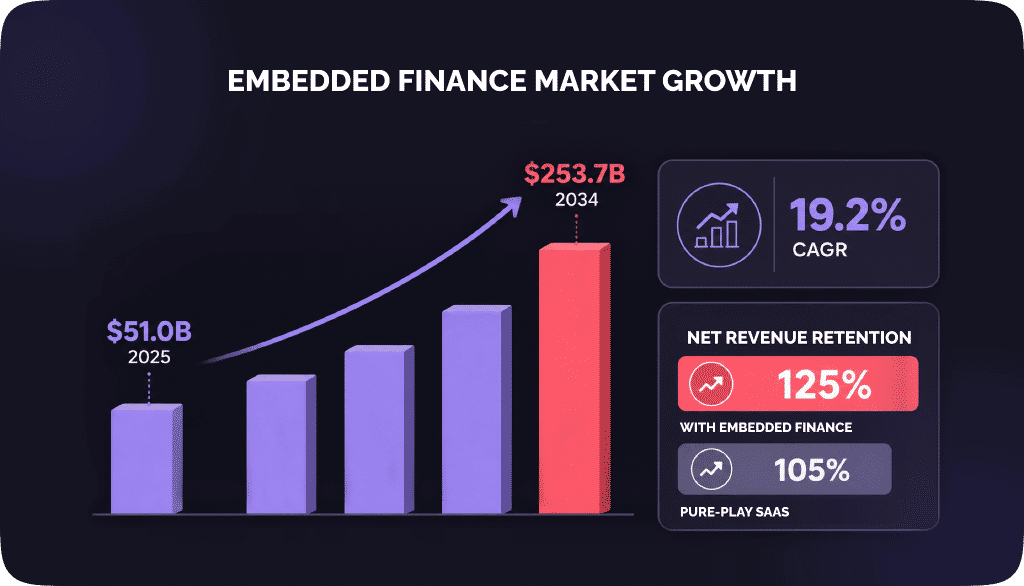
The market pressure is real. According to Marketintelo’s embedded finance vertical SaaS market report, the global embedded finance vertical SaaS market was valued at $51.0 billion in 2025 and is projected to reach $253.7 billion by 2034, expanding at a 19.2% CAGR. The same analysis notes that platforms integrating at least 1 embedded financial product see net revenue retention above 125%, against roughly 105% for pure-play software vendors. That gap is why vertical SaaS companies can offer lending and payment processing as core products rather than as integration tickets, and why many SaaS teams that started in the fintech space now describe themselves as financial infrastructure.
What you will learn in this article:
- Why financial institutions are moving off legacy systems, and what breaks during migration
- The reference architecture behind a production SaaS platform in finance: API layer, ledger, embedded fintech rails, underwriting, risk engine
- How to treat regulatory requirements as runtime controls rather than documentation
- Where onboarding friction destroys B2B conversion, and how to instrument it
- A build vs. buy framework based on margin control, not preference
Why financial institutions are replacing legacy cores with SaaS platforms
Traditional core banking systems were designed around nightly batch settlement. Everything downstream inherits that assumption: reporting, reconciliation, fraud checks, customer balances. When a bank tries to launch real-time payments on top of a batch core, the mismatch surfaces immediately as a reconciliation issue that no amount of middleware can cleanly fix.
3 forces are pushing the shift:
- Instant settlement expectations. Once FedNow and SEPA Instant become the baseline, a T+1 ledger is a competitive liability. Read more on real-time payments and how they reshape settlement design.
- Regulatory reporting velocity. Per Cloudsmith’s DORA compliance checklist, major incidents in 2026 require initial notification within 4 hours of classification, an intermediate report within 72 hours, and a final report within 1 month. A system that cannot produce an auditable incident record on demand is not compliant, regardless of policy documents.
- Distribution economics. Marketintelo observes that vertical SaaS providers already hold deep, trust-based relationships with their users, which gives them dramatically lower customer acquisition costs and far superior data sets for credit underwriting, fraud detection, and risk pricing. This is the power of SaaS distribution applied to financial products and services: the customer relationship already exists, so fintech providers built on top of it start with a structural Customer Acquisition Cost (CAC) advantage over standalone fintech apps.
What a “vertical SaaS company” means in a financial context
A vertical SaaS business owns the operational workflows for a specific industry: restaurants, clinics, freight, and property management. That ownership produces transaction density. As SaaS Mag puts it, the key predictor of an embedded finance opportunity is transaction density: the more money flows through the platform, the stronger the case.
This is the mechanism behind the vertical SaaS fintech playbook. Fractal Software’s analysis, summarized by SaaS Mag, describes the sequence: embedded payments come first, then embedded lending using transaction data to underwrite, then insurance, payroll, and banking products. Each layer depends on data generated by the previous one.
Sequencing matters more than ambition. This means that vertical SaaS teams should not launch credit before they have 18 months of clean payment history. A vertical SaaS company can capture the lending margin only once it can observe the cash flow that justifies the limit. Top fintech SaaS operators treat this as a data prerequisite, not a roadmap preference.
Takeaway: Do not evaluate a fintech SaaS opportunity by market size. Evaluate it by how much money already moves through your workflows and how much of that flow you can observe with clean, structured data.
Reference architecture for a fintech SaaS platform
Below is the layer model we use at Geniusee when scoping a new SaaS fintech product. Each layer has a distinct failure mode and scaling curve. Software companies entering finance for the first time typically underestimate the middle 3.
| Layer | Core responsibility | Primary failure mode |
| API & integration layer | External connectivity, rate limiting, versioning | Breaking changes cascade to client integrations |
| Ledger & accounting core | Double-entry truth, immutability | Balance drift; unreconcilable states |
| Payment orchestration | Routing, retries, settlement | Duplicate charges under retry storms |
| Underwriting & decisioning | Risk scoring, limits, approvals | Silent model drift; unexplainable declines |
| Risk & fraud engine | Real-time signal evaluation | False positive rate destroys UX |
| Data & analytics | Reporting, regulatory extracts | Analytics queries starve transactional DB |
| Identity & access | Tenant isolation, Role-Based Access Control (RBAC) | Cross-tenant data exposure |
The API and integration layer
Your API surface is a contract you cannot break. In B2B SaaS finance, a client’s Enterprise Resource Planning (ERP) integration is a six-month project on their side. When you version carelessly, you do not annoy them, but cost them a quarter. This is the difference between a general software platform and one that moves regulated money on behalf of clients: your release cadence becomes their release cadence.
Practical rules that hold up in production:
- Version at the resource level, not the platform level. Forcing all clients onto /v3 because one endpoint changed generates unnecessary migration work.
- Idempotency keys on every write endpoint. Non-negotiable for payment processing. Without them, network retries create duplicate transfers.
- Webhooks with signed payloads and replay endpoints. Clients will lose events. Give them a way to catch up without asking your support team.
- Sandbox parity. A sandbox that behaves differently from production is worse than no sandbox at all, because it creates false confidence.
For deeper coverage of connectivity patterns, see our work on fintech integration and core open APIs for banking.
The ledger: the part you cannot outsource
Many teams building a SaaS fintech product treat the ledger as an implementation detail and store balances as a mutable column. This works until the first dispute, at which point you cannot reconstruct how a balance reached its current value.
Design requirements for a financial ledger:
- Append-only, double-entry. Every movement has a debit and a credit. Balances are derived, never stored as truth.
- Explicit currency and precision handling. Integer minor units. Never floating point.
- Idempotent posting. The same transaction ID, posted twice, produces a single entry.
- Temporal queries. “What was this account’s balance on March 14 at 09:00 UTC?” must be answerable without a restore from backup.
Embedded payments and payment processing
Embedded fintech rails turn a software product into a payment facilitator (payfac-as-a-service) for merchants. The commercial upside is significant: SaaS Mag’s 2026 vertical SaaS analysis finds that embedded finance can more than double addressable revenue per customer without meaningfully increasing customer acquisition cost. Here, embedded finance revenue reaches $51 billion in 2026, up from $22 billion in 2021, with a 19% CAGR, but it moves merchant risk onto your balance sheet or your sponsor’s.
What has to exist before you turn it on:
- Merchant underwriting at onboarding, with automated document collection and beneficial ownership checks
- Reserve and rolling-hold logic for high-risk merchant categories
- Chargeback ingestion and representment workflow
- Settlement reconciliation runs daily against the processor’s report, with a break-investigation queue
This is the exact scope we handled on PayGuard, a Payment Card Industry (PCI) compliant card payment service, where the tokenization boundary and the reconciliation queue were designed before the first merchant was onboarded. The payment gateway development page covers the processor-side architecture in more detail, and what embedded finance is and how it works explains the commercial model.
Automated underwriting
Automated decisioning is where fintech SaaS applications create the most value and regulatory exposure simultaneously.
A workable decisioning stack separates 3 things that teams routinely conflate:
- Feature computation — deriving signals from transaction history, cash flow patterns, and third-party bureau data. This should be a versioned, testable pipeline.
- Policy rules — hard eligibility gates expressed declaratively, editable by risk teams without a deploy.
- Scoring models — statistical or ML components producing a probability, with full input logging.
The separation matters because regulators ask different questions of each. A policy rule must be explainable in a sentence. A model must be explainable in an adverse action notice. If your scoring logic and your policy logic live in the same 2,000-line function, you cannot answer either question.
We applied this separation on a lending platform built where risk analysts needed to adjust eligibility gates weekly without waiting for a release cycle. Policy rules moved into a versioned declarative layer; the scoring model stayed in the pipeline with full input logging. The practical breakdown of that architecture is in the loan origination system features.
Risk management and real-time data analytics
Risk engines fail in a specific way: they get tuned tight after an incident, false positives spike, operations drown in manual review, and someone quietly relaxes the thresholds without documenting it.
Build the feedback loop into the system:
- Every decline writes a labeled record. Every manual override writes a reason code.
- Analysts see precision and recall per rule, per segment, weekly.
- Rule changes are versioned and require the same review as code changes.
Tradesmarter is a useful reference point, a trading software solution where market-data throughput and reporting load had to be separated at the storage layer, not just the query layer, because spiky correlated traffic made shared-connection contention a daily failure rather than an edge case. Data analytics at this scale is an infrastructure decision before it is a product decision.
Related reading: financial business intelligence and AI in fintech for mitigating risk.
Takeaway: The ledger, the decisioning separation, and the risk feedback loop are the 3 architectural decisions that are expensive to reverse. Everything else can be refactored.
Regulatory compliance as an engineering discipline
Costs here are structural, not incidental. FintechSpecs’ stage-by-stage breakdown puts it plainly: at pre-seed, a founder can manage basic KYC and PCI requirements for $30,000 to $80,000 per year using third-party tooling; by Series A, when System and Organization Controls 2 (SOC 2), AML programs, and dedicated staff enter the picture, total annual spend commonly exceeds $250,000.
For EU-regulated entities, the number is larger. CrunchSpark’s DORA cost model calculates that steady-state annual Digital Operational Resilience Act (DORA) compliance for a mid-size fintech of roughly 100 staff runs approximately £325,000 to £640,000 per annum, inclusive of threat-led penetration testing amortization.
For fintech startups, the sequencing question is sharper than the total: which framework does your first enterprise contract trigger, and which are you paying for a year early? Service providers in this space often sell the full stack when the buyer needs 1 layer.
Scope reduction is the highest-leverage compliance move
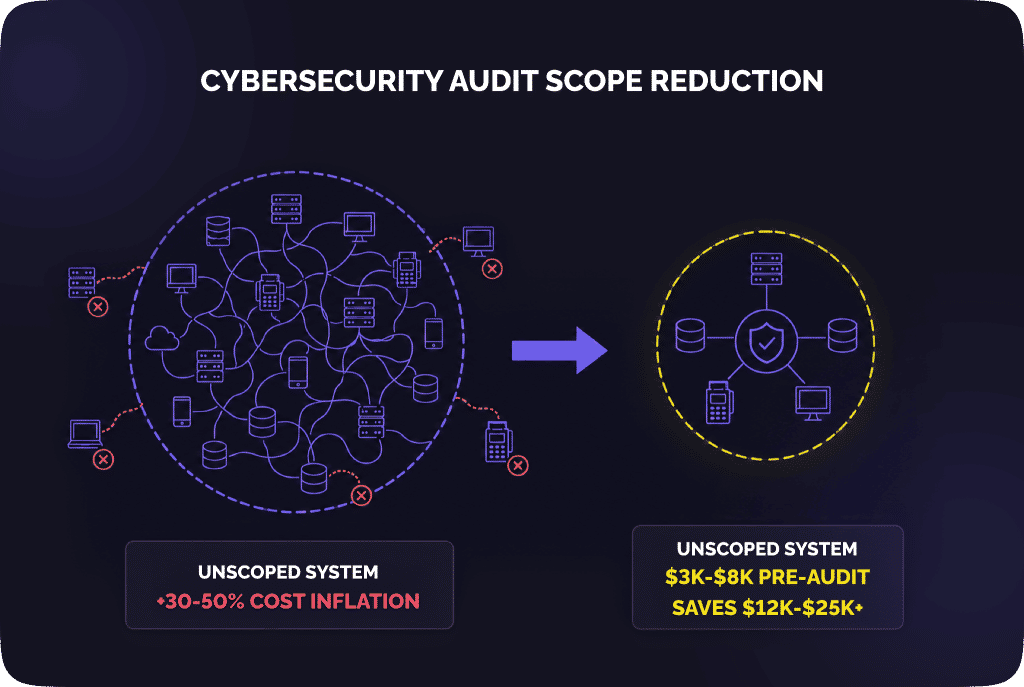
Trio’s 2026 fintech compliance cost analysis, citing RedSecLabs data, reports that scope creep alone causes 30–50% cost inflation, because systems that appear outside the cardholder data environment at the start frequently surface as in scope during the Qualified Security Assessor (QSA) assessment. We mean application logs capturing partial card data, development environments with production data copies, and email archives containing card data. The same source notes that a pre-audit scoping engagement with a QSA typically costs $3K–$8K and prevents $12K–$25K+ in mid-audit remediation surprises.
Architectural responses:
- Tokenize at the edge. Card data never enters your application layer. Your systems handle tokens exclusively.
- Isolate the cardholder data environment at the network and account level, not just by naming convention.
- Scrub structured logs by schema, not by regex. Define which fields may be logged; deny all other fields by default.
- Never copy production data into non-production environments. Generate synthetic fixtures instead. Cloud-based fintech SaaS platforms fail this one most often, because ephemeral environments make production snapshots feel harmless.
KYC/AML as a workflow, not a checkbox
Identity verification is where compliance and user experience collide hardest. Every additional step costs conversion; every removed step costs risk.
A layered onboarding design:
| Stage | Check | Trigger |
| Registration | Email/phone verification, device fingerprint | All users |
| Activation | Document capture, liveness, sanctions screening | Before first transaction |
| Elevated | Beneficial ownership, source of funds | Threshold breach or high-risk category |
| Continuous | Transaction monitoring, sanctions re-screening | Ongoing |
Trio estimates that integrating a KYC provider: document capture, liveness detection, and identity verification at onboarding, costs $15K–$30K, including the state machine work. The state machine is the part that teams underestimate: verification is asynchronous, providers return “pending” for hours, and your product has to represent partial states without blocking the user entirely.
On Zytara, a digital banking product serving a younger demographic, this state modeling directly drove the onboarding design: users could explore the product while verification was resolved in the background, with money movement gated rather than access. The same pattern applies to any fintech app that runs identity checks asynchronously against third-party providers.
See fintech regulation: legal and regulatory aspects and AI compliance for the governance side, plus continuous authentication and fraud in fintech.
Data residency and GDPR in a multi-tenant platform
Multi-tenant SaaS platforms serving EU and US financial institutions face a design fork early:
- Pooled tenancy with logical isolation — cheapest to operate, hardest to defend in an enterprise security review
- Siloed tenancy per region — satisfies residency requirements, multiplies operational surface
- Hybrid: pooled compute, siloed data stores per jurisdiction — the pragmatic middle for most SaaS enterprise deals
Decide before the first enterprise contract. Retrofitting residency into a pooled schema is a rewrite. This is one of the few areas where in-house control is non-negotiable. Regardless of how much of the stack you buy, financial institutions will ask, and “our vendor handles it” is not an answer that survives a security review.
Additional context: banking cloud security and cloud data protection.
Takeaway: Compliance spend correlates with scope, not with rigor. Reducing what falls inside the audit boundary is cheaper than auditing more things thoroughly.
Onboarding, workflow, and B2B user experience
B2B fintech UX gets neglected because the buyer is not the user. The CFO signs; an operations analyst uses the product 40 hours a week. Churn comes from the analyst.
Where B2B onboarding breaks
Enterprise activation for a fintech solution typically involves: contract, security review, data migration, integration build, user provisioning, training, and go-live. Most platforms instrument only the last 2.
What to measure:
- Time from signature to first transaction. The single most predictive retention metric in B2B fintech.
- Drop-off by verification step. If 22% of merchants abandon at document upload, that is a product defect, not a compliance cost.
- Support tickets for onboarding. Rising ticket volume signals that the product should handle the workflow itself.
- Integration time on the client’s side. If your median client takes 11 weeks to integrate, your API documentation or your sandbox is the bottleneck.
FintechSpecs makes the connection between these metrics and the P&L explicit: the categories founders consistently miss include engineering time spent building and maintaining compliance controls, customer support load driven by identity verification failures and transaction holds, onboarding drop-off caused by friction in KYC flows, and the vendor due diligence burden that comes with every new third-party integration.
Design patterns that reduce friction without reducing control
- Progressive verification. Let users explore the product before full KYC. Gate money movement, not access.
- Saved and resumable application state. Merchant onboarding spans days. Losing form state loses the merchant.
- Explain declines. “Verification failed” generates a support ticket. “Your document expired in March — upload a current one” does not.
- Role-aware defaults. A treasury operator and a compliance reviewer should not see the same landing screen.
- Bulk operations everywhere. B2B users work in batches of 200, not individually. A product without bulk actions gets exported to Excel, where the real work happens.
Anatomy Financial is the clearest example of the last point in our portfolio — a financial operations product where the users work in batches by default, and where single-record workflows would have pushed the whole job back into spreadsheets. SaaS tools aimed at finance teams live or die on this detail.
Our UI/UX practice and the write-up on UX/UI of banking applications go deeper into financial interface design.
Takeaway: Measure time-to-first-transaction. It compresses onboarding quality, integration quality, and compliance friction into one number your board can track.
Build vs. buy: a decision framework for fintech SaaS development
“Build everything” and “buy everything” are both wrong. The useful question is which layers determine your margin and your differentiation. Many fintech SaaS teams answer it by default rather than deliberately, then discover at Series B that a vendor owns their unit economics.
The layer-by-layer default
| Layer | Default | Why |
| Card acquiring / processing | Buy | Licensing and scheme membership are prohibitive |
| KYC/identity verification | Buy | Commodity, provider-maintained global coverage |
| Ledger | Build | Defines your product’s correctness guarantees |
| Underwriting policy & models | Build | This is the differentiation |
| Fraud signals | Buy signals, build decisioning | Vendors have network data that you cannot replicate |
| Core workflow product | Build | It is the reason customers pay you |
| Compliance reporting | Build on bought primitives | Regulator-specific formats are yours to own |
When building is the right call
Build when at least 2 of these hold:
- The vendor’s roadmap gates your roadmap. If a feature you need sits behind their quarterly planning, you have outsourced your velocity.
- Per-transaction economics compress your margin at scale. Model the vendor cost at 10x current volume. If gross margin drops below your target, you will rebuild later at a higher cost.
- The capability is your commercial differentiator. Nobody buys your platform because you integrated a standard KYC vendor. They may buy it because your underwriting approves 30% more applicants at the same loss rate. Leveraging SaaS infrastructure is table stakes; the judgment layer on top is the fintech business.
- Regulatory accountability sits with you regardless. Outsourcing execution never outsources liability. Where you carry the risk, you prefer to carry the control.
The Synapse failure made point 4 concrete for the industry. As documented in CoinLaw’s embedded finance statistics, the April 2024 Synapse Financial Technologies bankruptcy left more than 100,000 people without access to over $265 million held across several fintech platforms, and the bankruptcy trustee identified a shortfall between Synapse’s records and those of the partner banks, estimated at $65 million to $96 million. Vendor dependency is a risk register item, not a procurement detail.
When buying is the right call
Buy when the capability is regulated infrastructure you cannot license economically, when the vendor’s network effect is the actual product (fraud consortium data, sanctions lists), or when speed to a first paying customer outweighs unit economics for the next 12 months. Building a SaaS business on borrowed rails is a legitimate strategy, provided you know which rails you intend to replace and when.
The hybrid most teams should run
Build the ledger, the workflow, and the decisioning. Buy processing, identity, and fraud signals. Wrap every bought component behind your own interface so a vendor swap is an implementation change, not a product change. That abstraction costs perhaps 3 weeks up front and saves quarters later.
That boundary lets us swap infrastructure under a live financial workload during the VMware-to-AWS migration without the product layer noticing. For the staffing side of this decision, see the dedicated team and fintech consulting services. If you are still validating the concept, the discovery phase is where you should draw the build-vs-buy map.
Takeaway: Buy the regulated plumbing. Build the ledger and the judgment. Abstract everything you buy.
How Geniusee approaches fintech SaaS development
The order below is not a preference. It reflects which decisions get more expensive the longer you defer them.
- Regulatory mapping before architecture. Which jurisdictions, which licenses, whose balance sheet. This determines data residency, tenancy model, and audit surface. Doing it after the schema exists means redoing the schema.
- Ledger and money-movement design first. Correctness constraints are the least expensive to establish before there is production data to migrate.
- Thin vertical slice to production. One complete flow: onboard, transact, reconcile, report, and end to end on real infrastructure, before any feature breadth. This surfaces the integration problems while they are still cheap.
- Compliance controls as code from day one. Encryption, logging policy, access review, and evidence collection are built into CI rather than assembled in the six weeks before an audit.
- Scale testing against realistic distributions. Financial traffic is spiky and correlated. Uniform load tests pass, and then production fails on the first month-end close.
| Case | Now sits in | Claim it proves |
| PayGuard | Embedded payments | Tokenization boundary + reconciliation designed upfront |
| Lending platform | Automated underwriting | Policy/model separation in production |
| Tradesmarter | Risk & analytics | Storage-layer separation under spiky load |
| Zytara | KYC/AML workflow | Async verification state modeling |
| Anatomy Financial | B2B UX patterns | Bulk-first operational design |
| VMware→AWS | Build vs. buy hybrid | Vendor abstraction proven by a live swap |
More on our capabilities: fintech software development, banking software development, and product development.
Conclusion
Fintech SaaS rewards teams that make a small number of correct architectural decisions early and refuse to relitigate them. The ledger you can audit, the decisioning you can explain, the compliance scope you deliberately kept small, and the onboarding you measured: these compound. Feature velocity does not compensate for getting them wrong.
The market opportunity is well-documented and widely understood. The execution gap is where the returns are.
If you are scoping a fintech SaaS platform, migrating off a legacy core, or deciding which layers of your financial stack to own, talk to our fintech team. We will map the architecture and the compliance surface before anyone writes code.
What is fintech SaaS?
Fintech SaaS is cloud-delivered software that provides financial capabilities (payments, lending, compliance, treasury) on a subscription or transaction-fee basis. It covers both standalone fintech products and vertical SaaS platforms that embed financial services into industry-specific workflows.
How long does it take to build a fintech SaaS product?
A production-ready MVP with payments, KYC onboarding, and a compliant ledger typically takes 5–8 months. Adding automated underwriting or multi-jurisdiction compliance extends this to 10–14 months. Regulatory approvals often run in parallel and can become the critical path.
What compliance requirements apply to a fintech SaaS platform?
Most platforms that handle card data need PCI DSS, SOC 2 Type II, and KYC/AML programs. EU operations add GDPR and DORA. Specific licenses depend on whether you hold funds, lend, or facilitate payments on someone else’s license.
How much does fintech SaaS compliance cost per year?
Early-stage platforms using third-party tooling spend roughly $30,000–$80,000 annually on basic KYC and PCI. By Series A, with SOC 2 and AML programs in place, spending typically exceeds $250,000. EU-regulated entities face substantially more under DORA.
Should a vertical SaaS company build embedded payments in-house?
Rarely from scratch. Most vertical SaaS companies use a payfac-as-a-service provider for processing while building their own merchant onboarding, reconciliation, and reporting. This captures payment economics without acquiring scheme membership or full processing infrastructure.
What makes fintech SaaS different from general B2B SaaS development?
3 things: money movement must be provably correct and auditable, regulatory requirements become runtime system properties rather than policies, and downtime carries direct financial and reporting consequences under frameworks like DORA.