

Something shifted in the outsourcing market in 2023, and by 2026, it’s fully realized. The old logic — find the lowest software development hourly rate, sign a contract, ship the work overseas — no longer holds. Not because offshore development talent got worse, but because companies using it got smarter, and the higher cost of getting it wrong became a major risk.
While a software developer in the U.S. costs $75–$135/hour, the math of offshore software development rates remains compelling. You can achieve significant cost savings (up to 40%) through outsourced development, but only if you choose the right outsourcing destination and development partner.
In this guide, you’ll find:
- 2026 custom software development process rates by country and region
- A full role-by-role pricing breakdown (engineers, QA, designers, architects)
- How to evaluate total software development outsourcing cost beyond hourly rates
- The most popular pricing models and the situations when each is applicable
- 4 steps that will help you pick your outsourcing company or destination
The global outsourcing market in 2026
The software development outsourcing market is estimated to reach $618 billion in 2026, up from $564 billion in 2025, and may reach $977 billion in 2031, with a compound annual growth rate of 9.6%.
The demand side tells a clear story. The U.S. had 1.4 million unfilled technical positions in 2025 alone, compared to just 400,000 graduate computer science students each year. The same shortage exists across Western Europe, in particular, for AI/ML engineers, cloud architects, and cybersecurity experts. Companies are not outsourcing just to save money. They are outsourcing due to a lack of sufficient local talent.
Key stats shaping the market today:
- 64% of IT leaders globally outsource software development.
- Over 50% of IT outsourcing focuses on application and software projects, with 59% specifically in AI and machine learning.
- 59% of U.S. businesses cite cost as the primary outsourcing driver — the other 41% outsource development to scarce skills, speed, and innovation.
- The right outsourcing solutions can cut software development costs by up to 40% and reduce time-to-market by up to 50%.
- Nearshore delivery is the fastest-growing model, projected at 13.95% CAGR through 2031.
Why outsource software development?
If you are planning your project scope, these benefits can help guide your decision when choosing an outsourcing provider.
1. Significant cost savings
Outsourcing also enables you to save on labor, taxes, insurance, and infrastructure costs without compromising output quality. Such savings can be directly invested in product and growth.
2. Access to a wider talent pool
You no longer have to be restricted to local candidates. Outsourcing expands access to hundreds of thousands of skilled engineers to markets with high supply and low talent competition, such as the U.S. or Western Europe.
3. Faster time-to-market
With an already assembled and productive outsourced team, delivery can start in days, not months. You bypass the hiring process, orientation, and the time it takes to onboard and get internal hires up to speed.
4. Scalability
You can grow or contract a team based on the project stage, with no HR overhead, severance, or recruitment expenses.
5. Broader competency coverage
An effective outsourcing partner not only provides developers but also QA engineers, DevOps experts, business analysts, designers, and project managers all under one roof. Geniusee, for example, addresses all the ways to develop an MVP, as well as options for AI-driven app development and team organization.
6. Structured processes and quality standards
Established outsourcing vendors bring mature development project workflows: sprint governance, QA automation, documentation standards, and escalation paths. That structure often exceeds what early-stage in-house development teams have built.
7. Transparent project control
Frequent updates, project managers, and common tooling (Jira, Confluence, GitHub) provide you with all the information about what is being created, when, and why, without being in the same office.
Is the outsourcing model illegal in the US?
No, there is nothing illegal about outsourcing in the U.S. The federal laws do not forbid the use of foreign talent or the outsourcing of services abroad by the private software outsourcing firms.
But in 2026, the companies financially strain from such a practice:
- The HIRE Act: This proposed 25% excise tax on payments made to foreign contractors, introduced in late 2025, has offered a potential win but has yet to be approved, and tax deductions on such payments have been eliminated.
- Regulatory Scrutiny: EEOC and the Department of Labor have heightened scrutiny of misclassification and hiring practices that explicitly discriminate against qualified U.S. citizens.
Key factors that affect the software development project cost
Before comparing regions, it’s worth understanding what drives the price of outsourcing services:
- Project complexity and scope — the larger and more technically challenging the job, the more senior (and more expensive) the talent needed.
- Seniority mix — a team with a substantial proportion of senior engineers is twice to three times as expensive as a junior-heavy team, but tends to produce with much less rework.
- Region and city — even the rates differ not only by country but by city. The price of a Warsaw developer is higher than that of a second-tier Polish city.
- Pricing model — each of the fixed-price, time-and-materials (T&M), and dedicated-team models has its own cost profile and risk distribution.
- Use of AI tooling — teams that adopt GitHub Copilot, Cursor, and other AI tooling can shorten schedules, altering the economics of charging by the hour or by outcome.
- Project clarity — well-defined requirements minimize rework. One of the least appreciated cost levers is a well-specified brief on the client side.
Software development outsourcing rates by region
The table below covers senior-level engineering talent (5+ years, full-stack or specialized). Junior and mid-level rates run 30–50% lower.
| Region | Avg senior rate | Top hubs | English proficiency | Best fit |
| Eastern Europe | $45–$75/hr | Warsaw, Kyiv, Bucharest | High (B2–C1) | Enterprise & scale-ups |
| Latin America | $50–$85/hr | São Paulo, Mexico City, Bogotá | Medium–high | Startups & US companies |
| India | $28–$55/hr | Bengaluru, Hyderabad, Pune | High | Enterprise (scale) |
| Southeast Asia | $22–$48/hr | Ho Chi Minh City, Manila | Medium | Startups (cost focus) |
| Africa | $20–$45/hr | Cape Town, Lagos, Nairobi | High (SA native) | Early-stage startups |
| W. Europe / Canada | $90–$160/hr | Berlin, Toronto, Lisbon | Native | Regulated enterprise |
One thing this table doesn’t show: the spread within each region is as important as the average. A senior Rust engineer in Warsaw and a junior PHP developer in a second-tier Polish city are both “Eastern Europe” — but they’re not the same hire, not the same risk, and not the same outcome.
Software development rates in Eastern Europe
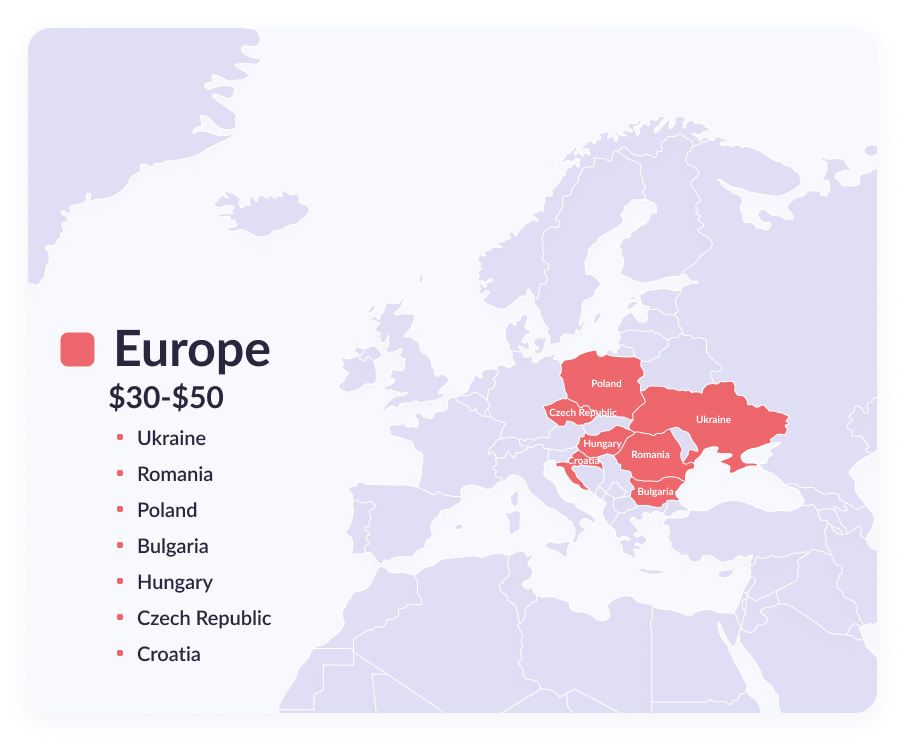
Eastern Europe has never competed purely on price. It competes on seniority density — a higher proportion of mid-to-senior engineers per team than you’ll find in high-volume markets.
The IT outsourcing market in the region is expected to expand to $7.43 billion by 2030, growing steadily at 6.82 percent per year, amid a talent-strained market that emphasizes quality over quantity.
Ukraine outsourcing costs in 2026
Ukraine continues to be a source of highly qualified engineering talent worldwide, especially in systems programming, embedded systems, cybersecurity, and applied mathematics. Yes, the current warfare has made logistics a complex matter. Yet the Ukrainian technological industry has demonstrated impressive resilience in its operations — most of the established tech firms have remained active through 2022-2025, and teams are based in both Lviv and Kyiv (some), as well as in Poland, Germany, and Portugal, with personnel relocated. For companies with established Ukrainian vendor relationships, continuity has been fairly sustainable. In new engagements, a geopolitical risk assessment is needed: consider business continuity plans, secondary office location, and data residency configuration.
Poland software outsourcing costs
Poland is the anchor market in the region. The European offices of Google, Microsoft, Amazon, and Samsung R&D centers are located in Warsaw and Krakow, which is why the local talent pool is trained according to the worldwide engineering standards. Polish developers are consistently ranked in the top 10% worldwide on platforms such as HackerRank and Codility. The prices have risen: now in Warsaw, the price for senior engineers is 55-75/hour. Nevertheless, there is still an abundance of highly experienced senior talent— individuals who are capable of owning architecture, conducting technical due diligence, and working in cross-functional product teams.
Ways to hire software developers in Romania
Romania is underrated. Bucharest and Cluj-Napoca have also quietly developed a good base of full-stack and mobile engineers, especially in Java, React, and NET. The Romanian developers typically bring excellent experience working with European clients, solid English proficiency, and rates that are 10-15 percent lower than those of similar talent in Poland. The country is a suitable entry point for companies that are seeking Eastern European quality at a slightly lower price.
What makes Eastern Europe distinct as a region is its R&D orientation. These aren’t primarily staff augmentation markets. The culture of engineering education in Poland, Ukraine, and Romania produces people trained to solve problems, not just to execute tickets.
Rates by country
| Country | Specialists | Avg rates | Popular tech | Major cities | Famous startups |
| Ukraine | 200K+ | $30–$55 | React, Node.js, Java, Python, Swift, AWS | Kyiv, Lviv, Kharkiv, Dnipro | Grammarly, Petcube, People.ai |
| Poland | 279K | $40–$65 | Java, JavaScript, Python, PHP, SQL | Warsaw, Kraków, Wrocław | DocPlanner, Brainly, Synerise |
| Romania | 116K | $30–$50 | Java, .NET, React, JavaScript, Python | Bucharest, Cluj-Napoca, Timișoara | UiPath, TypingDNA |
| Bulgaria | 55K | $30–$50 | JavaScript, React, PHP, Java, Python | Sofia, Plovdiv, Varna | Transmetrics, Metrilo |
| Hungary | 80K | $40–$55 | Java, JavaScript, Swift, Python, SQL | Budapest, Debrecen | Turbine, Shapr3D |
| Czech Republic | 96K | $35–$60 | JavaScript, Java, Python, AWS | Prague, Brno, Ostrava | Avast, Kiwi, Emplifi |
| Croatia | 29K | $25–$50 | JavaScript, Java, PHP, SQL | Zagreb, Split | Rimac Automobili, Photomath |
Pros and cons
| Pros | Cons |
| High seniority density and specialized skills | Rates have risen — no longer the cheapest option |
| Convenient time zones for European clients | Smaller volume market than India |
| Strong English proficiency (B2–C1 typical) | Ukraine requires business continuity planning due to the ongoing conflict |
| EU legal alignment (GDPR, IP enforcement) | |
| Strong R&D and problem-solving culture |
Quick verdict: Best choice for companies building complex, differentiated products that need engineers who think, not just code. Expect to pay for it. The TCE math works out in your favor at 6+ months.
Software development rates in Latin America
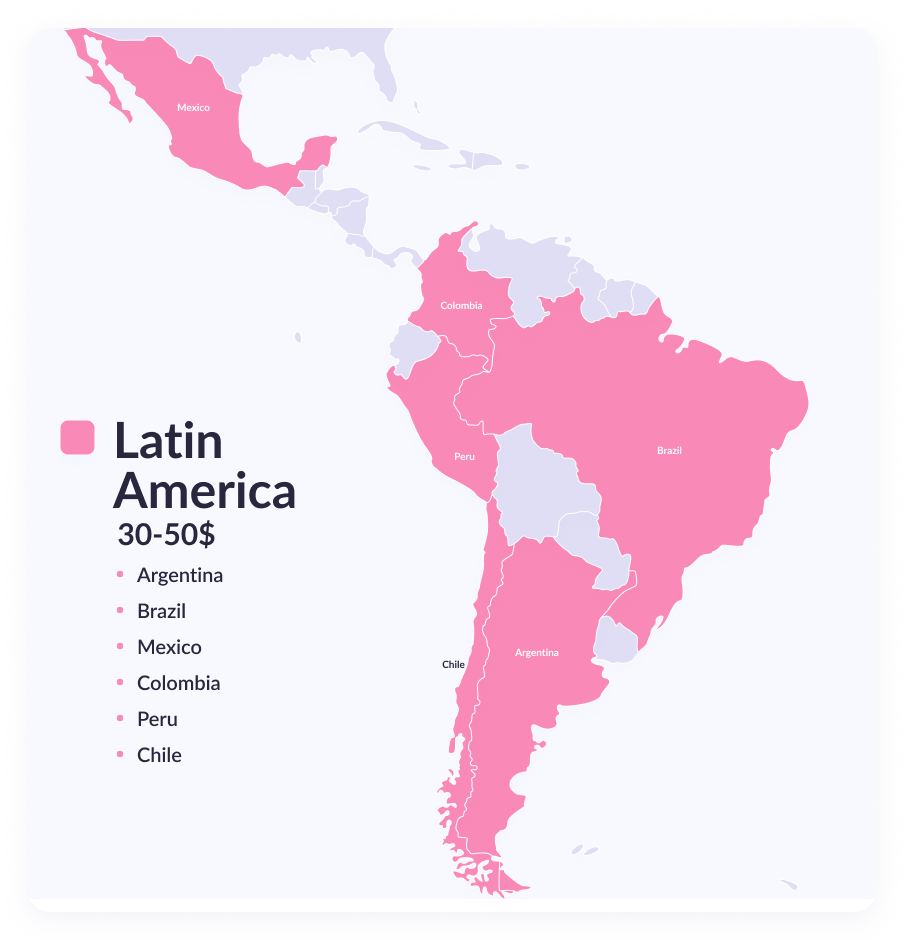
For US-based companies, Latin America has a structural advantage that no other region can replicate: time zone alignment.
When your engineering lead is in San Francisco, and your developers are in Medellín, you have a 2-hour difference. When they’re in São Paulo, it’s 4 hours — still fully workable for real-time collaboration. You can do a morning standup, a midday code review, and an afternoon design session. You can call someone when something breaks. You cannot do any of this with a team in Vietnam or India during normal business hours without someone working at 6 AM or 10 PM.
This time zone overlap alignment isn’t just about convenience, but also about speed. Decisions that take 24 hours via async communication take 20 minutes on a call. Blockers get resolved in hours instead of days. For startups where time-to-market is a survival variable, this is worth real money.
The market data reflects this value. Latin America’s nearshore IT and business service exports are projected to exceed $78 billion in 2025, led by Mexico, Colombia, and Brazil. The region is the rare exception to the global rate compression trend: while developer hourly rates declined 9–16% in Eastern Europe and South/Southeast Asia in 2024, LatAm held firm — a signal that proximity commands a premium the market is willing to pay.
The cost of offshore software development in Brazil
Brazil is the region’s largest market by volume and has been growing rapidly in engineering maturity. The concentration of fintech, healthtech, and SaaS companies in São Paulo is high, and it is therefore likely that the developer pool has experience working on real products, not just outsourcing. Java, Python, and mobile (Flutter and React Native, in particular) are strong with Brazilian engineers. In São Paulo, senior engineers’ costs range from 60 to 85/hour, reflecting the city’s cost of living and talent competition.
The right outsourcing partner from Mexico
Mexico has one of the most favorable positions for US enterprise clients. Common border, equal time zone with Central US, USMCA trade platform, and an emerging tech scene in Mexico City, Guadalajara, and Monterrey. The nation has invested significantly in technology education, and the engineering pipeline at institutions such as ITESM (Tec de Monterrey) is yielding strong talent in cloud infrastructure, data engineering, and mobile. The legal maturity of the IP environment in Mexico, which is partially influenced by the IP chapter of the USMCA, provides the enterprise legal teams with more to do than in certain other LatAm markets.
Software solutions from Colombia
Colombia is the emerging-market value play in LatAm. Both Bogotá and Medellín have created robust tech ecosystems, some of which are the result of US nearshore investment and others of highly active government and private-sector support for the local start-up ecosystem. Wages are 15-25 percent lower than in Brazil and Mexico, even for tech employees with equivalent experience and English fluency, which is significantly higher than the country average. Colombia is the first option for startups that want to enjoy the benefits of a time zone advantage in the LatAm market while paying LatAm prices.
Rates by country
| Country | Senior rate | Strengths | Best for |
| Brazil | $60–$85/hr | Fintech, mobile (Flutter, React Native), Python, Java | Mid-market and product-led companies |
| Mexico | $50–$75/hr | Cloud, data engineering, mobile | U.S. enterprise with USMCA IP needs |
| Colombia | $45–$65/hr | Full-stack, strong English in major cities | Startups wanting LatAm time zones at a lower cost |
| Argentina | $40–$65/hr | Strong CS education, Node.js, Python | Engineering-led teams on tighter budgets |
Pros and cons
| Pros | Cons |
| Full-time zone overlap with the U.S. | Higher rates than in Asia or Africa |
| Strong cultural compatibility with U.S. clients | IP law maturity varies by country |
| Growing engineering talent pipeline | Less volume than India for large-scale staffing |
| Fast-growing outsourcing market |
Quick Verdict: The default choice for US startups and mid-market companies that need real-time collaboration. The TCE advantage over Asia is significant when you factor in management overhead and communication lag.
Software development rates in Asia
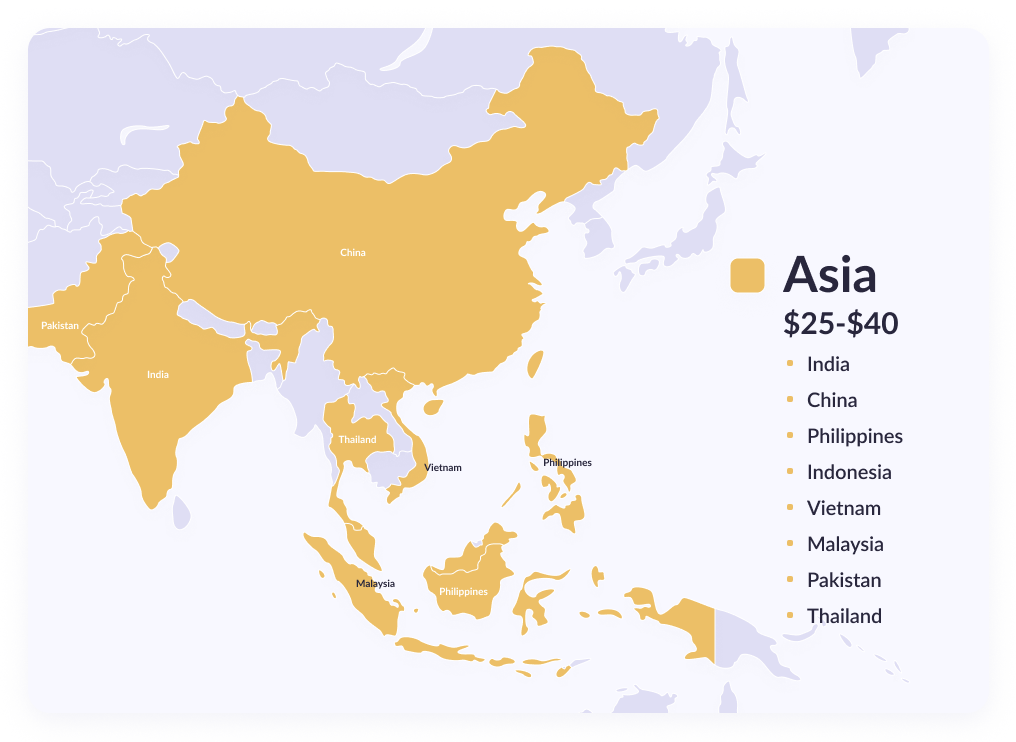
Asia is not one market. The reason companies have incompatible expectations is that they treat it as a single category: offshore to Asia. The three key markets have different needs. Together, the Asia-Pacific will reach $129.78 billion in IT outsourcing revenue by the end of 2025, with a 7.03% CAGR to 2030 (Statista).
Worth mentioning: In the first quarter of 2025, the number of new employees at leading IT companies in India declined by 72 percent, as clients slowed the renewal cycle and insisted on AI-enhanced productivity rather than simply increasing staff. This is changing the Indian vendor market: companies able to show outcome-based delivery using AI tooling are accelerating; companies still competing on labor arbitrage are shrinking.
The costs of software development outsourcing in Vietnam
The emerging market in Southeast Asia is Vietnam. The cities of Ho Chi Minh and Hanoi have built large engineering communities, especially in web development, mobile, and, now, to some extent, in data engineering. Vietnamese developers are characterized by good execution discipline and low costs (22-45/hr seniors). The English proficiency gap at the senior level is decreasing, but it remains one of the factors to consider when taking up a position that requires intensive communication with stakeholders. Vietnam offers good TCE to companies that require volume web development, mobile applications, or well-scoped API development.
Find the right outsourcing partner in the Philippines.
The Philippines is in a special place: mother-tongue English, high levels of cultural alignment with US work standards, and a strong talent pool, formed in part by the decades-long infrastructure of the BPO industry. The IT-BPO industry also injected 38.7 billion pesos into the Philippine economy in 2024. This sector employs more than 1.3 million workers. Philippine developers are especially good at communication-heavy roles, such as customer-facing programs, technical project management, and QA. The deep backend engineering talent pool is smaller than in Vietnam or India. Still, in full-stack web development and product support roles, the Philippines can offer a mix of English proficiency and affordable prices hard to find in other parts of Asia.
Rates by country
| Country | Senior rate | Strengths | Best for |
| India | $28–$55/hr | Scale, Java enterprise, AI/ML, cloud | Large-scale builds, enterprise maintenance |
| Vietnam | $25–$45/hr | Web, mobile, data engineering | Well-scoped execution work |
| Philippines | $22–$40/hr | Native English, BPO culture, QA | Communication-heavy roles, product support |
| Indonesia | $20–$38/hr | Growing mobile and web market | Early-stage, cost-focused startups |
India is the world’s largest outsourcing market and will remain so. The country accounts for approximately 17.6% of the global software outsourcing market. Bengaluru, Hyderabad, and Pune have talent pools large enough to staff entire engineering organizations — something no other outsourcing region can match at scale. If you need 50 engineers in 90 days, India is the only realistic answer outside of Western markets.
Pros and cons
| Pros | Cons |
| Massive talent pool (India, especially) | Significant time zone gap for U.S./EU clients |
| Very competitive rates | Quality and seniority consistency vary widely |
| Strong enterprise delivery track record (India) | Cultural and communication friction in some markets |
| The Philippines offers native English fluency | Async-only collaboration adds management overhead |
Quick Verdict: India for scale. Vietnam for cost-efficient execution. The Philippines for English-critical development roles. Be specific about which segment of each market you’re accessing — the variance within these countries is enormous.
Software development rates in Africa
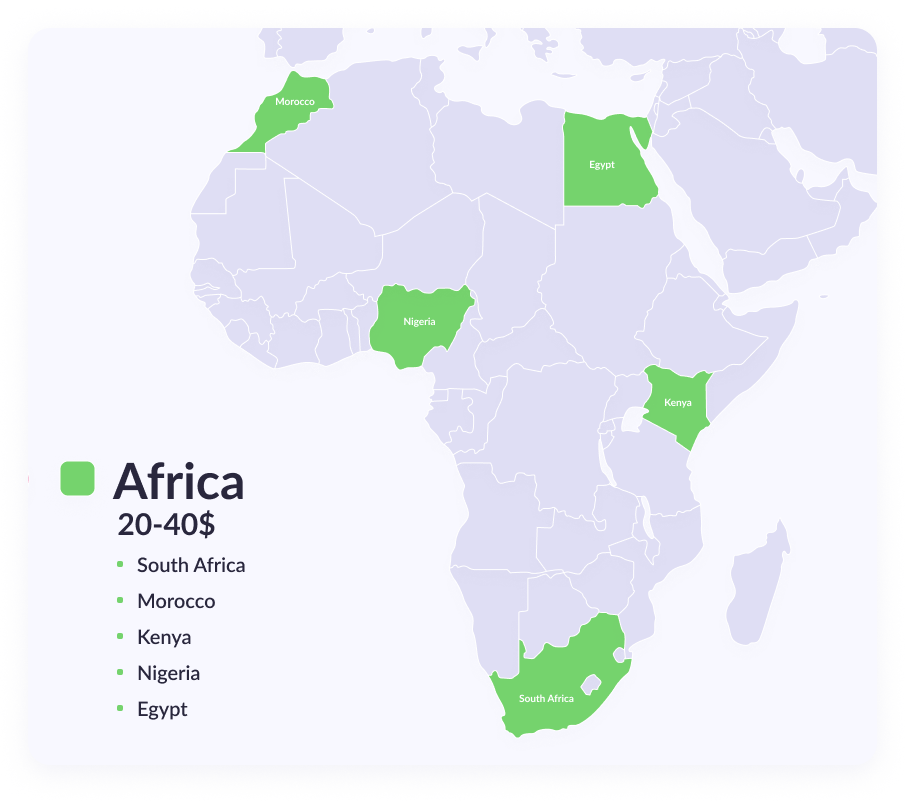
Africa’s tech sector is real, it’s growing fast, and it’s still underutilized by companies outside the continent. The Middle East & Africa region is the fastest-growing outsourcing geography globally, with a 13.20% CAGR forecast through 2031. By 2026, early-mover companies will begin to access this pipeline — but the market is still early enough that first-movers can still access strong talent at rates that will not stay this low for long.
The cost of outsourcing IT services in South Africa
South Africa is the most mature market on the continent for custom software outsourcing. Cape Town and Johannesburg have established tech ecosystems, English is a native business language, and the time zone alignment with Western Europe is near-perfect. South African developers are strong across web, mobile, and cloud infrastructure, and the country’s engineering graduates from UCT, Wits, and Stellenbosch compete well against global benchmarks. Rates for senior talent ($35–$55/hr) represent genuine value, especially for European companies. The main constraint is volume — the talent pool is smaller than Eastern Europe, so for engagements requiring 20+ engineers, you’ll hit supply limits.
The real cost of outsourcing software in Nigeria
Nigeria is the continent’s largest developer population. Lagos is home to a dense concentration of fintech engineers, driven by the world-class fintech ecosystem that has emerged in Nigeria over the past decade. Flutterwave, Paystack, and similar companies have trained a generation of engineers in high-stakes payment systems, API design, and mobile-first architecture. English is the working language. The infrastructure challenges that historically made Nigeria difficult for outsourcing (power reliability, internet stability) have improved significantly with the proliferation of co-working spaces and dedicated tech hubs. For fintech-adjacent work specifically, Nigerian engineers bring rare domain depth.
Software developers and competitive pricing in Kenya
Kenya is East Africa’s tech hub, with Nairobi increasingly recognized as a serious engineering center. The Nairobi tech community has strong ties to global companies — Google, Microsoft, and Andela have all invested in the Kenyan market — and the English proficiency among tech workers is high. Rates are at the lower end of the global range, and the talent is younger on average, meaning you’re often working with engineers who are 3–6 years into their careers rather than 10+. For early-stage startups willing to invest in mentorship and code review infrastructure, this can be outstanding value.
Rates by country
| Country | Senior rate | Strengths | Best for |
| South Africa | $35–$55/hr | Native English, EU time zone overlap, mature ecosystem | European companies, fintech |
| Nigeria | $25–$45/hr | Fintech depth, large developer population | Fintech-adjacent products |
| Kenya | $20–$38/hr | Growing ecosystem, Google/Andela investment | Early-stage startups, junior-mid talent |
| Morocco | $22–$40/hr | French/English bilingual, EU proximity | European nearshore alternative |
Pros and cons
| Pros | Cons |
| Competitive rates with a strong growth trajectory | Smaller senior talent pool than Asia or Eastern Europe |
| South Africa offers native English and the EU time zone | Infrastructure quality varies by country |
| Nigeria has world-class fintech engineering depth | Limited volume for large-scale team builds |
| Strong untapped potential | Data privacy law maturity varies |
Quick verdict: Best option for European companies needing time zone alignment at accessible rates (South Africa), fintech-specific development (Nigeria), or early-stage startups willing to work with talented junior-to-mid engineers (Kenya).
Comprehensive global IT rate card [2026]
This is the table you actually need for budget planning. Rates reflect established tech hubs in each region.
Rates are in USD per hour. These reflect standard Agency/Staff Augmentation models for “Product-Grade” talent.
| Role | North America | Central Europe | Eastern Europe | South America | Asia | Africa |
| Junior SWE | $65–$95 | $50–$75 | $30–$45 | $35–$55 | $20–$35 | $20–$30 |
| Mid-level SWE | $95–$145 | $75–$110 | $45–$70 | $50–$85 | $35–$55 | $30–$50 |
| Senior SWE | $150–$210 | $110–$160 | $70–$100 | $75–$115 | $55–$90 | $50–$75 |
| Junior UX/UI | $60–$90 | $45–$70 | $25–$40 | $30–$50 | $20–$35 | $20–$30 |
| Mid-level UX/UI | $90–$125 | $70–$100 | $40–$65 | $45–$75 | $35–$55 | $30–$45 |
| Senior UX/UI | $130–$180 | $105–$145 | $65–$95 | $70–$105 | $50–$80 | $45–$65 |
| Junior QA | $55–$80 | $40–$65 | $25–$35 | $30–$45 | $18–$28 | $20–$30 |
| Mid-level QA | $80–$110 | $65–$95 | $35–$55 | $45–$65 | $25–$45 | $30–$40 |
| Senior QA | $115–$155 | $95–$135 | $55–$85 | $65–$95 | $45–$70 | $40–$60 |
| DevOps Engineer | $140–$195 | $105–$155 | $70–$115 | $75–$115 | $50–$90 | $45–$75 |
| Project Manager | $120–$175 | $90–$140 | $60–$100 | $65–$105 | $40–$80 | $40–$70 |
| Business Analyst | $110–$160 | $85–$135 | $55–$95 | $60–$100 | $40–$75 | $35–$65 |
| Solutions Architect | $185–$260 | $140–$200 | $90–$150 | $100–$150 | $75–$120 | $65–$110 |
Total cost of engagement that actually matters
If you’re still using an hourly rate as your primary filter, you’re optimizing for the wrong variable.
The total cost of engagement (TCE) is what serious operators use in 2026. Here’s what it includes:
- Direct labor cost — the rate you pay per hour or sprint
- Management overhead — the internal time your team spends managing the external team
- Communication lag cost — delays from async-only work, time zone gaps, or language friction
- Rework risk — the cost of redoing delivered work due to misalignment or quality gaps
- Onboarding cost — the time it takes a new team to get productive on your codebase
- Compliance overhead — contracts, NDAs, data processing agreements, audits
Cultural misalignment alone accounts for failure in up to 60% of offshore projects (SQ Magazine). A $30/hour team in Southeast Asia can easily become more expensive than a $65/hour team in Eastern Europe when you factor in 12 hours a week of clarification calls, delayed releases, and a sprint of rework.
AI for cost optimization
Generative AI tools like GitHub Copilot, Cursor, and Claude Code are changing the output curve at every level of seniority. EPAM projects that 80% of the development lifecycle will involve AI touchpoints by the end of 2026, with individual productivity gains of up to 75%.
When evaluating vendors, ask: what percentage of their team uses AI tooling daily, how they handle AI-generated code in review, and whether their QA automation ratio has improved as a result. A vendor without an answer to those questions is running 2022 workflows in a 2026 market.
How to choose your outsourcing destination: a 4-step framework
Stop researching destinations before you’ve answered these four questions.
Step 1: Define your complexity level
Is your project low complexity (standard web app, mobile app with known patterns), medium complexity (custom integrations, multi-tenant SaaS), or high complexity (AI/ML, real-time infrastructure, regulated industries)? Complexity determines which talent pool you actually need.
Step 2: Define your real budget
Not just the hourly rate — the total engagement budget, including internal management overhead, onboarding, and a 15–20% rework buffer. This step is your total cost of the engagement envelope.
Step 3: Define your non-negotiables
Time zone overlap? (If yes and you’re U.S.-based, LatAm rises to the top.) English fluency for stakeholder-facing roles? ISO 27001 certification? GDPR compliance? Data residency in the EU? Each non-negotiable eliminates regions before you spend time evaluating vendors.
Step 4: Match region and model
| Complexity | Budget | Recommended region | Model |
| Low | Under $50K | Southeast Asia / Africa | Fixed price |
| Medium | $50K–$300K | LatAm / Eastern Europe | T&M with sprint governance |
| High | $300K+ | Eastern Europe / India (senior) | Dedicated team |
| Regulated | Any | Eastern Europe / LatAm / W. Europe | Dedicated team + DPA + ISO |
IT outsourcing pricing models
When you outsource, the pricing model shapes your risk, flexibility, and control. Here are the 6 main outsourcing strategies in use today for cost reduction:
| Model | Advantages | Disadvantages | Best for |
| Time and materials (T&M) | Flexible with changing scope; ideal for evolving projects | Harder to estimate total cost upfront; needs active oversight | Software engineering with uncertain or changing requirements |
| Fixed price | Predictable cost and timeline | Less flexibility if scope changes; risk of quality trade-offs | Short, well-defined projects (MVP, specific integrations) |
| Output-based | Payment tied to results; incentivizes delivery | Requires precise metric definition; hard to apply to exploratory work | AI implementations, performance optimization, and defined KPI goals |
| Dedicated team (retainer) | Team continuity, institutional knowledge, flat monthly cost | Less flexibility than T&M for ad hoc changes | 12+ month product development engagements |
| Shared risk and reward | Aligns client and vendor interests | High complexity to set up; potential disputes on penalties | High-stakes projects with variable outcomes |
| Build-operate-transfer (BOT) | Allows eventual in-house transition; vendor absorbs early risk | Long lead time (18–36 months); complex contract structure | Enterprises planning to build a permanent offshore capability |
A note on outcome-based pricing in 2026: This model is growing fastest, especially for AI projects. Instead of billing for time, the vendor bills for defined outcomes — a model accuracy threshold, a feature shipped to specification, or a deployment completed. If your vendor still only offers hourly billing with no acknowledgment of AI tooling, ask why.
Startup vs. enterprise: 2 different outsourcing decisions
The same question — “should we outsource software developers?” — means something completely different depending on who’s asking.
For startups
Your priorities are speed, flexibility, and capital efficiency. You need a team that can move fast, own features end-to-end, and adapts when requirements change — without renegotiating a 40-page contract.
The right model is T&M with sprint governance. You pay for work done in defined sprints, you own everything produced, and you keep the flexibility to change direction. Manage risk through strong sprint planning and a technical lead who reviews output and owns architectural decisions.
WhatsApp, Slack, and GitHub all outsourced in their early stages — not to cut costs, but to access talent and move faster than internal hiring allowed. 3 Estonian engineers built Skype’s backend. An Eastern European contractor built WhatsApp’s iOS app. Slack outsourced its entire product design and UX to a Canadian firm. The pattern: fast, focused, well-scoped outsourcing that added capability, not just capacity.
LatAm is the top pick for U.S.-based startups that need real-time collaboration. Eastern Europe wins when your product has the technical complexity that demands senior engineering depth.
For enterprise
Your concerns shift to IP protection, data processing agreements (DPA), GDPR Article 28 compliance, SOC 2 Type II vendor certification, and business continuity. 93% of organizations expect to outsource significant cybersecurity operations within 2 years — regulatory complexity is driving as much as cost.
The right model is a dedicated team structure with defined SLAs, code quality standards, and performance metrics. The BOT model is worth considering if you eventually plan to bring development in-house.
Famous companies that built on outsourcing
The companies now worth billions didn’t stumble into outsourcing. They made deliberate choices early that shaped everything that followed. These aren’t cautionary tales — they’re instruction manuals.
| Company | What they outsourced | Region | Outcome |
| Skype | Full backend architecture | Estonia (Eastern Europe) | Acquired by Microsoft for $8.5 billion |
| iOS app development | Eastern Europe | Acquired by Facebook for $19 billion | |
| Slack | Logo, website, web + mobile app | Canada | Acquired by Salesforce for $27.7 billion |
| GitHub | Backend MVP (Gist) | U.S. contractor | Now hosts 100M+ repositories |
| Alibaba | Early platform development | U.S. firm | Now valued at $200+ billion |
The decision in every case was not “how do we spend less?” but “how do we move faster and access skills we don’t have internally?” Cost efficiency was a side effect, not the goal.
Geniusee as your outsourcing partner
Geniusee is an offshore software development company with 200+ engineers across Ukraine and Poland, specializing in Fintech, Edtech, Retail, and AI-powered products. You can engage a single developer for staff augmentation or a full dedicated development team — each engineer works directly on your business goals for deep product context. Our engagement models include time and material, dedicated teams, and outstaffing, depending on your stage and needs. If you’re ready to explore options, contact us here.
Which country is best for outsourcing software development?
There’s no single answer — it depends on your priorities. Ukraine and Poland offer the best balance of seniority, English proficiency, and EU-aligned legal frameworks for European clients. Colombia and Mexico are strong for U.S. startups that need time zone overlap. India is the right choice when you need scale—50+ engineers quickly.
How much does it cost to outsource software development in 2026 in Ukraine?
Senior engineers in Ukraine run $40–$55/hour in 2026. Mid-level engineers cost $35–$45/hour, and junior engineers start around $25–$30/hour. Rates are slightly higher in Kyiv and Lviv than in secondary cities.
What is the average hourly rate for software outsourcing globally?
The cost of IT outsourcing ranges from $20–$30/hour at the junior end in Africa and Southeast Asia, up to $75–$135/hour for senior engineers in North America. Eastern European senior engineers typically cost $45–$75/hour. The global average for senior talent across all outsourcing regions sits around $40–$60/hour.
How can outsourcing reduce development costs?
The primary savings come from lower labor costs in regions where salaries and overheads are structurally lower. A senior engineer who costs $100/hour in-house in the U.S. might cost $50/hour from a reliable outsourcing partner in Eastern Europe, at comparable technical quality. Beyond rate differences, outsourcing also eliminates recruitment costs, employer taxes, equipment costs, office space costs, and HR overhead.
Is outsourcing actually cheaper when you factor everything in?
Yes — when done well. The key is calculating the total cost of engagement (TCE), not just hourly rates. A cheap team that requires heavy management, produces rework, or misses releases can easily cost more than a premium team that runs clean sprints and delivers on spec. The best outsourcing outcomes come from choosing based on value delivered per dollar, not just the rate card.
Who owns the intellectual property in an outsourcing contract?
IP ownership defaults to the developer or their employer unless a contract explicitly states otherwise. Your outsourcing agreement must include a clear IP assignment clause — all work produced is assigned to you upon payment. In EU member states like Poland and the Czech Republic, these assignments are strongly enforceable. For extra protection, don’t grant any single vendor access to your entire codebase, and maintain internal control over core IP components.
What does GDPR compliance require from an outsourcing vendor?
If your company has EU users, your outsourcing vendor handling personal data is a Data Processor under the General Data Protection Regulation (GDPR). You need a Data Processing Agreement (DPA) in place that covers: data categories and purposes, security measures, sub-processor arrangements, and data return/deletion upon contract end. Vendors in EU member states operate under GDPR natively. Vendors outside the EU require Standard Contractual Clauses or equivalent transfer mechanisms.