
Organizations have invested heavily in applicant tracking systems and sourcing tools over the past decade, yet hiring challenges persist. The issue was a lack of software that learns.
AI has not simply added another layer to existing processes — it has changed what is technically possible. With predictive analytics, automated screening, and intelligent sourcing now integrated into mainstream HR platforms, talent acquisition teams are reducing costs, improving candidate experience, and recovering significant time from administrative tasks.
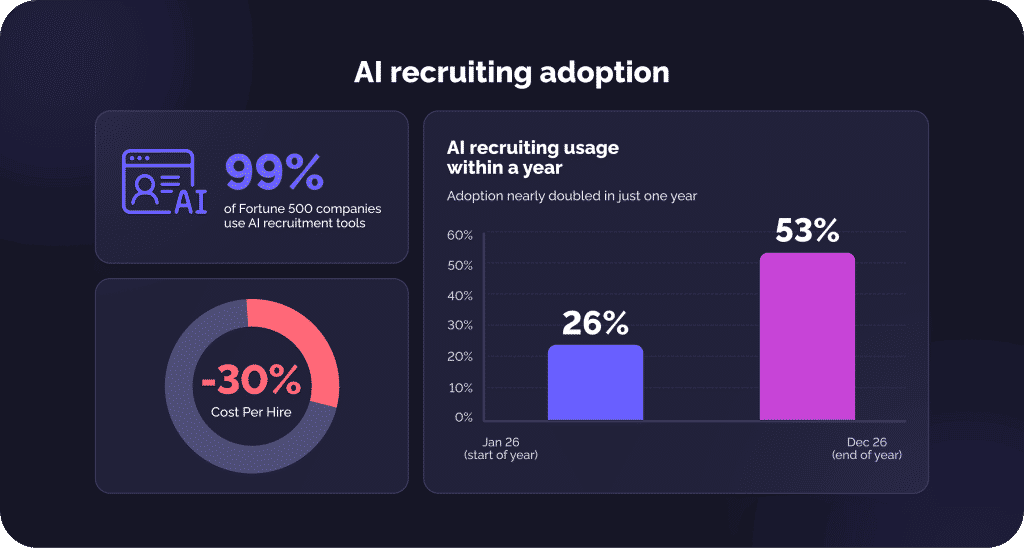
The market reflects this situation. The HR AI market is projected to reach $3.25 billion, growing at a CAGR of 24.8% between 2018 and 2030. Usage in recruiting has more than doubled within a single year — from 26% to 53%. 87% of companies now use AI in some form across their business, and 99% of Fortune 500 companies have AI as part of their recruitment technology stack. AI can reduce cost per hire by 30% and meaningfully shorten time-to-hire. The one persistent concern: two out of three American adults still have reservations about AI influencing their career decisions.
Key takeaways
- AI adoption in recruiting has reached 87% in a year, moving from experimentation to operational dependency.
- Properly integrated AI can reduce cost per hire by 30% and compress hiring timelines from weeks to days.
- Modern platforms now go beyond content generation. Agentic AI sources candidates, manages outreach, and updates the ATS without manual intervention.
- AI systems trained on biased historical data replicate those biases — making regular auditing a technical and legal requirement, not an optional practice.
- The EU AI Act and NYC Local Law 144 now classify recruitment AI as high-risk, with formal compliance requirements.
- 83% of companies remain in the early stages of AI integration, with AI switched on but not embedded in daily workflows.
- AI augments what recruiters do — it does not replace the judgment, relationship-building, and contextual assessment that effective hiring requires.
How recruiting technology has evolved
This change did not happen all at once. For a long time, HR technology innovation largely meant better record-keeping. Applicant tracking systems organize inboxes. Job boards digitized listings. The tools stored information more efficiently but did not interpret it.
The meaningful change came when platforms began learning rather than just storing. Instead of rigid rule sets, modern systems identify patterns from historical hiring decisions, predict which candidates are likely to succeed in a given role, and automate the repetitive work that historically consumed a significant portion of every recruiter’s day.
Applicant tracking systems (ATS)
Earlier applicant tracking systems (ATS) functioned essentially as organized repositories for candidate data — useful for managing volume, but not designed to surface insights.
Platforms like Greenhouse and Lever have evolved well past that baseline, now layering AI into both recruiter workflows and candidate-facing experiences. HireVue goes further, applying computer vision and behavioral analysis to early-stage video screening. Tools like Beamery and Eightfold.ai operate at a different level entirely, combining natural language processing (NLP), deep learning, and real-time labor market data to predict candidate success before an initial conversation.
The core technologies behind it
A few things make all of this work:
Natural language processing enables systems to parse job descriptions and candidate profiles with contextual understanding rather than relying solely on keyword matching. It identifies what a candidate has done, how their experience maps to a role’s requirements, and where the gaps are.
Machine learning allows the system to improve over time by learning from historical hiring outcomes — which candidates performed well, which did not — and adjusting its rankings accordingly. The more data a well-designed system processes, the more precise its output becomes.
Computer vision powers the video interview layer. Platforms like HireVue analyze behavioral signals — such as facial expressions, gestures, and eye contact — as part of early-stage candidate evaluation.
Predictive analytics replaces speculation about the quality of hire with data-informed probability estimates. These systems benchmark applicants against your existing high-performing employees and flag which candidates are likely to succeed long-term — or which might exit within six months — before any significant interview time is invested.
How AI is reshaping each step of the hiring process
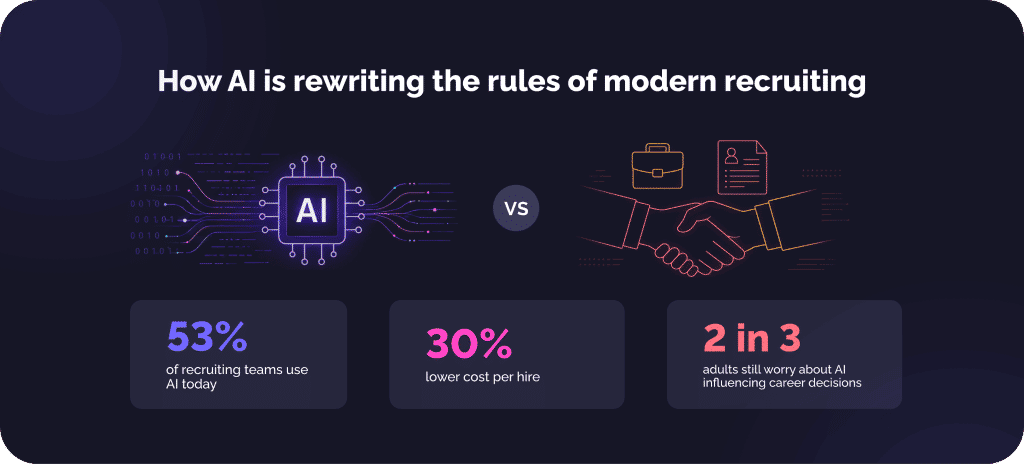
AI is reshaping recruiting not by digitizing existing processes, but by fundamentally changing what those processes can accomplish. HR teams can now automate tasks that previously required significant manual effort and make candidate selection decisions with considerably more precision.
Resume screening and matching
Rather than manual resume review, AI platforms now handle initial screening through web interfaces or API integrations. Tools like Textkernel and SeekOut connect skills data, experience signals, and candidate intent to help recruiters reach the most relevant profiles faster.
Transparency remains an area of ongoing development: when a candidate is filtered out, there should be a clear, auditable reason. The screening speed itself, however, represents a meaningful change in what recruiting teams can accomplish at scale.
Sourcing passive candidates
The most suitable candidate for a given role is frequently not actively searching job boards. AI sourcing tools scan LinkedIn, GitHub, and niche professional platforms to identify passive candidates: individuals who are not actively job-seeking but would respond to a well-timed, relevant approach.
What distinguishes AI sourcing from standard Boolean search is semantic understanding. These systems do not simply match keywords—they interpret role requirements in context. Tools such as Entelo, HireEZ, and AmazingHiring also automate initial outreach, allowing recruiters to focus time on substantive conversations rather than prospecting.
Screening, scheduling, and skills tests
Conversational AI — such as Paradox’s Olivia — and video platforms like HireVue now manage early candidate screening: consistently, at speed, without the scheduling bottlenecks of calendar-dependent manual coordination. For technical hiring, platforms such as Codility, HackerRank, and Harver deliver structured assessments that provide a more accurate picture of capability than a resume alone.
Workday completed its acquisition of Paradox, integrating HiredScore’s automated screening with Paradox’s conversational AI into a single end-to-end enterprise suite. Paradox now schedules approximately 32 million interviews annually — roughly 1 in 10 interviews conducted in the U.S. For existing Workday customers, this has become the default enterprise recruiting stack.
It is also worth distinguishing between the two types of AI frequently discussed in this context. Generative AI creates job descriptions, outreach emails, and candidate summaries. Agentic AI acts — it identifies a candidate, analyzes their profile against the job description, drafts and sends a personalized email, and schedules a follow-up call without manual prompting. Many vendors currently position their products as agentic, but their maturity levels vary considerably. Understanding where a platform genuinely sits on that spectrum is one of the most important evaluation questions when assessing HR technology.
Predictive analytics and hiring decisions
Modern AI recruiting systems do not simply rank resumes; they estimate the likelihood of offer acceptance, cultural alignment, and long-term performance. That represents a qualitatively different kind of tool than anything HR teams had access to previously.
The important constraint: these systems learn from historical data. If past hiring decisions reflected bias, an unaudited model will treat those patterns as signals of success and replicate them. Regular auditing and clearly defined ethical guardrails are required to prevent the automation of historical errors.
How IBM applied predictive analytics to retention.
IBM objective was not simply to fill roles faster. The goal was to understand which candidates would remain with the organization and develop over time. By applying predictive analytics across performance, retention, and skills data, IBM built models that correlate specific candidate signals with long-term organizational contribution — changing evaluation from “who looks qualified today” to “who is likely to matter in three years.”
Candidate experience and why it is important
Strong candidates have options. A slow, impersonal, or unresponsive hiring process loses the people you most want to hire. AI recruiting tools address this by enabling personalized engagement at a scale no human team can sustain.
Personalization at scale
AI monitors candidate profiles, engagement history, and behavioral signals to deliver relevant job alerts and timely follow-ups. AI chatbots operate around the clock, answering candidate questions and moving people through the process without gaps between business hours. Some platforms add sentiment analysis, adjusting outreach tone based on candidate engagement signals.
Keeping candidates in the loop
Real-time status updates used to depend on a recruiter remembering to send an email. Now they are automated and integrated directly with CRM platforms and recruiting dashboards. Candidates receive progress updates without recruiter intervention, which keeps engagement high and reduces silent withdrawals.
Chipotle’s Ava Cado
Chipotle opens approximately 300 restaurants per year, which requires hiring over 9,000 people annually. Manual scheduling and screening at that volume was not sustainable.
The company deployed an AI recruiting assistant named Ava Cado to handle initial screening, manage candidate questions, and coordinate interview scheduling. Application completion rates reached approximately 85%. Time-to-hire dropped from 12 days to a matter of days. The assistant did not replace recruiter judgment — it managed coordination, so recruiters could focus on the conversations that genuinely required them.
Bias in AI recruiting systems
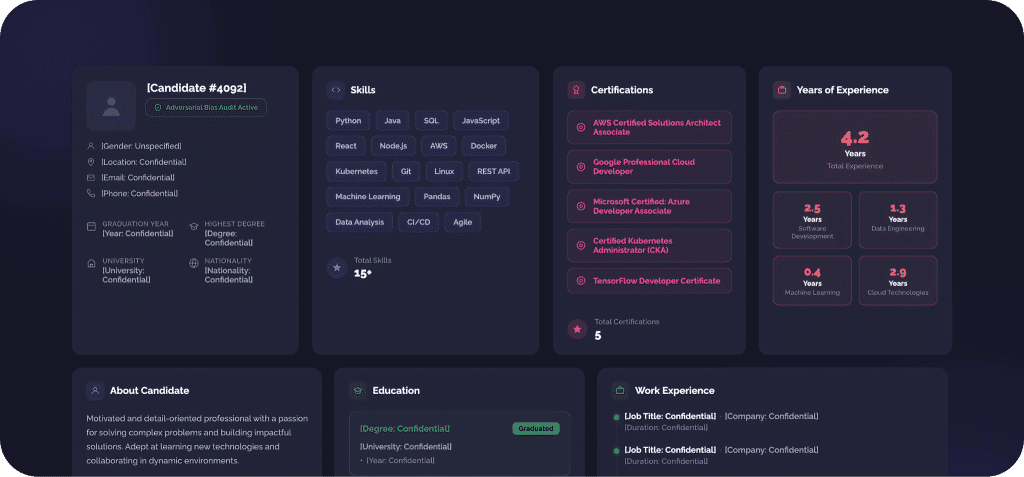
The potential for AI to reduce bias in recruiting is real. A well-designed system does not factor in a candidate’s name, educational background, or career gap patterns it has learned to treat as negative signals. It focuses on what predicts performance.
The risk is equally real. Train a model on historically biased hiring data, and it learns those biases. If past hiring consistently favored one demographic group, an unaudited model will treat that pattern as a predictor of success and reproduce it.
Approaches that help
Advanced systems apply adversarial training to actively identify and remove patterns linked to historical discrimination. They anonymize sensitive candidate details — names, schools, demographic markers — and use counterfactual testing to verify that irrelevant characteristics do not affect outcomes.
| Factor | Traditional recruiting | AI recruiting |
| Name bias | Names imply ethnicity or gender | Personal details anonymized |
| Resume origin | Prestigious schools given preference | Skills-focused evaluation |
| Job description language | Gendered wording deters diverse candidates | Biased language flagged automatically |
| Interview tone | Subjective impressions drive outcomes | Behavior assessed through computer vision and NLP |
| Historical patterns | Past (often flawed) preferences get repeated | Requires active mitigation to avoid replication |
Pymetrics uses neuroscience-based games to assess fit without ever looking at a resume. Unbiasify strips demographic information from profiles, surfacing only what’s relevant to the role.
Compliance, transparency, and current regulatory requirements
For most of the past decade, AI in recruiting operated without significant regulatory oversight. That environment has changed.
Current regulatory requirements
The EU AI Act classifies recruitment AI as high-risk. That classification carries substantive obligations: formal risk assessments before deployment, ongoing monitoring of algorithmic use, and documentation demonstrating responsible implementation.
In the U.S., New York City’s Local Law 144 requires bias audits for hiring algorithms and explainable decision-making processes. Other states are developing comparable legislation. European organizations have adapted by prioritizing GDPR and works council compliance; vendors such as Phenom People and Beamery continue advancing innovation in that market, though AI feature adoption in EMEA currently lags the U.S.
The practical implication: AI recruiting systems can no longer be treated as tools you deploy and leave unmonitored. The ability to audit decisions, demonstrate their impact on candidates, and document responsible use is increasingly a legal requirement rather than a best practice.
Why explainability matters in practice
Explainable AI (XAI) gives candidates, recruiters, and compliance teams a clear basis for understanding why a decision was made. Three methodologies currently in use:
- LIME breaks down the reasoning behind individual prediction decisions.
- SHAP quantifies how much each input variable contributed to a model’s output across a set of decisions.
- Model cards document what a system can and cannot do, and where its known limitations lie.
When candidates understand how they were evaluated, disputes decrease. When compliance teams can trace decisions to specific data inputs, legal exposure decreases. Transparency serves both ethical and operational objectives.
The Eightfold AI lawsuit
A lawsuit against Eightfold AI alleges that AI-generated candidate scores informed hiring decisions without human review, and without candidates receiving any disclosure about how they had been evaluated. The legal outcome aside, the direction is clear: auditability and explainability are now requirements, not differentiating features.
Integrating AI into your existing HR technology stack
AI recruiting tools deliver the most value when they connect to what an organization already uses. An isolated platform that does not communicate with your ATS, HRIS, or CRM creates additional operational overhead rather than reducing it.
Integration options
Most modern platforms connect through standard API-based architectures. Vendors typically offer one of two models:
All-in-one suites consolidate everything within a single integrated platform, covering the full recruiting lifecycle.
Modular tools function as targeted additions that improve specific workflow stages without requiring a complete infrastructure replacement.
Neither model is universally preferable. The right choice depends on your organization’s size, customization requirements, and budget constraints. What matters in either case is that the integration does not create new data silos.
Data quality is what determines success
Every AI recruiting system performs in direct proportion to the quality of the data it runs on. Clean candidate profiles, accurate interview records, and maintained performance data are the foundation that determines whether sophisticated algorithms produce useful output.
Models also require regular retraining as roles, required skills, and workforce composition change over time. The quality of AI outputs depends entirely on the quality of the underlying data — this constraint is unglamorous but foundational, and it determines whether the more advanced capabilities deliver value in practice.
Emerging directions in AI recruiting
As AI technology matures, recruiting will become more automated, more data-driven, and more capable of anticipating workforce needs before they become urgent.
Generative AI in the hiring workflow
Generative AI is already an operational tool for many HR teams, not a future capability under evaluation. Rather than hours spent drafting job descriptions, candidate outreach emails, and hiring committee summaries, that content is generated in minutes and refined from there.
Tools such as ChatGPT for HR, Jasper, and Copy.ai are reducing the administrative side of recruiting without compromising the quality of what gets communicated. Recruiters spend less time on documentation and more time on tasks that require their judgment.
Talent intelligence platforms
The most advanced platforms now combine external labor market data with internal talent analytics to support genuine workforce planning. Tools such as Gloat, Eightfold.ai, and SkyHive use predictive AI to help organizations identify hiring needs before they become urgent, surface internal talent that would otherwise go unnoticed, and address skills gaps before they create operational problems. This moves the recruiting function from reactive to strategic.
Real cases from the Geniusee team
Imagine AI – AI-powered recruitment platform
This is the most relevant case for the article. It directly matches recruiting topics: candidate matching, CV parsing and tailoring, job ad generation, recruiter chatbot, meeting transcription, LinkedIn/ZoomInfo integrations, compliance tools, and AI reporting. Strong metrics too: 85% less manual recruitment work, 90% faster candidate search, CV tailoring from 15 min to 2 min, sourcing from hours to under 10 min, 98% fill rate.
Forethought – AI-powered customer experience automation
Not recruiting-specific, but good as a supporting example for conversational AI/chatbot workflows. It can support the point about automated candidate communication, response generation, sentiment analysis, and scalable personalized interactions.
Practical implications for recruiting teams
AI has materially changed what is possible in talent acquisition, but only when the ethical and compliance dimensions receive equal attention alongside the technology investment.
The productivity case is established. Talent acquisition professionals using generative AI report recovering 20% of their working week, according to LinkedIn’s 2025 Future of Recruiting report. Teams that have integrated these tools into their workflows are advancing ahead of those still in the evaluation phase.
AI does not replace effective recruiters. It extends what they can accomplish, enabling them to operate at a scale previously unattainable. The judgment calls, relationship-building, and contextual assessment that hiring requires remain human responsibilities. Everything else can be handled.
Ready to build something that fits how you hire? Geniusee creates custom recruiting software with AI that works with your existing processes, not around them. Reach out and let’s figure out what that looks like for your team.
How does AI help recruiters make better decisions?
AI processes candidate data at a volume and speed that no human team can match, and identifies patterns that correlate with long-term performance. Recruiters receive better-ranked shortlists faster, and can direct their time toward the conversations and judgment calls that require them.
Can AI replace human recruiters?
Not the functions that matter most. Automation handles sourcing, scheduling, and early screening effectively. Hiring decisions that affect candidates’ careers and shape team composition still require human involvement. AI functions as a capable operational tool — it does not replace the judgment that effective hiring demands.
How accurate are AI candidate assessments?
Accuracy depends heavily on data quality and model design. Well-structured data, regular model retraining, and rigorous design can produce strong predictions about skills alignment and long-term performance. These outputs should inform recruiter decisions, not substitute for them.
What compliance requirements apply to AI recruiting systems?
The EU AI Act classifies recruitment AI as high-risk, requiring formal risk assessments, ongoing monitoring, and documented evidence of responsible deployment. In the U.S., New York City’s Local Law 144 mandates bias audits and explainable decision-making for hiring algorithms. Organizations operating across multiple jurisdictions should assess their obligations in each market before deployment.
What is the difference between generative AI and agentic AI in recruiting?
Generative AI produces content — job descriptions, outreach emails, candidate summaries. Agentic AI executes tasks — it can identify a candidate, analyze their profile, send a personalized message, and schedule a follow-up without manual instruction. Many vendors currently describe their products as agentic; the capability varies significantly, and understanding a platform’s genuine maturity level is one of the most important questions in any procurement process.